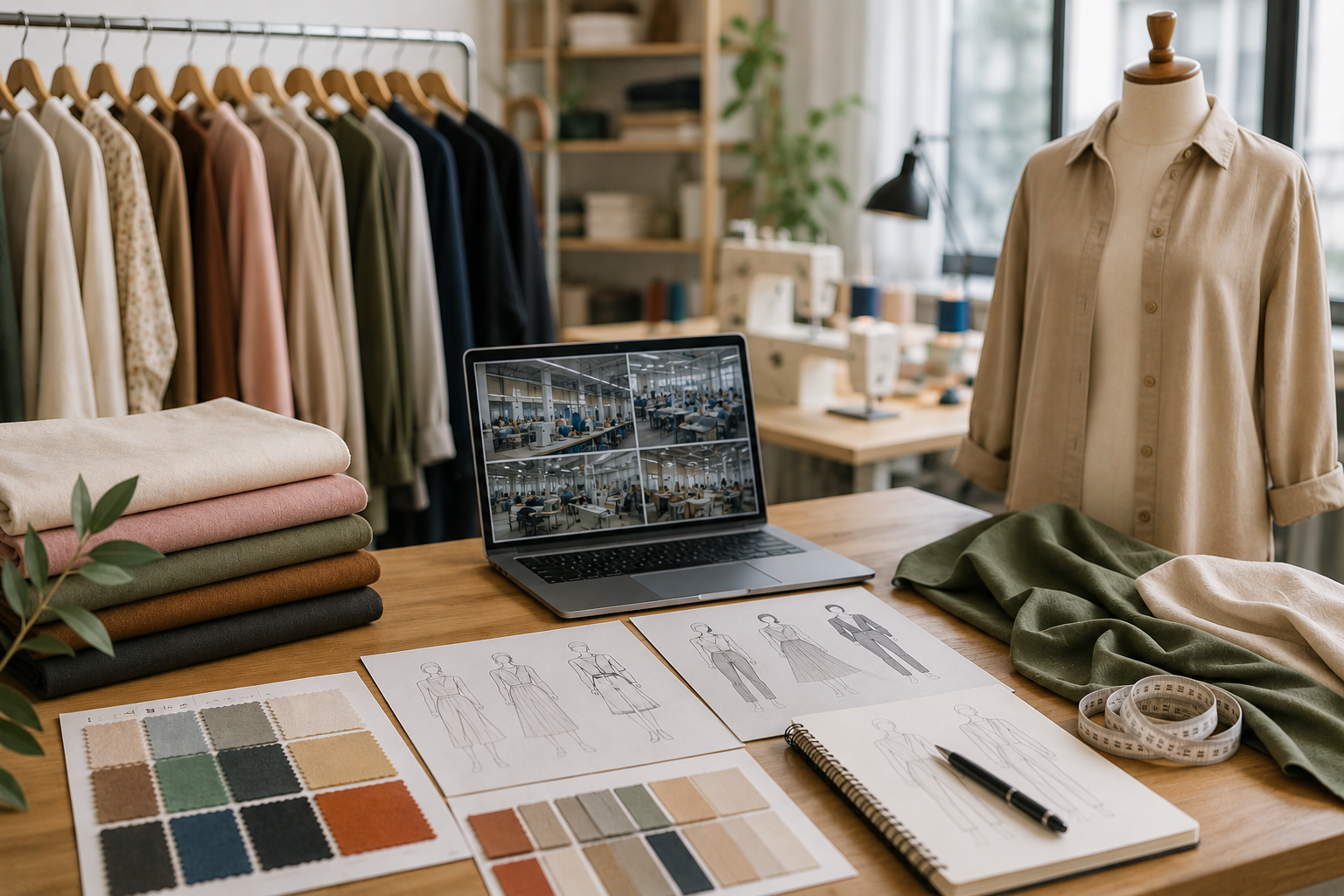
Know Your Production Model Before You Search
The first step in finding womens clothing manufacturers is understanding which production model your brand actually needs. There are three main types: cut and sew, private label, and full-package production. Cut and sew means the factory builds your design from your own patterns, fabrics, and specs. Private label means you buy an existing factory style and brand it as your own. Full-package means the factory handles sourcing, cutting, sewing, and finishing under one roof.
Searching without this clarity is where most brand owners waste time. A cut and sew manufacturer will not be a good fit for a brand that wants pre-existing women’s basics relabeled. A private label operation likely cannot execute a highly technical original design. Settling this question before you reach out to anyone eliminates the majority of irrelevant options immediately. For a deeper breakdown of how cut and sew production specifically works, see Cut and Sew Manufacturers in the USA.
Set Your MOQ Ceiling in Writing Before Any Outreach
Minimum order quantity is where more manufacturer conversations fall apart than anywhere else. Womens clothing manufacturers in the USA vary widely in their minimums, from a few dozen units per style at smaller cut and sew studios to several hundred units at mid-size private label operations. Smaller studios, particularly those in Los Angeles and New York City, will often work with brands starting at lower quantities. Larger facilities generally require higher minimums before they will take on a new brand.
Before you contact anyone, calculate your maximum budget for the first production run, divide it by a realistic per-unit cost for your garment type, and write that number down. That figure is your MOQ ceiling. State it plainly in every inquiry message. Manufacturers who cannot work within that number will say so immediately, and you will stop spending time on conversations that were never going anywhere. See Private Label Apparel Manufacturing: MOQ and Costs for a full breakdown of how to calculate this realistically for your category.
Match the Manufacturer to Your Specific Garment Category
Women’s apparel covers an unusually wide range of construction types. Stretch activewear, woven dresses, structured outerwear, denim, and performance fabrics each require different equipment, different pattern expertise, and different sourcing relationships. A factory with deep experience in knit construction may have no capability for tailored structured pieces. A manufacturer that excels in denim may have limited exposure to technical performance fabric work.
When you evaluate womens clothing manufacturers, ask specifically about their production history in your garment category. Request photos or examples of completed women’s garments similar to what you are building. A Los Angeles studio is far more likely to have knit and activewear expertise from years of serving that market. A New York garment district manufacturer is more likely to have structured woven and fashion-forward design experience. Matching garment category to manufacturer background is one of the most direct ways to reduce sample iteration time and lower your risk of production defects. The right womens clothing manufacturers for your specific category are not the biggest or the most well-known. They are the ones whose production history maps directly to your product.
Treat Communication Speed as a Qualification Filter
How quickly a manufacturer responds to your first inquiry tells you almost everything about how the production relationship will function. A factory that takes ten days to reply to a cold inquiry will take ten days to respond when you are waiting on a sample revision. A factory that replies within 24 to 48 hours is actively seeking brand projects and is organized enough to handle them.
Make communication speed a hard filter. When you send an inquiry, note the date and time. If you do not hear back within 48 to 72 hours with something substantive, move on. This is not about being demanding. It is about reading a genuine signal. According to the US Bureau of Labor Statistics, the US apparel manufacturing sector has been shifting steadily toward smaller domestic operations, many of which depend on new brand partnerships for their growth. Factories actively seeking that business behave accordingly. Apply this filter from the first message and you will save weeks of time over the course of a sourcing process.
Always Order Samples Before Committing to a Production Run
No womens clothing manufacturer should receive a production order before delivering a sample. This is true even when the factory has strong references, years of experience, and an impressive portfolio. A sample is the only way to evaluate fit accuracy, seam integrity, fabric behavior in the actual construction, and how well the factory interprets your tech pack or design documentation.
Request a proto sample or fit sample before finalizing any agreement. Budget for the cost. This upfront expense protects a production investment that is many times larger. An activewear brand founder based in Atlanta once ordered samples from three different womens clothing manufacturers before selecting a production partner. One sample failed a basic stretch test. A second had inconsistent seam allowances. The third was clean, accurate to spec, and delivered quickly. That sample round determined which factory got the order. Always review samples against your full spec sheet at the stitch and construction level, not just by eye.
Verify Certifications Before Making Any Brand Claims
If your brand story includes Made in USA positioning, sustainable materials, or ethical production claims, your manufacturer must hold the certifications that substantiate those claims. Making a claim you cannot back up is a brand and legal risk. Verifying it early is a one-time task that protects everything you build afterward.
For sustainable fabric claims, look for manufacturers sourcing materials certified through Textile Exchange standards, including GOTS for organic or GRS for recycled content. For Made in USA labeling, the FTC’s guidelines require that the product be all or virtually all made domestically, meaning that foreign inputs must be negligible. Ask any prospective manufacturer for their certification documentation before you sign a production agreement or draft a single piece of marketing copy. For a full overview of what certifications matter most in apparel, see Certifications for Choosing a Clothing Manufacturer.