You verify garment factory quality standards and ethical practices in the United States by requesting a factory’s third-party quality and safety certifications, reviewing an inspection or audit report, and confirming labor compliance through a program such as WRAP (Worldwide Responsible Accredited Production). US apparel manufacturing recorded 1.9 recordable injury and illness cases per 100 full-time workers in 2024, according to the Bureau of Labor Statistics, a benchmark worth comparing against a specific factory’s own safety record when you request one. A documented certification check paired with a direct facility conversation, in person or by video, confirms far more than a marketing page ever will.
That injury rate is a national average, not a guarantee for any single factory, which is exactly why brand owners need their own verification steps rather than a website claim. Verifying a US garment factory means answering three separate questions: is it a real, operating business, does it produce consistent quality, and does it treat its workers fairly. This guide covers how to check each one, plus where to find manufacturers already screened for you.
What Counts as a “Verified” Garment Factory?
A verified garment factory is one whose business identity, production capability, and compliance records have been confirmed by an independent source, not just stated on its own website. A legitimate-looking site can still belong to a broker with no factory floor at all, or to an overseas operation marketed as domestic.
Look for these four elements before treating a factory as verified:
- A real, findable business registration. State filings, a Dun and Bradstreet listing, or a Better Business Bureau profile confirm the company legally exists.
- A physical, visitable address. Not a PO box or shared coworking suite, but one that signals an actual production facility.
- A production history you can check. References from other brands, or a listing on an established sourcing platform.
- At least one third-party certification or audit. The piece most brand owners skip, and the one that separates a verified factory from a self-described one.
These four elements are the backbone of any real verification check, not a certification logo pasted on a homepage. This checklist applies to a sector that is not small. Domestic apparel manufacturing contributed to more than 3.6 million US jobs and over $523 billion in annual retail sales as of 2026, according to the American Apparel & Footwear Association, spread across thousands of establishments, most with fewer than a dozen employees. That scale is why a directory of verified clothing manufacturers narrows the field faster than cold-searching factory websites one at a time.
How Do You Check Garment Factory Quality Standards?
You check garment factory quality standards by requesting a pre-production sample, an inspection report against an agreed defect limit, and any quality management certification the factory holds. Each check confirms something different, so skipping one leaves a real gap in what you know about a factory’s output.
Check | What It Confirms | How to Request It |
Pre-production sample | Fit, construction, and fabric hand before a bulk run | Ask directly, before committing to production |
AQL inspection report | Defect rate against an agreed limit, commonly AQL 2.5 for garments | Request from the factory or hire an independent inspector |
ISO 9001 certification | A documented, audited quality management system | Ask for the certificate number and verify with the issuing body |
In-person or video tour | Real production floor, equipment, and conditions | Schedule directly, or through a sourcing platform |
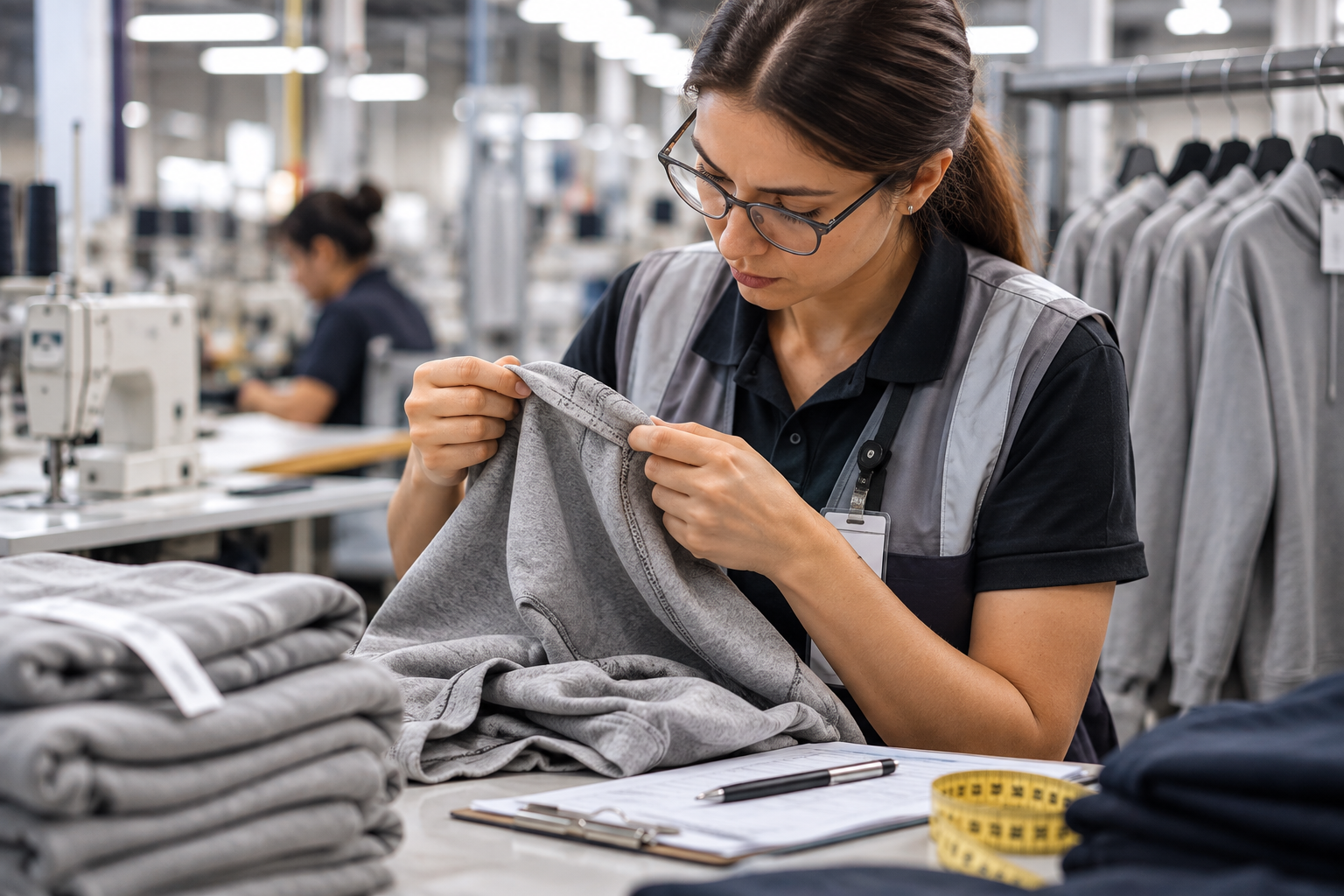
AQL, or Acceptable Quality Limit, is the maximum number of defective units allowed in a sample batch before a shipment fails inspection. A factory that cannot explain its own AQL standard, or refuses a pre-production sample, is telling you something about how it handles quality before you place a full order. A clearly stated AQL is one of the easiest garment factory quality standards to verify in a single email. The same discipline applies to the broader search process described in this guide to finding a clothing manufacturer in the USA, where a factory’s willingness to document its process is itself a quality signal.
How Do You Verify Ethical and Labor Standards?
You verify a garment factory’s ethical and labor standards by checking for independent workplace certifications and asking direct questions about wages, hours, and conditions rather than accepting a general ethically-made claim. Made in the USA does not automatically mean fair labor practices, since domestic factories remain subject to labor law violations, and certification closes that gap with a documented, third-party check.
Certification | What It Verifies | Issuing Body |
WRAP (Worldwide Responsible Accredited Production) | Fair labor, safe workplace, no forced or child labor | WRAP |
Fair Labor Association accreditation | Independent monitoring against a published workplace code | Fair Labor Association |
SA8000 | A documented social accountability management system | Social Accountability International |
OEKO-TEX STeP | Safe, socially responsible production facility practices | OEKO-TEX |
WRAP is a certification program that audits factories against twelve labor, safety, and environmental principles and reissues certification on a recurring cycle, not as a one-time badge. Before wiring money to a new factory, the Federal Trade Commission recommends confirming a verifiable business address and staying cautious of any supplier that only accepts wire transfers or refuses documentation, warning signs that apply to a factory’s ethical claims as much as its legitimacy. SCORE similarly recommends weighing a supplier’s communication and stability alongside its certifications, since a factory slow to answer basic questions rarely improves once you are a paying client.
Verified Manufacturers on Maker’s Row
Maker’s Row is a marketplace connecting apparel brand owners with verified US manufacturers, so a layer of the legitimacy check above is already done before a factory bids on your project. Post your garment project for free and manufacturer who match your product respond directly, letting you focus your own verification on certifications and labor compliance rather than basic legitimacy. Browse the full clothing manufacturers directory by category before posting.
FAQs About Verifying Garment Factories in the USA
A quality audit checks production output, such as defect rates and adherence to a tech pack, while an ethical audit checks working conditions, wages, hours, and labor practices on the factory floor. Some certifications, like OEKO-TEX STeP, cover elements of both, so a factory can pass one type and fail the other.
Confirm legitimacy by checking for a real business registration, a verifiable physical address, and references from brands that have already produced there. A factory that only communicates through a contact form or pressures you to pay before documentation changes hands is a warning sign the FTC flags for new suppliers generally. A directory that screens for US-based production before listing adds another layer of confirmation.
No, a Made in the USA label does not automatically mean fair labor conditions. Domestic factories remain subject to wage and safety violations, so the label tells you where a garment was assembled, not how the people making it were treated. Certifications such as WRAP or Fair Labor Association accreditation are the more reliable signal for labor practices specifically.
Ask for documentation on garment factory quality standards, such as ISO 9001 or a recent AQL inspection report, and labor certifications, such as WRAP or SA8000, since these cover different parts of your due diligence. If a factory holds neither, that is not automatically disqualifying for a very small or new operation, but more verification falls on you through sample orders and a facility visit.
Yes, most US garment factories allow in-person visits or video walkthroughs before you commit, and requesting one is standard practice when vetting a domestic manufacturer. A factory that resists a visit or call, without a reasonable scheduling constraint, is worth treating with extra caution.
Audit costs vary by scope, location, and how many lines are inspected, so no single figure applies across every factory. A factory already holding a certification such as WRAP or ISO 9001 typically needs a lighter, less costly re-verification than a first-time audit. Requesting itemized quotes from more than one inspection firm is the most reliable way to compare costs.
Independent certification bodies such as WRAP, the Fair Labor Association, and Social Accountability International conduct the audits that verify labor standards at individual factories, separate from general government labor law enforcement. Brand owners are not required to use these certifications, but a factory that has earned one has passed a documented, repeatable check rather than made a self-reported claim
Verification Is a Habit, Not a One-Time Check
Every US garment factory worth manufacturing with can back up its garment factory quality standards and labor claims with real documentation, not just language on a homepage. When you are ready to start that conversation, verified manufacturers on Maker’s Row are already building projects with brand owners like you.