Walk into any showroom and you will hear dress names that sound interchangeable: shift, sheath, A-line, fit-and-flare. For brand owners, that confusion is expensive. Picking the wrong silhouette means extra sample rounds, surprise fabric bills, and minimum orders that do not match your budget. This guide explains the nine dress styles that matter most and what each one asks of a US factory.
Knowing the types of dresses changes how you plan production, because every style sets fabric yardage, sewing steps, and fit risk. A wrap dress and a bodycon dress can sell at the same price yet need very different factories.
We cover nine types of dresses below, with best uses, key properties, and production notes, then compare them in one table.
Why Do Types of Dresses Matter for Brand Owners?
The types of dresses you choose matter because each silhouette fixes yardage, sewing steps, and fit risk. A silhouette is the overall outline a dress makes on the body. A shift hangs straight from the shoulders, while a fit-and-flare cinches at the waist and flares below it. That one difference changes the pattern pieces, the zipper, and the number of fit rounds you pay for.
Fabric is the second lever. Longer and fuller styles consume more cloth, and our fabric sourcing guide explains how fabric choice shapes both price and availability. If you want a seasonal angle, our guide to casual summer dresses for women covers lightweight styles in depth.
What Are the 9 Types of Dresses? The Complete List
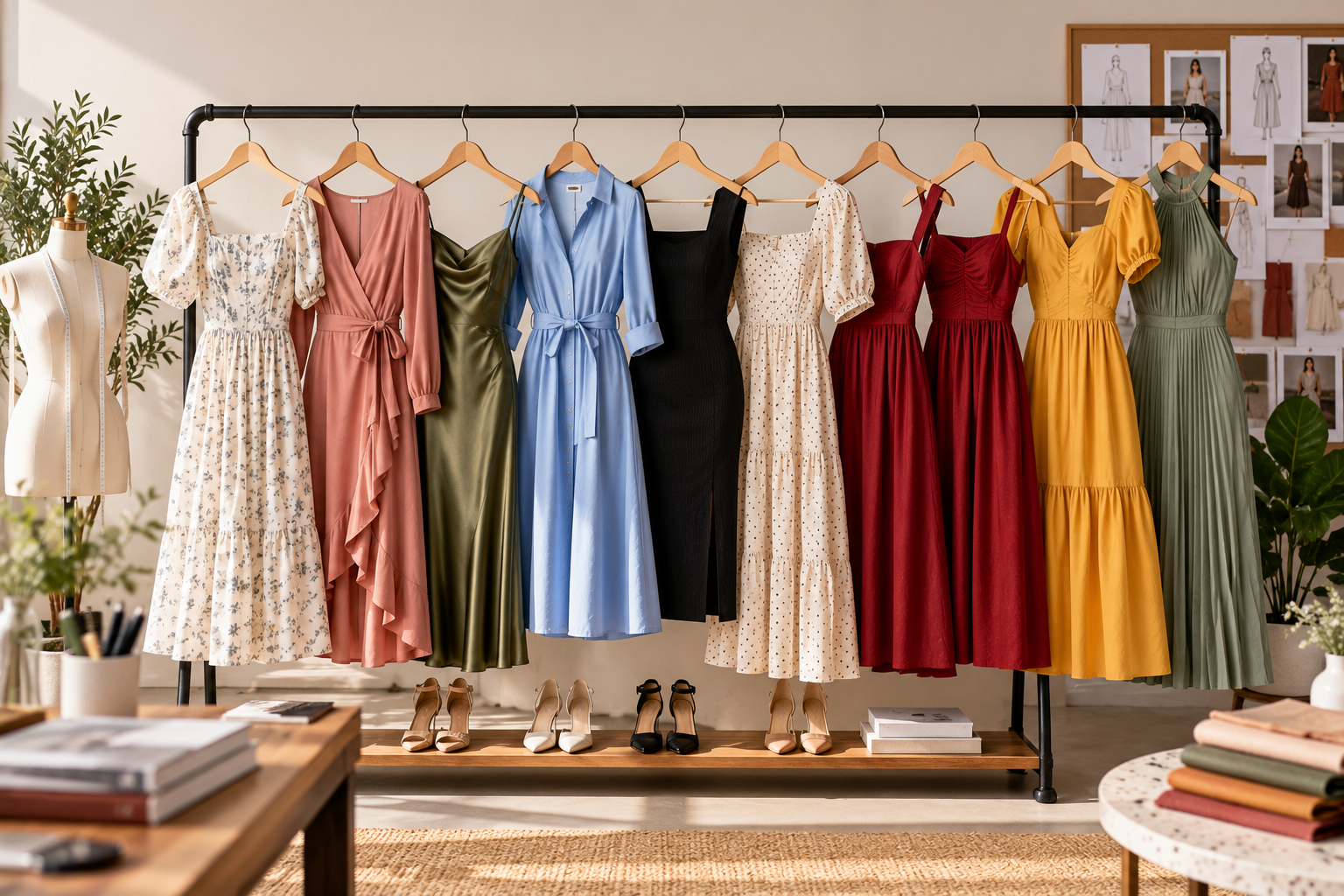
The nine types of dresses every brand owner should know are the A-line, sheath, wrap, shirt, slip, maxi, bodycon, shift, and fit-and-flare. Each entry gives a definition, best use, key properties, and a production note. MOQ (minimum order quantity) is the smallest number of units a manufacturer will produce per order, and our MOQ guide shows how to work with it.
1. A-Line Dress
An A-line dress fits close at the shoulders or bust and widens gradually to the hem, tracing the shape of the letter A.
Best for: Everyday wear, workwear, and brands serving wide size ranges. Properties: Simple seams, a gentle flare, and few darts. It works in woven cotton, rayon, and light knits. Common use in fashion: Day dresses, school events, and casual summer collections.
Among the types of dresses in this guide, the A-line is quick to sample, so you can often approve fit in fewer rounds. Studio-scale factories offer the lowest entry minimums for this style.
2. Sheath Dress
A sheath dress is a close-fitting, straight-cut dress that follows the lines of the body from shoulder to knee.
Best for: Office wear, interviews, and formal daytime events. Properties: Darts for shaping, structured woven fabric, and usually a lining and back zipper. Common use in fashion: Workwear capsules and occasion dressing.
The close fit means errors show immediately, so budget for several fit samples before bulk production. Linings and zippers add sewing operations, which raises labor cost and calls for factories that sew structured wovens.
3. Wrap Dress
A wrap dress crosses one front panel over the other and closes with a tie or button at the waist.
Best for: Day-to-night collections and brands that want one style to flatter many body shapes. Properties: An adjustable closure, a V-neckline, and fluid fabrics such as viscose, rayon, silk, and jersey. Common use in fashion: Office-to-evening wear and resort collections.
Overlapping panels and long ties use extra fabric, and the closure must stay secure through repeated wear. Many factories apply minimums per style and per color, so a wrap dress offered in three colors multiplies your first order.
4. Shirt Dress
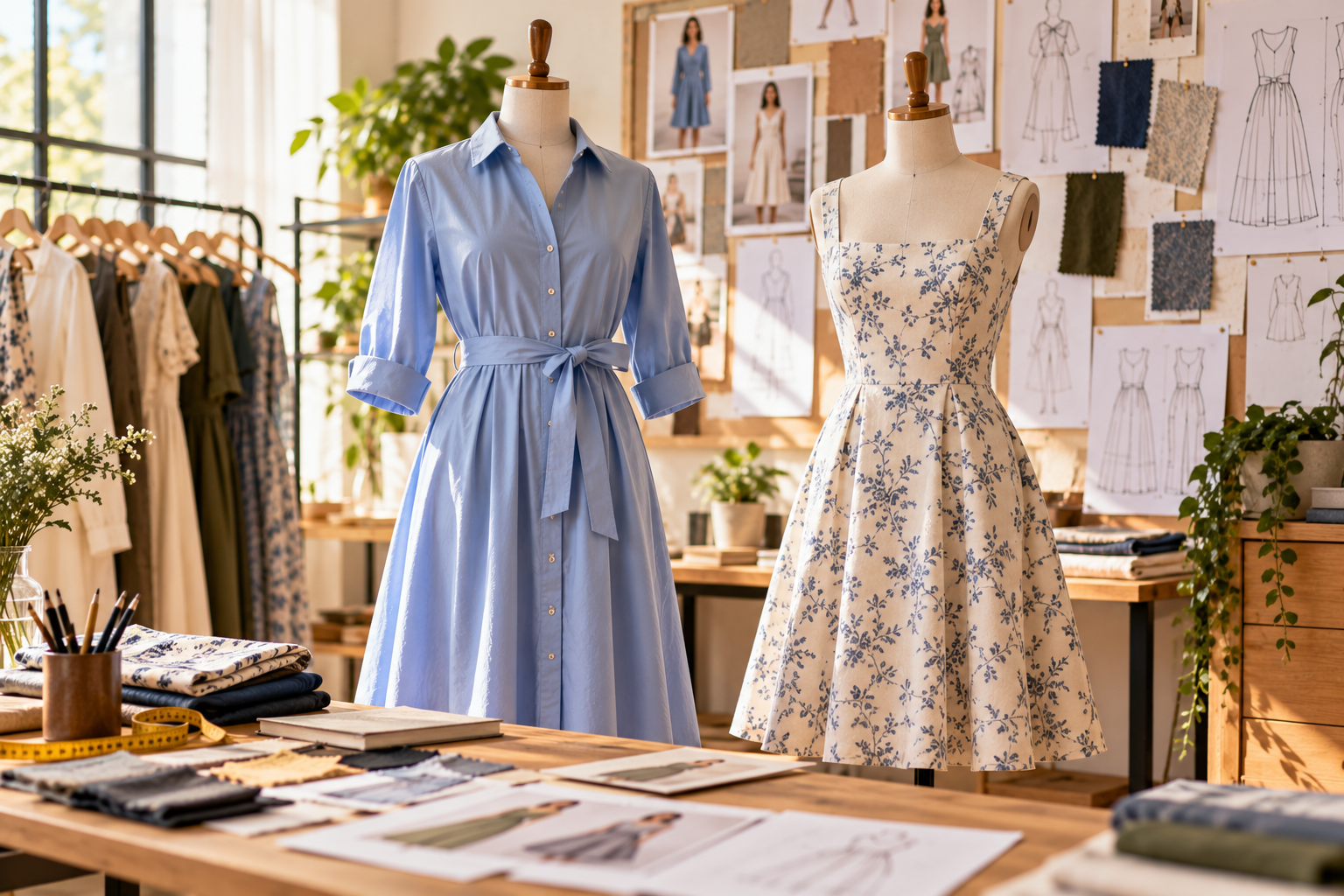
A shirt dress borrows men’s shirt details, with a collar, a button-front placket, and often a belt at the waist.
Best for: Workwear, travel, and smart casual collections. Properties: Woven cotton, linen, or chambray, plus a collar, buttons, and buttonholes. Common use in fashion: Utility and workwear capsules.
Woven fabric is cloth made by interlacing yarns at right angles, so it has little natural stretch. Collars, plackets, and buttonholes each add a separate sewing operation, which means labor makes up more of the price than on a simpler shift.
5. Slip Dress
A slip dress is a slim dress with thin straps and a fluid, lingerie-inspired drape.
Best for: Evening wear, date nights, and layering over tees or under blazers. Properties: Bias cut, spaghetti straps, minimal seams, and satin, silk, or viscose fabric. Common use in fashion: Eveningwear and layered everyday looks.
Bias cut means cutting fabric at a 45 degree angle to its weave so it drapes and stretches slightly. That drape is the appeal, but the cloth shifts while it is cut, and one mis-cut panel wastes expensive fabric. Ask whether the factory’s cutters handle satin or silk every week.
6. Maxi Dress
A maxi dress has a hemline that falls at the ankle or the floor.
Best for: Resort wear, travel, and summer collections. Properties: Long length, often tiered or gathered skirts, in lightweight cotton, rayon, or linen. Common use in fashion: Beachwear, vacation edits, and wedding-guest styles.
Length drives cost, because every extra inch adds fabric and tiers or gathers add more. Confirm yardage per dress with your factory before you approve a quote.
7. Bodycon Dress
A bodycon dress is a tight, stretchy dress designed to hug the body.
Best for: Going-out collections and brands that offer wide size ranges. Properties: Stretch knit fabric such as jersey or rib, usually with a small spandex content, and few pattern pieces. Common use in fashion: Party and nightlife collections.
Knit fabric is cloth made from interlocking loops of yarn, so it stretches and recovers. Knits behave differently from wovens on the sewing line, so choose a factory that sews stretch fabric daily. Because bodycon styles are fitted, test sizes on real fit models before you commit to bulk.
8. Shift Dress
A shift dress is a straight, loose dress that skims the body without defining the waist.
Best for: First collections, everyday wear, and brands testing demand. Properties: Minimal seams, no waist seam, and it works in woven or knit fabric. Common use in fashion: Casual wear, workwear, and uniform-style dresses.
Fewer pattern pieces and no waist seam make the shift one of the simplest types of dresses to sew. That lowers labor cost and sampling risk, which makes it a sensible hero product for a founder with a small first run.
9. Fit-and-Flare Dress
A fit-and-flare dress has a fitted bodice and waist with a skirt that flares out below.
Best for: Cocktail events, parties, and occasion dressing. Properties: A waist seam, a fuller skirt, a zipper, and often a lining. Common use in fashion: Cocktail, party, and vintage-inspired collections.
The bodice and skirt are separate pieces joined at the waist, so this style needs more construction steps than a shift. Cocktail and evening specialists in New York’s Garment District, listed in our dress manufacturers guide, are a natural starting point.
Whichever of these types of dresses you pick, certified fibers help you back up sustainability claims. As of October 2026, Textile Exchange lists standards such as the Organic Content Standard, the Recycled Claim Standard, and the Responsible Wool Standard. It is also merging them into the Materials Matter Standard, effective December 31, 2026 and mandatory from December 31, 2027.
Comparison Table: Types of Dresses at a Glance
This table compares all nine types of dresses by best use, key properties, relative cost, and where to find US production. Cost ranges are relative production tiers, not dollar quotes, because real prices depend on fabric, order size, and factory.
Type | Best For | Properties | Cost Range | USA Availability |
A-line | Everyday wear and workwear | Gentle flare, few darts | Lower to medium | Small-batch womenswear studios, such as The Evans Group (Los Angeles), 10 to 50 units per style at studio level |
Sheath | Office and formal wear | Darts, lining, back zipper | Medium | Structured woven specialists, such as Manufacture New York (Brooklyn), 36 to 100 units |
Wrap | Day to night, many body shapes | Overlapping panels, ties, fluid fabric | Medium | Boutique womenswear factories, such as Prange Apparel (Nashville), 25 garments per style and color |
Shirt | Workwear and travel | Collar, placket, buttons, woven cotton | Medium to higher | Woven cut and sew factories; request collar and placket samples first |
Slip | Evening wear and layering | Bias cut, satin or silk, few seams | Medium, fabric-driven | Factories with experienced silk and satin cutters; confirm before quoting |
Maxi | Resort, summer, guest events | Long length, tiers, high yardage | Medium to higher | Woven or knit cut and sew factories that can handle your yardage |
Bodycon | Going-out and wide size ranges | Stretch knit, spandex, few pieces | Lower to medium | Knit specialists, such as Nikibiki (Vernon, CA), 50 pieces per style and color |
Shift | First collections | No waist seam, minimal pieces | Lower | Woven or knit factories, such as Made X Hudson (Catskill, NY), no set minimum and 50 units per style advised |
Fit-and-flare | Cocktail and occasion wear | Waist seam, full skirt, zipper | Medium to higher | Cocktail specialists, such as Dream Fashion and Grace Apparel Production (New York), 20 to 1,500 units per style |
Minimums in the table come from the factory listings in our dress manufacturers guide, published October 2026, so confirm current numbers before you apply them.
How Do You Choose the Right Dress Type for Your Brand?
Choosing among the types of dresses comes down to matching fabric, construction, and minimum order to your customer, your budget, and your first production run. Ask these five questions before you contact a factory.
- What can you afford to order? Say you plan one wrap dress in three colors with Prange Apparel in Nashville, which lists 25 garments per style and color. Your first order is 75 dresses, not 25.
- Which fabric family fits the style? Among the types of dresses, woven fabric suits sheath and shirt styles. Stretch knit suits bodycon, and fluid viscose or silk suits slip and wrap styles.
- How many fit rounds can you fund? Fitted types of dresses such as the sheath and bodycon need more sampling than a shift. Send a tech pack with every request. A tech pack is the specification document that shows a factory every detail of your design, including sketches, measurements, materials, and trim.
- How complex are the finishing details? Collars, linings, and zippers each add sewing operations, and each operation adds labor cost.
- Does your label meet US rules? Most clothing needs a label showing fiber content, country of origin, and the maker or dealer, according to the FTC. An unqualified “Made in U.S.A.” claim requires a dress made completely in the US of US-made materials.
Find Dress Manufacturers on Maker’s Row
Maker’s Row is a marketplace that connects apparel brand owners with verified US manufacturers who bid on your project directly. Finding the right dress manufacturer does not have to mean months of cold emails. On Maker’s Row, post your dress project for free and verified US manufacturers bid directly. Review bids, check profiles, connect when ready.
Whichever of the types of dresses you choose, describe your silhouette, fabric family, and target quantity in the project brief. A lined sheath in woven crepe or a bodycon in stretch jersey, for example, will draw bids from factories that sew those exact materials. Many dress factories work as cut and sew shops. Cut and sew manufacturing is production where a factory cuts fabric to your pattern and sews it into finished garments. Our cut and sew guide profiles ten of them.
Brand owners post unlimited projects and receive bids from verified factories at no upfront cost. To reply to factories and search profiles, subscription plans give full access.
FAQs About Types of Dresses
By silhouette, the main styles are the A-line, sheath, wrap, shirt, slip, maxi, bodycon, shift, and fit-and-flare. Other types of dresses are grouped by length, neckline, sleeve, or occasion, so you will see many other names in stores. For production planning, silhouette matters most because it sets pattern pieces and sewing steps.
There is no fixed count, because dresses can be classified by silhouette, length, neckline, and occasion. This guide covers nine core types of dresses, and many other dress names combine or modify them.
A sheath dress follows the body with darts and shaping, while a shift dress hangs straight with no waist definition. The sheath needs more fit samples and often a lining and zipper. The shift uses fewer pattern pieces, so it is usually cheaper to sample and sew.
The shift dress is generally the easiest of the types of dresses to manufacture, followed by the A-line. Both use few pattern pieces and avoid collars, linings, and waist seams. A simple style lowers sampling risk, which helps a founder placing a first small order.
The best fabric for different types of dresses depends on the style, so match the cloth to the silhouette. Use woven cotton or linen for shirt dresses, satin or viscose for slip dresses, and stretch knit for bodycon dresses. Factories price fabric and sewing skill together, so settle the fabric before you request quotes. If you plan sustainability claims, certified fibers add credibility.
Yes, you can manufacture dresses in the USA. The U.S. Bureau of Labor Statistics counted 6,199 private apparel manufacturing establishments in the first quarter of 2026 (preliminary) and about 25,280 sewing machine operators in 2025. Not every factory sews dresses well, so match your style to a factory’s fabric and construction experience.
Most US dress manufacturers set minimums between 20 and 100 units per style, and some studios start at 10. These figures come from the listings in our dress manufacturers guide from October 2026. Some factories apply the minimum per color, so a style in three colors triples your first order. Confirm whether the number covers one style, one color, or one size before you plan your palette.
Now You Know the Types of Dresses, Here Is Your Next Step
Your dress brand is one manufacturer away from becoming real. The factories are on Maker’s Row, ready to bid.