Walk down any shopping street and you will pass several ladies wear boutiques that look alike from the sidewalk. Inside, they run very different businesses. One reorders every week. Another waits months for a single gown. A third sells only its own label. For brand owners, mixing these up is expensive, because the wrong pitch or the wrong production plan costs samples, time, and budget. This guide breaks down five types of ladies wear boutiques, what each one specializes in, and what each means for your manufacturing decisions.
Knowing the boutique type you are selling to, or building, shapes almost every production choice. It sets your order size, your size range, and how fast you must restock. Get it wrong and you may order too many units, skip key sizes, or miss a reorder window.
It also changes your factory conversations. When you can say “I need small, repeatable runs for a trend-led shop,” a manufacturer can quote faster and more accurately.
Below, we list the five types, compare them in one table, and show you how to choose.
Why Do Ladies Wear Boutique Types Matter for Brand Owners?
Ladies wear boutique types matter because each type buys, sizes, and reorders differently. Those habits set the MOQ, fit standards, and lead time your factory must meet. A ladies wear boutique is a small specialty retailer that sells curated women’s clothing to a defined customer. Because boutiques curate, no two types need the same product from you.
MOQ (minimum order quantity) is the smallest number of units a factory will make per order. A brand tied to a high factory MOQ will struggle to serve a shop that buys only a handful of units per style.
Let’s talk about the supply side. As of Q1 2026, the U.S. Bureau of Labor Statistics counts 6,199 private apparel manufacturing establishments (preliminary data). Domestic options exist, but each factory runs a different kind of work. Matching the boutique type to the right factory is where you save money.
Complete List: 5 Types of Ladies Wear Boutiques
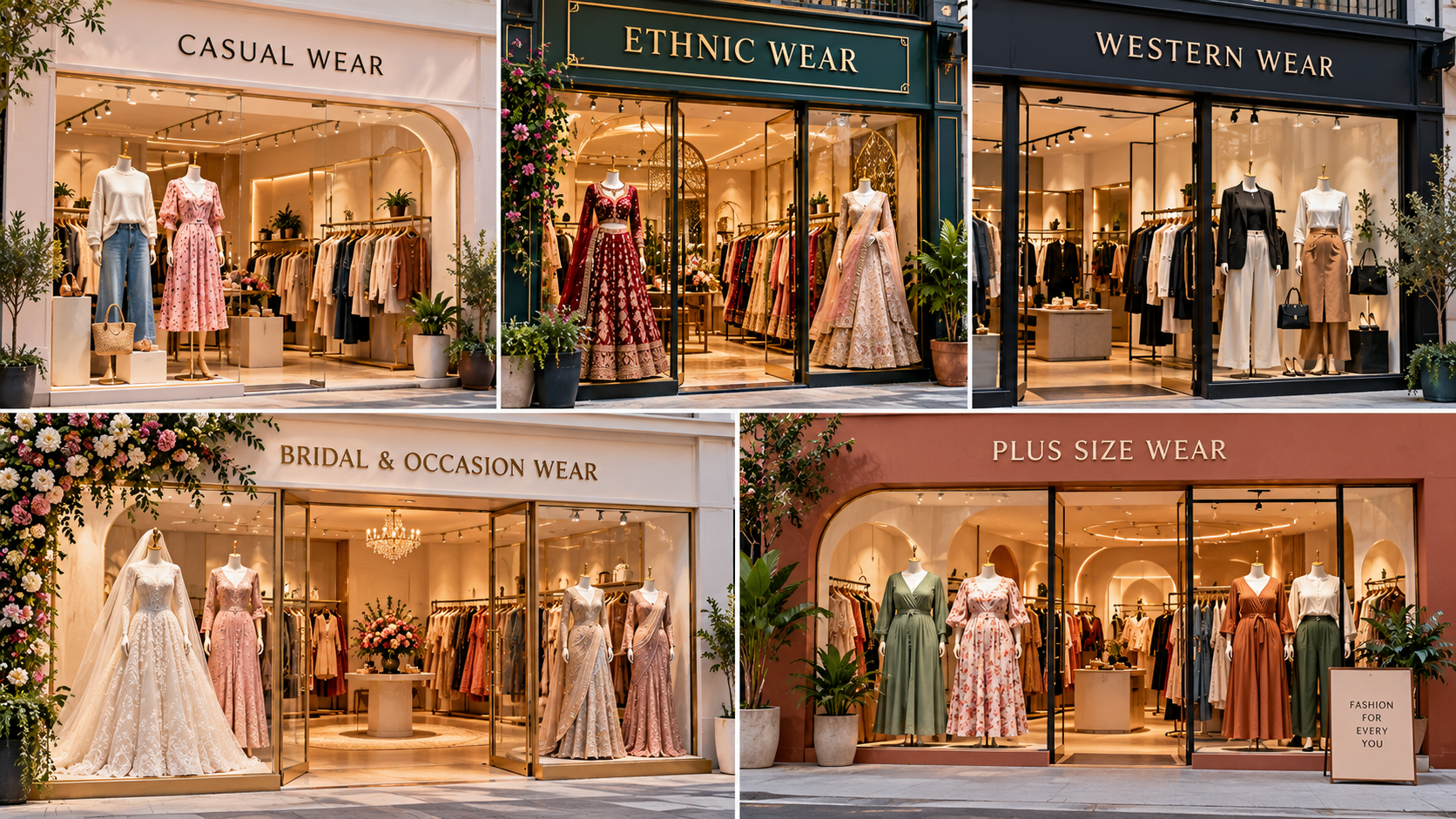
The five main types of ladies wear boutiques are contemporary trend, luxury and designer, bridal and occasion, plus-size, and private label. Each has its own specialty and its own production profile.
1. Contemporary Trend Boutique
A contemporary trend boutique sells current, everyday women’s fashion in small assortments that refresh often.
Best for: Brands with a quick-turn, mid-priced line of dresses, tops, and separates.
Properties: Small buys per style, frequent new arrivals, and a strong focus on seasonal color and print.
Common use in fashion: Dresses, knit tops, denim, light layers, and accessories for the repeat shopper.
A trend-led ladies wear boutique rewards fast replenishment, so look for factories with short sampling cycles and flexible MOQs. In many independent shops the owner is also the buyer, which keeps the relationship personal. Maker’s Row’s guide to selling to boutiques lists tight shipping deadlines as a core risk, because late shipments can lead to cancelled orders.
2. Luxury and Designer Boutique
A luxury and designer boutique sells premium women’s fashion built on fabric quality, construction detail, and brand story.
Best for: Brands with elevated fabrics, tailored silhouettes, and a higher price point.
Properties: Low unit volumes, high finishing standards, and heavy emphasis on fit and presentation.
Common use in fashion: Tailoring, structured dresses, silk and wool pieces, and statement outerwear.
Quality control matters more than speed here. A tech pack is a document that lists a garment’s measurements, materials, and construction details for the factory. Build a detailed tech pack first. Then ask each factory about its sample room, its finishing process, and how many fit rounds it includes before bulk production.
3. Bridal and Occasion Wear Boutique
A bridal and occasion wear boutique sells gowns, formal dresses, and event outfits, often made to order and fitted to the customer.
Best for: Brands making special-event dresses with detailed construction.
Properties: Long planning windows, appointment-based selling, and heavy reliance on fittings and alterations.
Common use in fashion: Wedding gowns, bridesmaid dresses, cocktail dresses, and formal separates.
Made-to-order production means a garment is cut and sewn only after an order is placed. This lowers inventory risk but demands strong pattern making and clear lead times. Ask each factory for sampling time and production time as two separate figures. The seven stages of apparel samples show why those timelines differ.
4. Plus-Size and Extended-Size Boutique
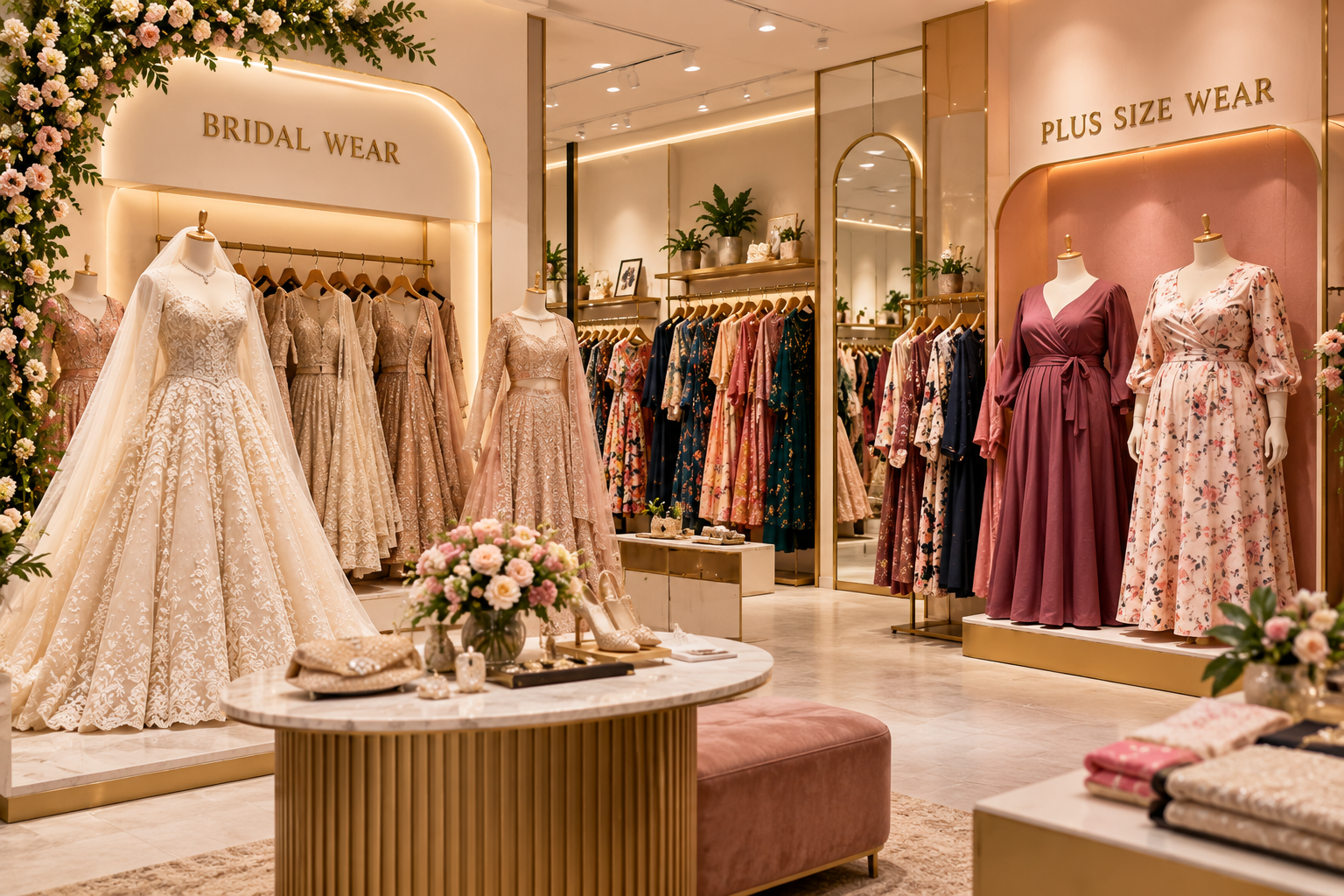
A plus-size boutique sells women’s fashion in extended size ranges and builds its reputation on dependable fit.
Best for: Brands that grade full size runs and fit real bodies well.
Properties: Wide size runs, high fit expectations, and loyal repeat customers who value consistent sizing.
Common use in fashion: Denim, wrap dresses, workwear, and knit separates in extended sizes.
Grading is the process of scaling a base pattern into every other size. Weak grading breaks the promise of consistent sizing, so ask each factory how it grades and which fit models it uses. Maker’s Row covers designing for plus-size and whether you need a fit model in detail.
5. Private Label Boutique
A private label boutique sells women’s clothing under its own name, made by outside factories to the owner’s specifications.
Best for: Founders who want one consistent look and direct control over product and pricing.
Properties: The owner acts as both brand and retailer, and carries the MOQ, sampling cost, and quality risk directly.
Common use in fashion: Signature dresses, capsule collections, and core basics that bring customers back.
Private label manufacturing means a factory makes garments that carry your brand label. This is the type closest to your own position as a brand owner, so start with a small test run before you scale. Maker’s Row’s guide to private label and white label manufacturers explains how much customization to expect. Planning to market your line as American-made? The FTC’s Made in USA standard says an unqualified claim needs nearly all content and processing to be domestic.
Groups such as the American Apparel & Footwear Association publish current industry statistics. Use them to size the ladies wear boutique category before you commit.
Comparison Table: Ladies Wear Boutique Types at a Glance
The table below compares all five ladies wear boutique types by best use, properties, price tier, and fit for small US runs.
Type | Best For | Properties | USA Availability |
Contemporary trend | Quick-turn, mid-priced lines | Small buys, frequent refresh | Strong: short runs and fast sampling |
Luxury and designer | Elevated fabrics and tailoring | Low volume, high finishing | Strong: sample rooms and tight quality control |
Bridal and occasion | Special-event dresses | Made to order, fittings | Strong: pattern making and long lead times |
Plus-size and extended | Full size runs, fit-led lines | Wide grading, loyal repeat buyers | Moderate: needs grading and fit-model skill |
Private label | Own-brand founders | Owner carries MOQ and quality risk | Strong: small batches and test runs |
Price tiers are general positioning guides, not quoted costs. Confirm real pricing and fit with each factory.
How Do You Choose the Right Ladies Wear Boutique Type for Your Brand?
You choose the right ladies wear boutique type by matching your product, price point, and production capacity to how that boutique buys. Ask yourself these five questions before you commit.
- Who is my customer, and where does she shop? The SBA tells new owners to confirm demand, market size, location, and competition before launch.
- What price can my costs support? Finalize your costing before you list wholesale prices. A line sheet is a one-page sales tool listing your styles, sizes, colors, and prices for buyers. Maker’s Row’s line sheet guide gives a simple $50 wholesale and $100 suggested retail example.
- How many units can I make at once? Compare your factory’s MOQ with the order sizes your target boutique places.
- Can my factory hold fit across every size I list? If not, narrow your size range or change factories.
- Can I ship on time and cover cash while I wait for payment? You often pay to produce an order before the boutique pays you.
Also Read: 12 Best Clothing Manufacturers Near Me In The USA (2026 Guide) →
Finding Ladies Wear Manufacturers on Maker’s Row
You can find ladies wear manufacturers on Maker’s Row by posting your project and letting verified US factories bid on it. Maker’s Row is a marketplace connecting apparel brands with verified US manufacturers. Name your boutique type, style, size range, and target quantity in your project brief. Factories that work at that scale respond directly, so you skip months of cold emails.
On Maker’s Row, brand owners post unlimited manufacturing projects for free and receive bids from verified US factories at no upfront cost. To connect directly, subscription plans give full access.
FAQs About Ladies Wear Boutique Types
The five main types are contemporary trend, luxury and designer, bridal and occasion, plus-size, and private label boutiques. Each one specializes in a different customer and buys in a different way. Your product and price point decide which type fits your brand best.
A boutique sells a curated selection to a defined customer, while a regular clothing store stocks a wide range for a broad audience. Boutiques buy fewer units per style and refresh their assortments more often. That buying pattern is why small-run production suits them well.
Boutiques buy wholesale from brands, commission private label pieces from factories, or mix both. Wholesale buyers rely on line sheets to compare styles, sizes, colors, and prices. Private label owners work with factories directly and carry the production risk.
Boutiques place smaller orders than department stores, so brands that can produce in small runs have the advantage. Maker’s Row’s boutique selling guide lists smaller orders as a trade-off of this channel. In exchange, you often deal directly with the owner, who is usually the buyer.
Yes, small brands often start with boutiques before they approach larger retailers. The same guide advises proving your quality, delivery, and sell-through with boutiques first. Strong results there make larger buyers more willing to take a meeting.
About 71,400 people worked in US apparel manufacturing as of September 2026, according to preliminary BLS data. That figure includes 25,280 sewing machine operators counted in 2025. It shows that a domestic workforce still exists for small-batch ladies wear boutique production.
Now You Know the Types: Here Is Your Next Step
Your ladies wear brand is one manufacturer away from becoming real. The factories are on Maker’s Row, ready to bid.