Ask a pattern maker for a neckline and the first reply is a question: which one? Knowing the types of necklines is the fastest way to stop guessing. A neckline is the shape of the opening a garment makes around the neck and upper chest. It sets how a piece fits, how it looks, and how many minutes a sewer spends on it.
When you can name the neckline in your design, factory quotes arrive faster and sample rounds drop. You also spot early which styles will raise your cost per unit. A wrong guess here means a second sample, and every sample costs you weeks.
This guide covers eight types of necklines, from crew to cowl. Each one comes with production notes on sewing effort, cost, and factory availability. You also get a comparison table and a simple way to choose.
Why Do Necklines Matter for Your Production Costs?
Necklines matter because each one needs a different sewing method, and every extra sewing minute adds labor cost. Two tops that look almost the same can price very differently once a factory counts the steps. Knowing the types of necklines helps you predict that gap before you request quotes.
The U.S. Bureau of Labor Statistics reports that sewing machine operators earned a median of $17.37 per hour in 2025. That works out to about $0.29 per minute of direct labor, before factory overhead.
Here is an example scenario. You order 300 tops, and a sweetheart neckline adds 4 minutes of sewing compared with a crew neck. At $0.29 per minute, that is about $1.16 per top, or roughly $347 across the run. The 4 minutes is a planning assumption, not a BLS figure, so ask your factory for its real number.
Your spec also needs to be exact. A tech pack is the technical document that tells a factory exactly how to build a garment. A good tech pack names the neckline, its depth in inches, and how the edge is finished.
The 8 Types of Necklines, Explained
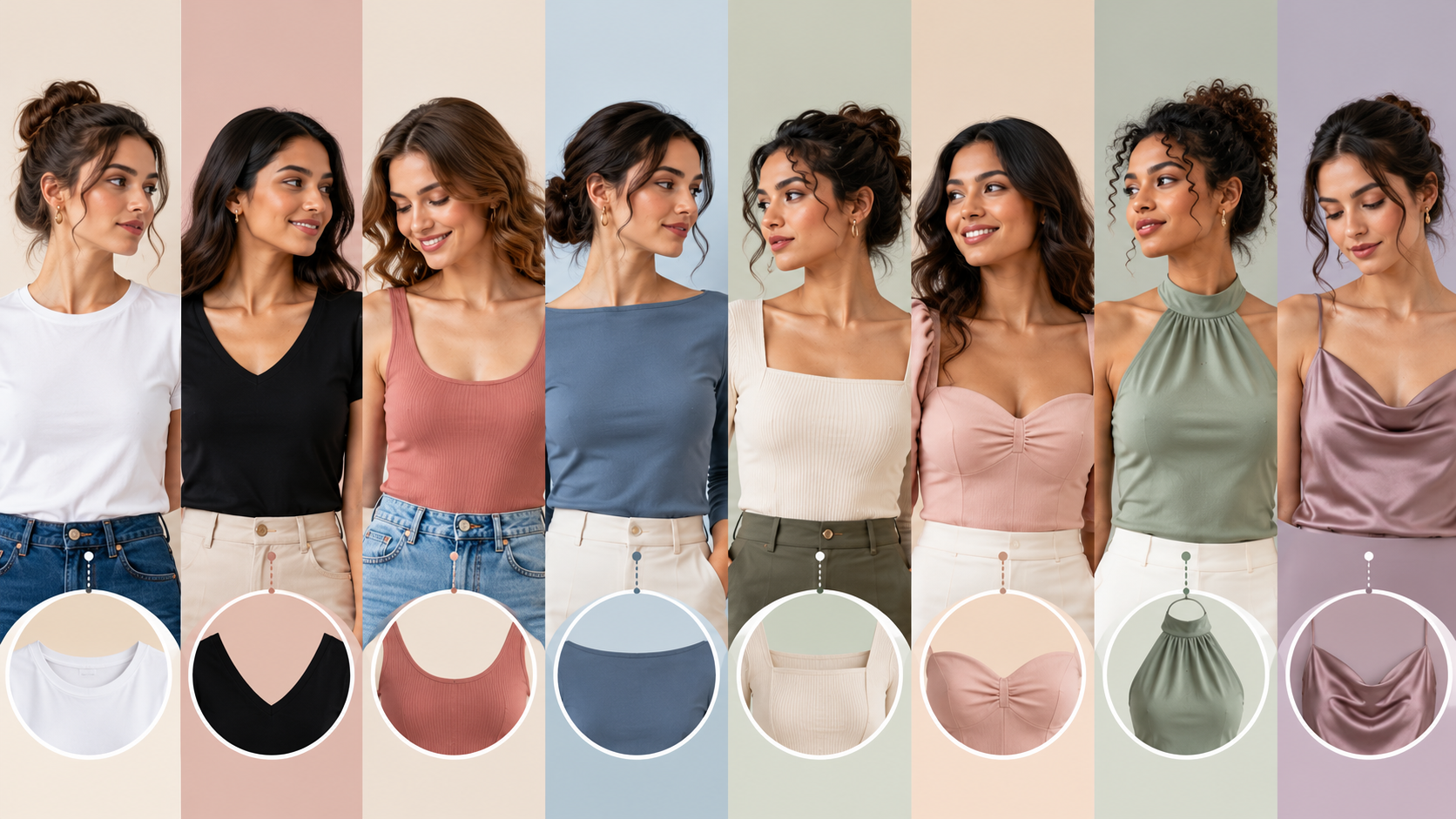
The eight most useful types of necklines for a new brand are crew, V-neck, scoop, boat, square, sweetheart, halter, and cowl. All eight can be made by a cut-and-sew manufacturer, but the effort differs a lot.
A few terms come up below. A binding is a narrow strip of fabric folded over a raw edge to finish it. A facing is a separate fabric piece sewn inside the edge and turned to hide the seam. An interfacing is an extra layer that adds structure to a part of the garment.
1. Crew Neck
A crew neck is a round neckline that sits close to the base of the neck.
- Best for: Basics, uniforms, and everyday knitwear.
- Properties: High, round, unisex, and low on fabric.
- Common use in fashion: T-shirts, sweatshirts, and knit sweaters.
Factories sew this neckline every day, usually with a rib binding, which is a stretchy knit strip that finishes the edge. It carries the lowest labor and sampling risk. That makes it the safest choice for a first, small order.
2. V-Neck
A V-neck is a neckline that dips to a point at the center front.
- Best for: Tees, sweaters, and scrubs.
- Properties: Elongates the neck, and the depth can vary a lot.
- Common use in fashion: T-shirts, cardigans, knit tops, and medical wear.
The point needs a precise miter, which is the angled join where the binding meets at the center. Specify the depth in your tech pack so every size looks consistent. Expect slightly more effort than a crew neck.
3. Scoop Neck
A scoop neck is a wide, rounded neckline that curves lower than a crew neck.
- Best for: Fitted tees, tanks, and knit dresses.
- Properties: Wide curve that shows the collarbones.
- Common use in fashion: Tank tops, bodysuits, and jersey dresses.
The curve can stretch while it is sewn, so factories often stabilize it with tape or elastic. Ask how your factory prevents gaping. Cost sits just above a crew neck.
4. Boat Neck
A boat neck, also called a bateau, is a wide, shallow neckline that runs nearly shoulder to shoulder.
- Best for: Breton stripes, structured knits, and shift dresses.
- Properties: Wide, straight across, and horizontal.
- Common use in fashion: Striped tops, sweaters, and simple dresses.
Woven fabrics usually need a facing so the wide opening lies flat. Shoulder seams also sit close to the opening, so placement must be exact. Many US cut-and-sew shops handle it well.
5. Square Neck
A square neck has straight horizontal and vertical edges that meet in two sharp corners.
- Best for: Summer dresses, bodysuits, and bridal pieces.
- Properties: Structured, geometric, and crisp.
- Common use in fashion: Sundresses, corset tops, and fitted bodysuits.
The corners must be clipped and reinforced so they turn cleanly. Poor corners pucker, and the fault shows in every unit. Choose a factory with proven experience on woven garments.
6. Sweetheart Neck
A sweetheart neckline dips at the center with two curves on top, like the upper edge of a heart.
- Best for: Formal dresses, bridal wear, and corset-style tops.
- Properties: Curved, structured, and supported.
- Common use in fashion: Prom dresses, wedding gowns, and bikini tops.
This shape usually needs interfacing, lining, or boning to hold its curve. That adds both materials and labor. Expect more sample rounds, and look for factories with dressmaking skill.
7. Halter Neck
A halter neckline wraps straps around the back of the neck and leaves the shoulders and upper back bare.
- Best for: Swimwear, sundresses, and active tops.
- Properties: Open shoulders and a closure at the neck.
- Common use in fashion: Swimsuits, evening dresses, and workout tops.
The neck closure may be a tie, hook, or button, so you also source small hardware. Strap length and bust support must be graded across sizes. Swimwear halters need a swim-specific factory.
8. Cowl Neck
A cowl neckline is a loose fold of fabric that drapes in soft folds at the front.
- Best for: Draped tops, slip dresses, and lightweight sweaters.
- Properties: Relies on drape, uses extra fabric, and is often cut on the bias.
- Common use in fashion: Satin slip dresses, jersey tops, and knit sweaters.
A bias cut is a cut made on the diagonal of the fabric grain, which adds stretch and drape. That uses more yardage than a straight cut. Test the fabric in a sample before you commit to a full order.
Fabric choice decides whether a cowl drapes or sags. Textile Exchange maps the main material families, including plant fibers, synthetics, manmade cellulosics, and animal fibers. Use it to match fiber to the drape you want. These eight types of necklines also give you a working vocabulary for any factory call.
Every neckline above also affects your minimum order quantity. Structured styles may need special materials that factories buy in larger lots.
Comparison Table: Types of Necklines at a Glance
Crew and V-necks are the cheapest and easiest to source. Sweetheart, halter, and cowl cost more because they need structure, closures, or extra fabric. Use this table to compare all eight types of necklines side by side.
Type | Best For | Properties | Cost Range | USA Availability |
Crew | Basics, tees, sweatshirts | Round, close to neck, minimal fabric | Lowest: one simple rib binding seam | Very high: nearly every cut-and-sew factory |
V-neck | Tees, knit tops, sweaters, scrubs | Pointed, elongating | Low: adds a mitered point to the binding | Very high: common on knit lines |
Scoop | Tanks, fitted tees, knit dresses | Wide, curved, low | Low to moderate: curve needs stabilizing | High: standard on knit and jersey lines |
Boat | Breton tops, shift dresses | Wide, shallow, horizontal | Moderate: woven versions need a facing | High: fine for most cut-and-sew shops |
Square | Summer dresses, bodysuits | Sharp corners, structured | Moderate to higher: corners need clipping and reinforcement | Moderate: best with woven-garment experience |
Sweetheart | Formal, bridal, corset tops | Curved, structured, supported | Higher: interfacing, lining, or boning | Moderate to lower: dressmaking-skilled shops |
Halter | Swimwear, sundresses, active tops | Open shoulders, neck closure | Moderate to higher: closure, hardware, strap grading | Moderate: swim and dress specialists |
Cowl | Draped tops, slip dresses, sweaters | Soft folds, bias cut, extra fabric | Moderate to higher: extra yardage and drapey fabric | Moderate: needs drape-savvy sewers |
How to read this table: Cost and availability describe relative sewing complexity, not quoted prices or a factory directory count. Fabric, quantity, and factory all change the final price, so request real quotes before you decide. For a wider view, read the guide on US apparel manufacturing costs.
How Do You Choose the Right Neckline for Your Brand?
Choose the simplest neckline that still delivers your design, then add complexity as your order volume grows. Five questions narrow the types of necklines fast.
- What fabric are you using? Knits suit crew, V, and scoop necklines with rib binding. Wovens suit boat and square necklines with facings. Drapey fabrics suit cowls.
- What is your budget per unit? Each extra sewing minute adds about $0.29 in direct labor, based on the BLS wage above. SCORE also notes that cost is not the only factor when picking a supplier. Reliability and quality count too.
- How big is your first order? Complex necklines add sample rounds. Review the 7 stages of apparel samples so you can budget the time.
- Who is your customer? Everyday wear favors crew, V, and scoop. Occasion wear favors sweetheart, square, and halter.
- Can your tech pack describe it? If you cannot draw the neckline and give its depth in inches, simplify it.
Finding Clothing Manufacturers on Maker’s Row
Finding the right clothing manufacturer does not have to mean months of cold emails. Maker’s Row is a US manufacturing marketplace where brand owners post projects and verified factories bid on them. Post your clothing project for free and verified US manufacturers bid directly. Review bids, check profiles, connect when ready.
List the types of necklines in your range, plus fabric and quantity, in the project brief. Factories that sew those details respond with bids. You can also browse the verified US clothing manufacturers before you post.
You post unlimited projects for free and receive bids from verified US factories at no upfront cost. To reply to factories and search profiles, subscription plans give full access.
FAQs About Types of Necklines
The most common types of necklines are crew, V-neck, scoop, boat, square, sweetheart, halter, and cowl. Each differs in depth, width, and shape, which changes both the fit and the sewing method. Crew and V-necks are the easiest to produce. Sweetheart, halter, and cowl styles need more structure or fabric.
The crew neck is the standard neckline on a basic T-shirt. It sits close to the base of the neck and uses a simple rib binding, so factories sew it quickly. V-necks and scoop necks are the usual alternatives. It is also the baseline for comparing other types of necklines.
The crew neck is usually the cheapest neckline to manufacture because it needs the fewest sewing steps. The U.S. Bureau of Labor Statistics reports a 2025 median wage of $17.37 an hour for sewing machine operators. Each extra minute therefore adds roughly $0.29 in direct labor. Ask your factory for its real minute count per neckline.
A scoop neck is wider and cuts lower than a crew neck. A crew neck hugs the base of the neck, while a scoop curves away and shows more collarbone. The scoop curve also needs extra stabilizing during sewing to prevent stretching.
A crew neck or V-neck is best for a first clothing line. Both are the simplest types of necklines to sew, keep sample rounds low, and work across many designs. Add structured styles such as the sweetheart once you have a proven first order.
Yes, your tech pack should name the neckline, its depth and width, and how the edge is finished. Without those details a factory guesses, and your sample comes back wrong. The guide to a professional tech pack walks through the format.
Name which of the types of necklines you need, plus fabric and quantity, in a project brief, and let factories respond with bids. You can also read the guide to finding a clothing manufacturer in the USA. Compare each factory’s samples before you commit to an order.
Now You Know the Types: Here Is Your Next Step
Your clothing brand is one manufacturer away from becoming real. The factories are on Maker’s Row, ready to bid.