Adding a 14K gold chain necklace to your collection is one of the smartest moves a jewelry founder can make. It is also easy to get wrong, because style, weight, and construction change your cost far more than most guides admit. This guide walks you through seven steps, from choosing a chain style to finding a US manufacturer who will bid on your project. It is written for brand owners building a line, not for shoppers buying a single piece.
A chain is the simplest piece in fine jewelry and the easiest one to price wrong. As of May 2023, the U.S. Bureau of Labor Statistics counted 21,810 workers in US jewelry and silverware manufacturing. Domestic capacity exists for brands that know what to ask for.
Most new founders hit three walls. They cannot tell which style suits their customer. They cannot predict gold cost per piece, and small inquiries rarely get factory replies.
This guide solves all three. Each step ends with something you can do today, and the manufacturer step shows you how to collect bids instead of chasing emails.
Step 1: What Role Does a 14K Gold Chain Necklace Play in Your Collection?
Your chain should do one job in your line: anchor a layering set, carry a pendant, or stand alone. Write a one-page brief with your target customer, your target retail price, and the three competitor chains you want to sit beside.
Next, choose between custom and private label. Private label manufacturing puts your brand on a design the factory already owns. Private label jewelry manufacturers can cut your development time, while custom work gives you a design nobody else sells.
Then fix your price ceiling, because gold weight drives cost more than any other choice. 14K gold is an alloy of 14 parts pure gold and 10 parts other metals, which makes it 58.3% gold by weight. The FTC Jewelry Guides advise against using the word “gold” or a karat mark on any alloy below 10 karat, according to this FTC advisory letter. That makes 10K the legal floor and 14K a step above it.
Before you move on, run your numbers through SCORE’s startup business plan template and book a free mentor review. Your brief now tells you what to choose, so Step 2 turns it into a style.
Step 2: Which Chain Style Fits Your Customer?
The right chain style depends on how your customer wears it: alone, layered, or with a pendant. Pick one hero style and one layering style for your first run, because a short range costs less to sample and sells faster.
Style | What it looks like | Best for | Watch out for |
Cable | Uniform round or oval links | Pendants and layering | Looks plain worn alone |
Curb | Flat, twisted links that lie smooth | Everyday and unisex pieces | Links that twist if poorly made |
Rope | Twisted strands with sparkle | Statement pieces | Dents and kinks in hollow builds |
Box | Square links with clean edges | Modern minimalist lines | Crush damage in hollow builds |
Paperclip | Elongated rectangular links | Trend-led layering | Thin wire that bends open |
Snake | Tight, smooth, fluid scales | Sleek solo wear | Kinks that never fully relax |
Test your shortlist against your brief. If your customer layers three chains, a cable or snake chain suits her better than a heavy rope. Style is only half the spec for a 14K gold chain necklace, so Step 3 covers the measurements.
Also Read: Best Small Batch Jewelry Manufacturers for Small Businesses in the USA →
Step 3: What Length, Width, and Clasp Should You Specify?
A factory needs five written specs before it can quote your 14K gold chain necklace: style, length, width, clasp, and target weight. A tech pack (spec sheet) is the document that lists every measurement and material a factory needs to quote and make your piece.
Length | Common name | Where it sits |
16 inches | Choker length | Base of the neck |
18 inches | Princess length | At the collarbone |
20 to 24 inches | Matinee length | Below the collarbone |
State width in millimeters, because a 1.5 mm cable chain and a 4 mm cable chain are two different products at two different costs. Pick a clasp next. A lobster clasp is a hinged claw that opens with a small lever and holds tighter than a spring ring. Add a 2 inch extender, and one SKU fits two lengths, such as 16 and 18 inches.
Finish by writing a target weight in grams, since weight sets your metal cost. Once the spec is on paper, you can decide how to build the chain.
Also Read: The Secret to Quality: How Manufacturing Jewelers Work →
Step 4: Should You Choose Solid, Hollow, or Gold-Filled?
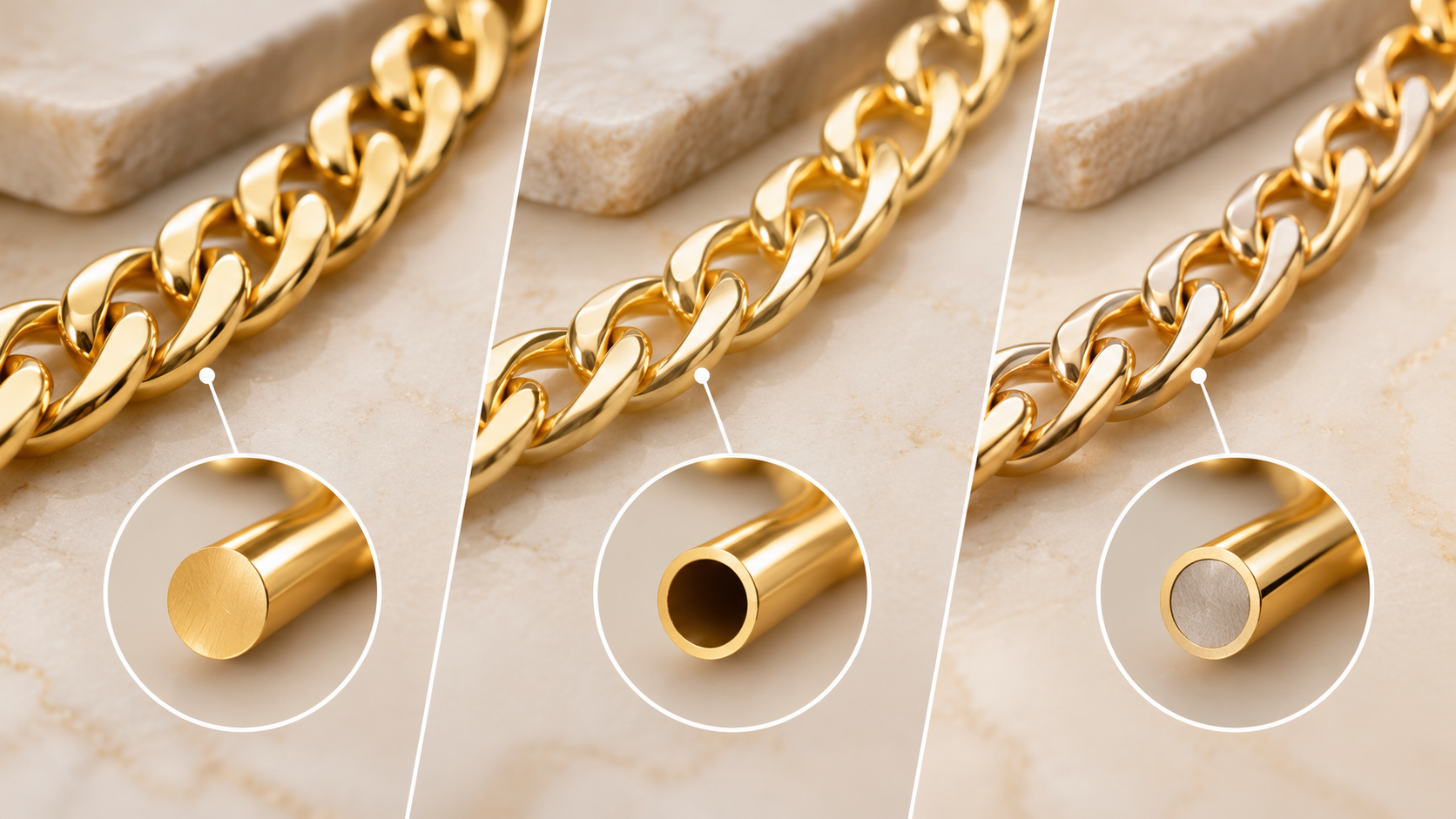
Choose solid for durability, hollow for a bold look at lower weight, and gold-filled for the lowest cost. A hollow chain is built from tube links with an empty core, so it uses less gold than a solid chain of the same size. Each build changes the price of your 14K gold chain necklace and the promise you make to customers.
Build | What it is | Gold content | Best for |
Solid 14K | 14K alloy throughout | 58.3% of total weight | Heirloom and everyday pieces |
Hollow 14K | 14K shell around an empty core | 58.3% of shell weight, less total gold | Bold looks at lower weight |
Gold-filled | Thick gold layer bonded to a base metal | Layer only, not solid gold | Budget-friendly lines |
Gold-filled jewelry bonds a thick layer of gold mechanically to a base metal such as brass or copper. Our guide to gold-filled jewelry explains why it sits between plated and solid gold. Never describe a gold-filled chain as solid 14K gold in your listing.
Karat also shapes the price. Compare the three common choices before you commit.
Karat | Gold by weight | Trade-off |
10K | 41.7% | Lowest gold cost, paler color |
14K | 58.3% | Balanced color, strength, and cost |
18K | 75.0% | Richer color, softer metal, higher cost |
You now know what to build, so Step 5 finds who builds it.
Step 5: How Do You Find a 14K Gold Chain Necklace Manufacturer?
You find a manufacturer by sending the same written spec to several US shops and comparing their answers. This is where most brand owners get stuck, and it decides whether your chain launches.
The old way means cold emails, trade shows, and referrals. Each one can take weeks, and small inquiries often go unanswered. A better way is to judge every shop on the same five points.
Criterion | Ask this | Green flag | Red flag |
MOQ | What are your prototype and production minimums? | Both stated in writing | Vague or shifting numbers |
Location | Where do you cast, solder, and finish? | Verifiable US address | Overseas work hidden behind a US office |
Sample policy | Do you offer a paid prototype? | Paid sample with a timeline | Refuses samples |
Communication | How fast do you reply? | Clear answers within days | Silence after the first quote |
Chain skills | Do you make chain in-house or outsource it? | Names the process | Cannot explain it |
Find 14K Gold Chain Necklace Manufacturers on Maker’s Row
Maker’s Row is a marketplace connecting jewelry and apparel brand owners with verified US manufacturers. Finding the right 14K gold chain necklace manufacturer does not have to mean months of cold emails. On Maker’s Row, post your chain project for free and verified US manufacturers bid directly. Review bids, check profiles, connect when ready.
List your style, length, width in millimeters, karat, build, clasp, and target quantity in the project so bidding factories can quote accurately. Posting projects and receiving bids costs nothing upfront, and subscription plans unlock replies and direct contact. For a wider shortlist, see our roundup of the best jewelry manufacturers in the USA. Once bids arrive, samples tell you who deserves the order.
Step 6: How Do You Test Samples Before You Commit?
You test a 14K gold chain necklace sample by checking it against your tech pack on weight, clasp, joints, and marks before you approve production. Pay for a sample from at least two shops, because side-by-side comparison shows quality differences no sales call can.
Run these checks on every sample:
- Weight: Weigh the chain and compare it with the target in your tech pack.
- Clasp: Open and close it 50 times, and confirm it still seals.
- Joints: Look at every solder point and jump ring under a loupe for gaps.
- Marks: Confirm the 14K stamp, then ask which maker’s mark sits beside it.
- Wear: Wear the sample for one week, and note kinks, snags, and skin reactions.
Send written feedback within days, not weeks, because slow answers stretch your launch date. Approved samples lead straight to the budget in Step 7.
Step 7: How Do You Plan Your First Production Run?
You plan your first run by pricing the metal first, adding labor and finishing, and ordering a quantity you can sell in one season. Your metal budget equals grams per piece times pieces times the current gold price per gram. Check the live price before you request quotes, because it moves daily.
Here is an illustrative example, not a customer result. Picture a founder in Austin who orders 25 solid 14K gold paperclip chain necklaces, 18 inches long, at 6 grams each. That is 150 grams of alloy, which holds about 87.5 grams of pure gold. Quotes show metal is her largest cost, so she redesigns to 4.5 grams per piece. The run drops to 112.5 grams of alloy, about 65.6 grams of pure gold, a 25% cut in metal before labor.
Protect your brand before you launch. Register your name and logo, because the USPTO says federal registration creates nationwide rights. Then photograph your approved sample from three angles and presell to your email list.
FAQs About Choosing a 14K Gold Chain Necklace
You need enough to cover gold, labor, samples, and a trademark filing, and gold weight is the biggest variable. Multiply grams per piece by pieces by the current gold price per gram, then add labor and finishing. At 6 grams and 25 pieces, you buy 150 grams of alloy. Ask at least two factories for itemized quotes that separate metal from labor.
Yes, you can launch without jewelry experience if you write a clear spec and order a paid sample first. Factories build to your tech pack, so your job is to define style, length, width, karat, and clasp. Start with one hero style instead of a full range.
Post your project on Maker’s Row and let verified US factories bid, or send a written spec to shops directly. Judge every shop on MOQ, location, sample policy, communication speed, and chain skills. Compare at least three responses before you pay for a sample.
MOQ (minimum order quantity) is the smallest number of pieces a factory will produce per order. Because gold is bought by weight, a higher MOQ raises the upfront cost of any 14K gold chain necklace order. Ask for prototype and production minimums separately, and look at small batch jewelry manufacturers if you want to start small.
No single timeline fits, because it depends on how many sample rounds you need. Ask each factory for written timelines covering sample, revision, and production separately. Plan for at least one revision round, and set your launch date only after you approve a sample.
Yes, a tech pack is the fastest way to get accurate quotes. List style, length, width in millimeters, karat, build, clasp, and target weight. Factories can quote from a sketch, but a written spec cuts back-and-forth and pricing surprises.
Ask each factory to sign a non-disclosure agreement before you share files, and file a federal trademark for your brand name and logo. The USPTO page on why to register a trademark explains the benefits. Ask an attorney whether your original pendant designs qualify for more protection.
Yes, it is real gold, at 58.3% pure gold by weight. The remaining metals add strength and set the color. A gold-filled or gold-plated chain is not solid 14K gold, so label each build accurately.
Your 14K Gold Chain Necklace Line Is Closer Than You Think
Your 14K gold chain necklace brand is one manufacturer away from becoming real. The factories are on Maker’s Row, ready to bid.