Requesting a clothing manufacturing quote should be simple: describe your product, get a number back. In practice, most brand owners send an email with a rough idea and get either silence or a quote that is impossible to compare against anything else. The problem is rarely the manufacturer. It is what gets sent to them, and in what order. This guide walks through exactly how to request, receive, and compare a clothing manufacturing quote from a US manufacturer, step by step.
Getting an accurate quote from a US clothing manufacturer is not about finding the cheapest factory first. It is about giving manufacturers enough detail to price your product correctly the first time, then knowing how to read what comes back. Brand owners who skip preparation typically get vague, padded, or wildly inconsistent numbers from different factories, which makes real comparison impossible.
This guide covers what to prepare before you request a quote, how to submit your request so a manufacturer can actually price it, what a real quote should contain, and how to compare quotes that rarely match line for line. If you are contacting your first US manufacturer this month, this is the sequence to follow.
What Manufacturers Need Before They Can Quote You
A US clothing manufacturer needs four things before they can give you an accurate quote: a tech pack or detailed product brief, your target order quantity, your fabric and material specs, and your realistic budget range. Send a factory a vague description and you get a vague, often inflated, quote back. Send them these four pieces and most factories can return a workable number within a few business days.
This matters because quoting is not guesswork on the manufacturer’s side. A factory calculates a clothing manufacturing quote by adding labor cost, material cost, and a share of factory overhead, then applying a margin, according to standard industry cost breakdowns used across the American Apparel and Footwear Association member base. Missing information forces a factory to guess, and factories price their guesses conservatively, in their own favor, not yours.
Step 1: Prepare Your Tech Pack or Product Brief
A tech pack is the specification document that tells a manufacturer exactly what to make, covering fabric type, measurements, construction details, trims, and finish. Without one, every factory prices your product differently because every factory is imagining a slightly different garment.
If you do not have a full tech pack ready, a detailed brief works for an initial conversation. Include a flat sketch or reference image, fabric weight and composition, size range, and any hardware or trim details. For a full walkthrough of what belongs in this document, see the complete guide to creating an apparel tech pack.
A factory quoting from a one-line email typically pads the price by 15 to 25 percent to cover the unknowns. A factory quoting from a complete tech pack prices closer to actual cost, because there is less risk on their side.
Step 2: Set Your Target MOQ and Budget Range
MOQ, or minimum order quantity, is the smallest number of units a manufacturer will produce in a single run, and it directly changes your per-unit price. US clothing manufacturers typically set MOQs between 50 and 500 units per style, depending on the production method and factory size, based on data compiled by AAFA.
Decide your target MOQ before you contact anyone. A factory that requires 500 units per style will quote a lower per-unit price than one that accepts 100 units, because fixed setup costs, machine configuration, and fabric cutting spread across more garments. Know your number, and know your ceiling on total spend, before you ask for a quote. As of 2026, Bureau of Labor Statistics data shows the US apparel and textile manufacturing sector employs over 250,000 workers across more than 11,000 establishments, the capacity this MOQ range is drawn from.
Example: A Portland, Oregon outerwear brand requested quotes for a 150-unit run of a lined jacket. One factory quoted $58 per unit at that volume; a second factory quoted $46 per unit but required a 300-unit minimum. Knowing their budget ceiling of $9,000 upfront let them choose the smaller run without stretching their cash position, instead of chasing the lower per-unit price.
Step 3: Build Your Manufacturer Shortlist
A manufacturer shortlist should include factories that produce your specific product category at your target MOQ, not just any US clothing manufacturer. A factory specializing in structured outerwear is not the right fit for a knit activewear line, regardless of how competitive their pricing looks on paper.
Start with clothing manufacturers in the USA that list your specific category, and confirm each one produces at your MOQ before you send a request. Contacting ten factories that do not work at your volume wastes time on both sides and delays every quote you actually need. For a full comparison of sourcing methods, read how to find a clothing manufacturer in the USA before you build your list.
Step 4: Submit Your Quote Request
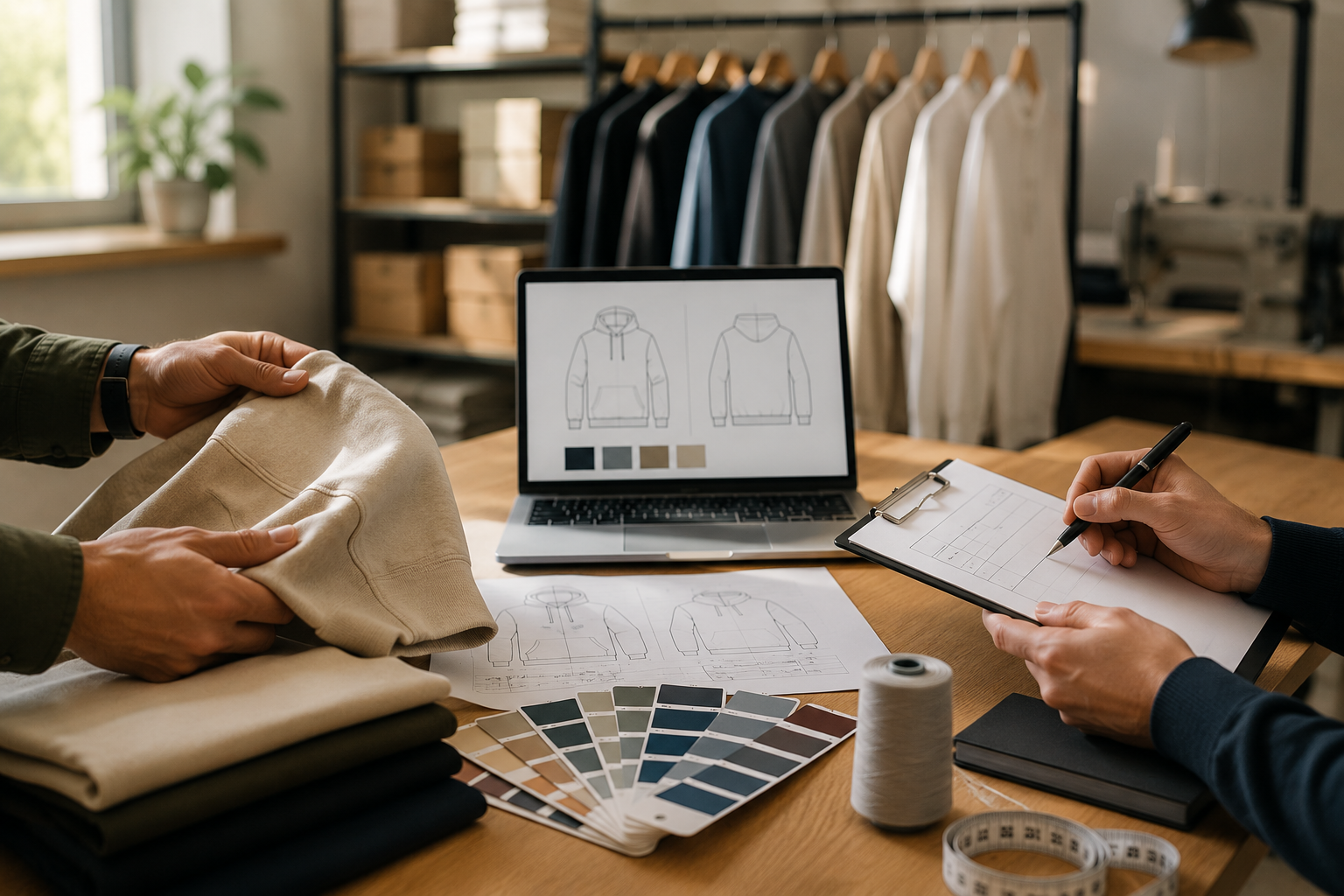
A quote request, often called an RFQ (request for quote), should include your tech pack or brief, target MOQ, target price per unit if you have one, your timeline, and whether you need sampling first. This is the step most brand owners get wrong, and it is the one that determines whether you get a usable quote or a guess.
Send the exact same information to every factory on your shortlist. If one factory gets more detail than another, their quotes will not be comparable, and you will end up choosing based on incomplete data.
The old way to do this is one email at a time, waiting days between replies, then repeating the process for each factory. On Maker’s Row, a marketplace connecting apparel brand owners with verified US manufacturers, you post your project once and multiple manufacturers who match your category and MOQ respond directly with quotes, instead of you tracking down each factory separately.
What Should Be Inside Every Manufacturing Quote?
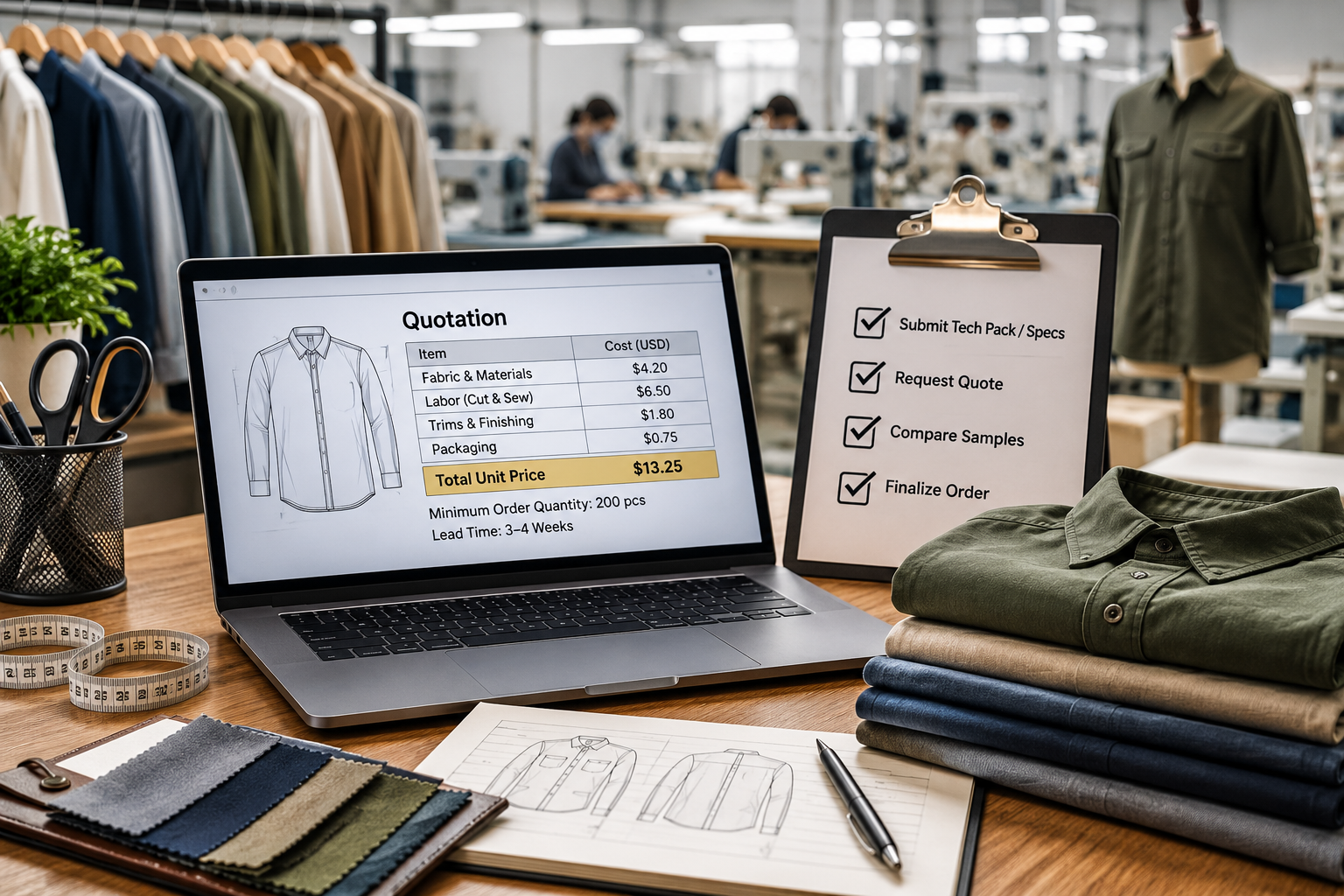
A complete clothing manufacturing quote breaks down into unit cost, one-time sampling and development fees, MOQ terms, and shipping or logistics charges. If a quote arrives as a single number with no breakdown, ask the factory to itemize it before you compare it against anyone else.
Quote Line Item | What It Covers | Typical Range | Ask This If Missing |
Unit cost | Labor, fabric, trims per garment | 15–80 per unit | Is this CMT and materials combined or separate? |
Sample and pattern fees | First pattern draft and sample rounds | 250–700 per style | Is this fee credited toward production? |
MOQ terms | Minimum units per order, per style or per color | 50–500 units | Does MOQ apply per style or per colorway? |
Shipping and logistics | Delivery of finished goods to you | 2–8 per unit domestic | Is this included or billed separately at shipment? |
Payment terms | Deposit required before production starts | 30%–50% upfront | Is the balance due on completion or on shipment? |
A quote missing any of these five items is incomplete. Do not assume a missing line means it does not apply. Ask directly.
How Do You Compare Quotes That Don’t Match Line by Line?
Quotes from different manufacturers rarely use the same format, so compare them by total landed cost per unit at your target volume, not by the headline number alone. A quote that looks cheaper at first glance can end up more expensive once sample fees, MOQ tier, and shipping are added in.
Build a simple side-by-side using the table above as your template: list unit cost, sample fees, MOQ, and shipping for each factory at the same order quantity. If one factory’s MOQ does not match another’s, ask both for pricing at the same volume before you compare, or the numbers are not measuring the same thing.
Price is not the only variable worth weighing. A factory quoting $4 more per unit but offering a two-week faster sample turnaround, or a lower sample fee credited toward production, can be the better deal even at a higher headline price. Read the full breakdown of what drives cost inside a clothing manufacturing quote for more detail on where each line item comes from.
Questions to Ask Before You Accept a Quote
Before you commit to any manufacturer based on their quote, confirm these five things directly:
- Is this quote valid for a fixed period, or can pricing change? Most US quotes stay valid for 30 to 60 days before fabric cost shifts can trigger a revision.
- What happens if my order volume changes before production starts? Ask for pricing at your target volume and one tier above and below it.
- Are sample fees refundable or credited toward my first production run? Policies vary widely between factories.
- What is included in the per-unit price, and what gets billed separately? Confirm trims, labels, and packaging are not hidden add-ons.
- What is the payment schedule, and what triggers each payment? Confirm whether the balance is due on completion or on shipment.
For a longer list of vetting questions beyond pricing, see 30 questions to ask clothing manufacturers before signing anything. The Small Business Administration lists supplier negotiation and contract review among the highest-value skills for a new business owner to build early.
Find Your Manufacturer’s Quote on Maker’s Row
Getting quotes you can actually compare starts with sending every factory the same complete brief at the same time. On Maker’s Row, post your clothing project for free and verified US manufacturers who match your category and MOQ respond directly with itemized bids. Review each quote, compare them side by side, and connect when you are ready to move forward.
FAQs About Getting a Clothing Manufacturing Quote
You need a tech pack or detailed product brief, your target MOQ, your fabric and material specs, and a realistic budget range. Sending all four upfront gets you an accurate quote faster than a follow-up email chain.
Most brand owners request quotes from three to five manufacturers to get a realistic price range without spending weeks managing responses. Fewer than three limits your comparison; more than five becomes difficult to track manually.
A factory with your complete tech pack typically returns a quote within three to seven business days. Incomplete briefs take longer because the factory has to request missing information first.
No, requesting a quote itself is free. Fees only apply once you move into sampling, which typically runs $100 to $300 per piece for pattern making and prototype development.
A complete quote includes unit cost, sample and pattern fees, MOQ terms, and shipping. Some factories itemize each line separately, while others bundle unit cost and list fees below it.
Yes, MOQ, payment terms, and per-unit pricing at higher volumes are usually negotiable. Sample and pattern fees are typically fixed because they reflect real one-time labor.
A quote is an estimate provided before production begins and can still be adjusted. An invoice is issued after the factory confirms your order, with terms that are no longer negotiable.
A tech pack is strongly recommended but not always required for a first conversation. A detailed brief with sketches and fabric references can open the discussion, but a full quote you can rely on needs a complete tech pack.
Your Clothing Brand Is One Quote Away From Production
You now know what a manufacturer needs to price your product accurately, what a complete quote should contain, and how to compare offers that never quite match. The next step is putting that brief in front of manufacturers who can act on it.
Create your project free today, describe your product, MOQ, and timeline, and let verified US manufacturers send you quotes you can actually compare.