A factory that claims ISO 9001 certification and one that can actually produce the paperwork are not the same thing, and that gap is where a lot of brand owners get burned. This guide breaks down the 8 ISO standards that matter most when vetting a US clothing manufacturer, so you know exactly what to ask for.
Vetting a clothing manufacturer usually means asking about MOQ (minimum order quantity), lead time, and price. ISO standards rarely make that list, even though checking for them is one of the fastest ways to confirm a factory runs a documented, auditable process instead of just claiming one. Most brand owners assume they only apply to industrial or medical manufacturing, not apparel.
This guide covers the standards relevant to apparel specifically, written for any brand owner sourcing production in the USA, from a first 100-unit run to an established label switching factories. If you have not shortlisted a factory yet, the guide on how to find a clothing manufacturer in the USA covers vetting criteria beyond certifications. You will learn what each of these ISO standards actually certifies and how to verify a manufacturer’s claim before you sign a production agreement.
1. ISO 9001: Quality Management Systems
ISO 9001 is the international standard for quality management systems, and it is the ISO standard held most widely among US clothing manufacturers. It certifies that a factory has a documented, repeatable process for planning, controlling, and reviewing production.
A factory with ISO 9001 must prove, through a third-party audit typically renewed every three years, that defects get tracked and corrective actions get documented between production runs. According to AAFA, apparel buyers increasingly treat documented quality systems as a baseline expectation rather than a differentiator.
For a small brand, this matters most when scaling past your first run: a factory running ISO 9001 processes should show fewer defect-rate surprises between order 1 and order 10.
2. ISO 14001: Environmental Management Systems
ISO 14001 is the international standard for environmental management systems, certifying that a manufacturer measures and actively reduces waste output, water use, and energy consumption during production.
Apparel manufacturing generates measurable waste at almost every stage, from cutting scraps to dye runoff, and this standard requires a factory to set reduction targets and track them year over year rather than making a one-time claim. The Sustainable Apparel Coalition uses environmental management data like this as an input to its own Higg Index scoring, which many retail buyers now request from suppliers.
If your brand markets itself as sustainable, ask whether ISO 14001 covers the facility producing your garments, not just the parent company’s headquarters.
3. ISO 45001: Occupational Health and Safety Management
ISO 45001 is the international standard for occupational health and safety management systems, requiring manufacturers to identify workplace hazards, set safety targets, and report incidents through a formal system rather than an informal one.
This standard replaced the older OHSAS 18001 in 2021. For a US factory floor running cutting machines, industrial sewing equipment, and pressing stations, it is the ISO standard most directly tied to worker injury rates. BLS data shows apparel manufacturing recorded 1.9 total injury and illness cases per 100 full-time workers in 2024, a rate a factory following this standard should actively work to bring down.
Ask any shortlisted factory for their most recent recordable incident rate. A manufacturer running true ISO 45001 processes should have this number on hand immediately.
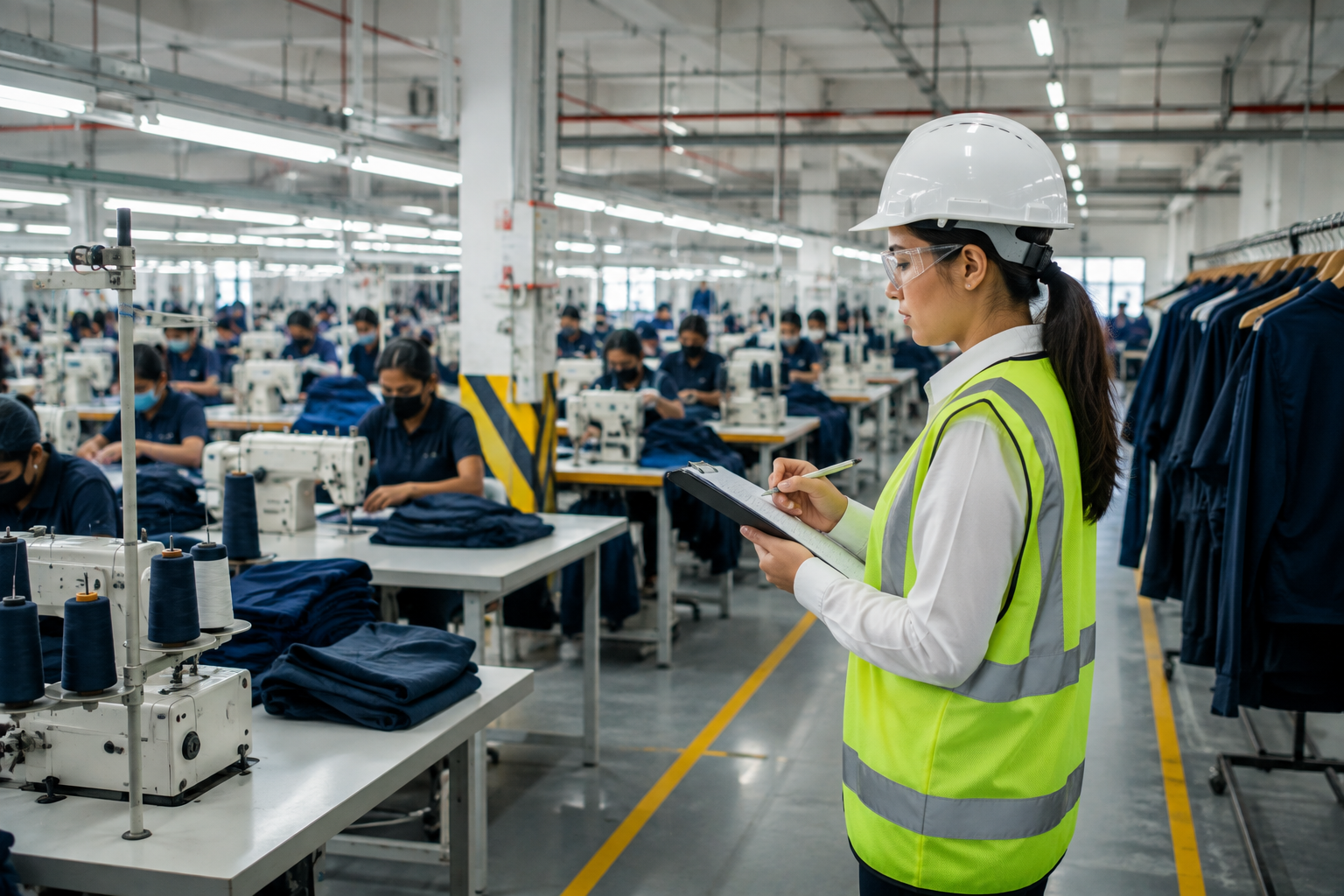
4. ISO 13688: General Requirements for Protective Clothing
ISO 13688 sets the general requirements a garment must meet before it can be classified as protective clothing, covering design, sizing, ergonomics, and labeling that more specific standards then build on.
This one matters if your brand produces workwear, industrial uniforms, or any garment marketed with a protective function. Among the ISO standards on this list, it does not certify a specific hazard on its own; it is the baseline framework that standards like ISO 20471 (below) reference. A manufacturer producing protective apparel should explain how their garments meet this baseline before discussing any specific hazard rating.
5. ISO 20471: High-Visibility Clothing
ISO 20471 is the international standard for high-visibility clothing, specifying the minimum area, placement, and retroreflective performance of fluorescent and reflective materials on a garment.
If your brand produces safety vests, hi-vis workwear, or uniforms for construction, transportation, or utility workers, this is the certification your manufacturer needs, not a general safety claim. Published in 2013, it defines specific visibility classes based on garment coverage area, so ask which class a factory’s garments are rated for, not just whether they are “hi-vis compliant.”
6. ISO 3758: Care Labelling Code
ISO 3758 defines the system of graphic care symbols used on garment labels, specifying how washing, bleaching, drying, and ironing instructions get communicated through standardized icons rather than text.
Of the ISO standards on this list, this is the one brand owners are most likely to get wrong on their own labels, not because a factory failed a certification, but because the artwork was outdated. It was most recently revised in 2023 to align symbols with the European GINETEX system, so confirm your factory’s label supplier is working from the current version before your first production run.

7. ISO 8559: Body Measurements for Garment Sizing
ISO 8559 is the international standard for anthropometric body measurements used in garment sizing, defining a consistent set of body dimensions so “size designation” means the same thing across manufacturers.
Instead of relying on arbitrary S/M/L labels, it ties garment sizing to measurable dimensions like chest girth, waist girth, and hip girth, and specifies which dimensions apply to which garment types. Unlike most ISO standards on this list, this one shapes your product spec directly, so aligning your size charts to it from the start reduces fit inconsistency between production runs.
8. ISO 105: Colorfastness Testing
ISO 105 is a series of standards covering colorfastness testing, measuring how well a fabric’s dye resists fading or bleeding under washing, light exposure, rubbing, and perspiration.
A garment that fails colorfastness typically shows up as a customer complaint, not a defect the brand catches first, which makes this one of the highest-cost ISO standards to skip. Ask which sub-tests (wash fastness, light fastness, and rub fastness are the three most common) your manufacturer runs before bulk dyeing, and request the reports during sample approval, not after production ships.
ISO Standards Comparison Table
Match the ISO standards above to your product category before your next factory call.
ISO Standard | Focus Area | Best For | Applies To |
ISO 9001 | Quality management systems | Any apparel brand | Whole-factory operations |
ISO 14001 | Environmental management | Sustainability-focused brands | Whole-factory operations |
ISO 45001 | Occupational health and safety | Any apparel brand | Whole-factory operations |
ISO 13688 | Protective clothing baseline | Workwear and uniform brands | Product design and labeling |
ISO 20471 | High-visibility clothing | Safety vests, hi-vis workwear | Specific garment category |
ISO 3758 | Care labelling symbols | Every apparel brand | Product labeling |
ISO 8559 | Body measurement sizing | Brands with size-fit issues | Product design and sizing |
ISO 105 | Colorfastness testing | Dyed or printed garments | Fabric and dye testing |
Which ISO Standard Should You Ask About First?
ISO 9001 is the standard to ask about first, because it certifies the quality process every other standard on this list depends on. A factory without a documented quality management system is unlikely to consistently maintain more specialized certifications.
After that, prioritize the ISO standards that map to your product. A swimwear brand does not need to ask about ISO 20471, and a hi-vis workwear brand should treat it as non-negotiable. If certification cost factors into your decision, the SBA recommends weighing compliance investments against the specific market you are selling into, since retail buyers and government contracts carry different requirements than direct-to-consumer sales.
How Do You Verify a Manufacturer’s ISO Certification?
You verify ISO certification by requesting the actual certificate document, which lists the certifying body, certificate number, and expiration date, then checking it against the issuing body’s public registry.
A legitimate certificate is never just a claim on a website or a sales deck. For any of the ISO standards above, confirm the certifying body is an accredited third party, not the manufacturer’s own quality department, and confirm the certificate has not lapsed. For regulated or protective apparel, also request the most recent audit report, since a certificate can stay technically valid while showing unresolved findings.
Also Read: Everything You Need to Know About ISO Certification for Manufacturers →
Also Read: 20 Key Questions to Ask American Clothing Manufacturers →
How Maker’s Row Helps You Find ISO-Compliant Manufacturers
Several of the ISO standards above come down to one thing: finding a manufacturer who can actually document their processes. That is exactly what Maker’s Row, a marketplace connecting apparel brand owners with verified US manufacturers, is built for.
State your certification requirements directly in your project brief, whether that is ISO 9001 for general quality assurance or ISO 20471 for a hi-vis workwear line, and manufacturers who meet those requirements respond directly. This is also where checking a manufacturer’s compliance history and quality control processes becomes faster than cold outreach alone.
FAQs About ISO Standards for Clothing Manufacturers
ISO certification against these standards is not legally required for US clothing manufacturers, but it is increasingly expected by retail buyers who want documented proof of quality, safety, and environmental practices. A manufacturer without certification is not automatically disqualified, but should be able to explain their quality process in detail.
Of all the ISO standards on this list, ISO 9001 is the most broadly important, because it certifies the quality management process underlying consistent production. The rest only matter if your brand produces that specific garment category.
State your required ISO standards in your sourcing brief before contacting factories, rather than asking about it after receiving a quote. Platforms like Maker’s Row let brand owners specify certification requirements directly in a project post, so manufacturers holding them can respond without a lengthy screening process.
Not on its own. ISO 9001 guarantees a manufacturer has a documented, consistent process for managing quality, which reduces variability. Two ISO 9001-certified factories can still produce different outcomes depending on equipment and material sourcing, so treat certification as one input, not the only one.
No. ISO standards are international and voluntary unless a buyer requires them, while CPSC (Consumer Product Safety Commission) compliance is a US federal requirement for categories like children’s clothing. A manufacturer can hold both, and children’s apparel brands need to confirm CPSC compliance separately.
Start Applying These Strategies Today
Your apparel brand is one manufacturer away from becoming real, and the factories that can actually document their ISO standards, not just claim them, are already on Maker’s Row, ready to bid.