You are comparing two diamond studs from a supplier. They look identical, but one costs far less because it is a lab-grown diamond. Is it a real diamond, and can your brand sell it? This guide answers both questions.
A lab-grown diamond is a real diamond that is grown in a lab from carbon instead of being mined. The Gemological Institute of America (GIA) says it has the same crystal structure as a mined stone.
If you are launching a jewelry line, you must choose the stone, write its spec, and describe it correctly. Each choice changes your quote and your legal risk. Below, we cover the definition, types, quality grades, how the stones are made, and how to brief a US factory.
What Is a Lab-Grown Diamond?
A lab-grown diamond is a diamond grown in a controlled lab, made of tightly bonded carbon with the same crystal structure as a mined diamond. For jewelry brands, this means the stone is a diamond, but you must say how it was made.
Let’s separate it from look-alikes. A diamond simulant is a different material, such as glass, moissanite, or cubic zirconia, that only resembles a diamond. GIA lists glass, moissanite, and cubic zirconia as simulants, not diamonds.
Lab-grown diamond | Mined diamond | Diamond simulant | |
Material | Carbon, diamond crystal | Carbon, diamond crystal | Glass, moissanite, or cubic zirconia |
Where it forms | Lab press or reactor | Earth, over millions to billions of years | Lab or factory |
Is it a diamond? | Yes | Yes | No |
FTC labeling | Qualifier such as “laboratory-grown” before “diamond” | No qualifier | Qualifier such as “simulated” or “imitation” |
In July 2018, the Federal Trade Commission (FTC) removed “natural” from its definition of a diamond. Trade press reported the change from the FTC’s own statement. It put lab-grown stones inside the definition, but sellers must still disclose where each stone came from.
Why Does a Lab-Grown Diamond Matter for Your Brand?
A diamond grown in a lab changes your stone cost, your spec sheet, and the words you may use in a listing. Four decisions depend on that:
- Stone cost. Lab-grown stones usually cost less than mined stones of the same size and grade. Business of Fashion has reported that their prices have fallen faster than mined prices, so get a dated quote.
- Spec clarity. Naming the growth method and report lab lets every factory bid on the same stone.
- Legal exposure. In March 2019, the FTC sent letters to eight jewelry sellers whose disclosures sat in hashtags or on FAQ pages.
- Customer trust. Shoppers will ask whether the stone is real. A report number and a girdle inscription give you proof.
What Are the Types of Lab-Grown Diamond?
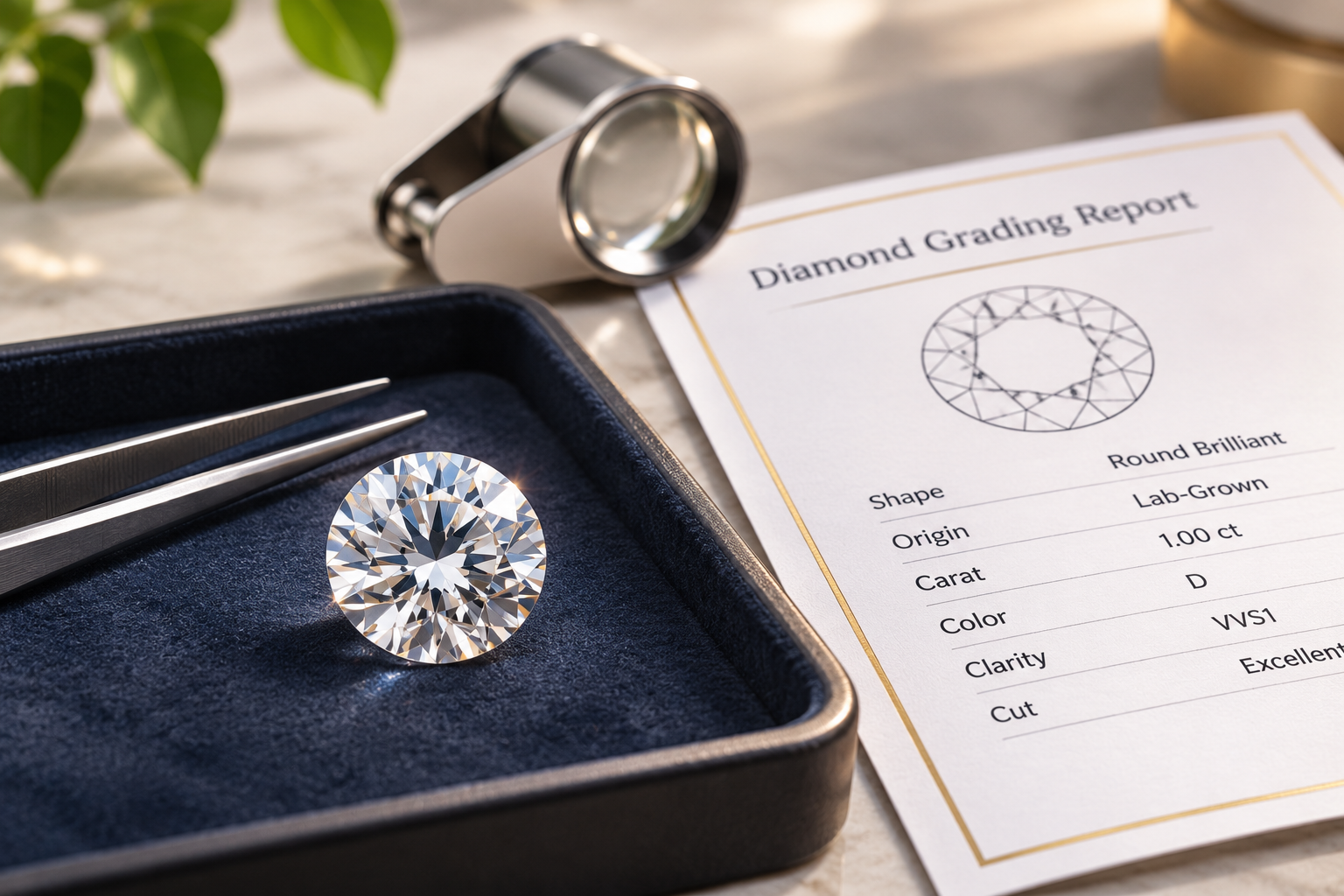
Lab-grown stones come in two main types, named for their growth method: HPHT and CVD. HPHT (high-pressure, high-temperature) growth heats a capsule holding a carbon source and a metal mixture under extreme pressure. CVD (chemical vapor deposition) growth builds a diamond layer by layer from a gas plasma at near-vacuum pressure.
HPHT | CVD | |
Conditions (GIA) | About 1,300 to 1,600°C (2,400 to 2,900°F) at 5 to 6 GPa (gigapascals) | Near-vacuum, about 700 to 1,200°C (1,300 to 2,200°F) |
Carbon source | Carbon source and metal mixture in a capsule | Microwave-activated gas plasma settling on diamond seeds |
Final size set by | Growth time and capsule volume | Seed size and growth time |
GIA’s 2024 view | Original method for gem-quality stones | Dominates the stones GIA grades |
Both methods make real diamonds. In its Summer 2024 update, GIA said most CVD stones it grades also get post-growth treatment, an HPHT heating step that removes color. Ask suppliers to state the growth method and any treatment on the report, so every factory quotes the same stone.
You will also see two color families. Colorless to near-colorless stones suit classic jewelry, while fancy-colored stones suit statement pieces. GIA reports fancy colors separately.
How Is Lab-Grown Diamond Quality Graded?
Independent labs grade lab-grown stones on the 4Cs, but since October 1, 2025, GIA reports “Premium” or “Standard” instead of letter grades. The 4Cs are carat weight, color, clarity, and cut, the four factors that set a diamond’s quality. GIA gives no assessment to stones below its Standard minimums.
GIA criterion (from October 1, 2025) | Premium | Standard |
Color | D | E to J |
Clarity | Very, Very Slightly Included or better | Very Slightly Included or better |
Polish | Excellent | Very Good |
Symmetry | Excellent | Very Good (Good for fancy shapes) |
Cut (round brilliants only) | Excellent | Very Good |
The International Gemological Institute (IGI) has said it will keep applying the 4Cs to both natural and lab-grown stones. So ask which lab issued the report, because the two labs describe quality differently. The simplest rule is to compare reports from the same lab only.
A laser inscription is a tiny mark on the stone’s girdle, its thin outer edge, that carries its report number and a lab-grown statement. GIA inscribes “Laboratory-Grown” plus a quality assessment number. GIA accepts stones from 0.15 carat, so smaller accent stones cannot carry a GIA assessment.
How Is a Lab-Grown Diamond Made?
Five steps turn carbon into a finished stone: growth, optional treatment, cutting and polishing, grading, and setting in jewelry. GIA notes that final size depends on growth time.
- Grow the crystal. A lab runs the HPHT or CVD process described above.
- Treat if needed. Many CVD stones get HPHT heating to remove color.
- Cut and polish. A cutter shapes the rough crystal into a faceted stone, such as a round brilliant, the classic round cut.
- Grade and inscribe. A lab such as GIA or IGI reports on the stone and laser-inscribes it.
- Set the stone. Your jewelry manufacturer mounts it in metal, and setting stones is part of hand finishing.
Lab-Grown Diamond in Practice: Real Examples
Three jewelry orders show how stone choices change cost, listing wording, and quality checks. All three are illustrations built from example inputs, not client cases.
Example: A Los Angeles stud order. A Los Angeles brand plans 60 pairs of studs, each ear holding one 0.25 carat round stone. That is 120 stones and 30 total carats (120 × 0.25). Each stone clears GIA’s 0.15 carat minimum, so the brand asks for report numbers and matched pairs.
Example: A Brooklyn listing rewrite. A Brooklyn brand titles a product “eco-friendly diamond studs #labgrowndiamonds.” The FTC’s 2019 letters called hashtags insufficient and flagged unqualified eco claims. The brand retitles it “Laboratory-Grown Diamond Studs” and drops the eco claim.
Example: A Chicago pendant check. A Chicago brand orders 25 pendants with one 0.50 carat stone each, or 12.5 carats in total (25 × 0.5). Before setting, the factory matches each girdle inscription to its report number. A mismatch sends that stone back to the supplier.
How Do You Use a Lab-Grown Diamond in Your Jewelry Line?
You use a lab-grown stone by writing one clear stone spec, requiring a report, and disclosing its origin in every listing. Six steps get you there:
- Pick the stone’s job. Decide whether it is a center stone or an accent, and set a target carat weight per piece.
- Write the stone spec. List shape, carat, color, clarity, cut, growth method, and whether post-growth treatment is allowed.
- Require a report. Ask for a GIA or IGI report and a matching girdle inscription on every center stone. If you need a stone source, read our guide to choosing wholesale jewelry suppliers.
- Vet the factory. Ask who sets stones and who pays for a stone chipped in setting. Review its material sourcing policies too.
- Disclose in every listing. Put “laboratory-grown” directly before “diamond” in titles, descriptions, and ads. The FTC’s 2019 diamond advertising letters say a disclosure should sit next to the name, not only on a separate page. Skip “eco-friendly” unless you can prove a specific benefit under the FTC’s Green Guides.
- Order a sample first. Check the stone against its report before you approve bulk production.
Also Read: The Secret to Quality: How Manufacturing Jewelers Work →
Lab-Grown Diamond on Maker’s Row
Maker’s Row is a marketplace connecting brand owners with verified US manufacturers. State your stone spec in the project brief, and each factory bids on the same stone.
Finding the right jewelry manufacturer does not have to mean months of cold emails. On Maker’s Row, post your jewelry project for free and verified US manufacturers bid directly. Review bids, check profiles, connect when ready.
Posting a project costs nothing, and bids from verified US factories arrive at no upfront cost. Replying to a factory and searching profiles need a paid subscription plan.
Maker’s Row connects you with manufacturers, so confirm with each factory whether it sources stones or sets stones you supply. A private-label manufacturer makes finished pieces that you sell under your own brand name. A private-label jewelry manufacturer can handle production through packaging. Our roundup of the best jewelry manufacturers in the USA shows who to compare first.
FAQs About Lab-Grown Diamond
These six answers cover the questions brand owners ask most.
Yes, it is a real diamond. GIA says it has the same crystal structure as a natural diamond, with nearly identical chemical, optical, and physical properties. The difference is origin, so you still disclose it.
The difference is how each formed. A natural diamond forms in the Earth over millions to billions of years, according to GIA. A lab grows its counterpart in a press or reactor. Price, reports, and labeling follow from that origin.
Not reliably by eye. GIA says growth history is the key difference, and it uses advanced instruments to detect it. For your brand, the practical proof is the lab report and the matching laser inscription.
No, moissanite and cubic zirconia are simulants made of other materials. GIA separates them from diamonds, which are made of carbon. Label each stone as what it is.
Usually yes. Business of Fashion has reported that lab-grown prices have fallen faster than mined prices. Prices keep moving, so ask each supplier for a dated written quote.
Use “laboratory-grown” or “laboratory-created” directly before the word “diamond,” in equal prominence. The FTC’s 2019 letters say company names and hashtags do not count as disclosure. Put the wording in the title and description, not only on a separate page.
Ready to Put a Lab-Grown Diamond Into Practice?
Your jewelry brand is one manufacturer away from becoming real. The factories are on Maker’s Row, ready to bid.