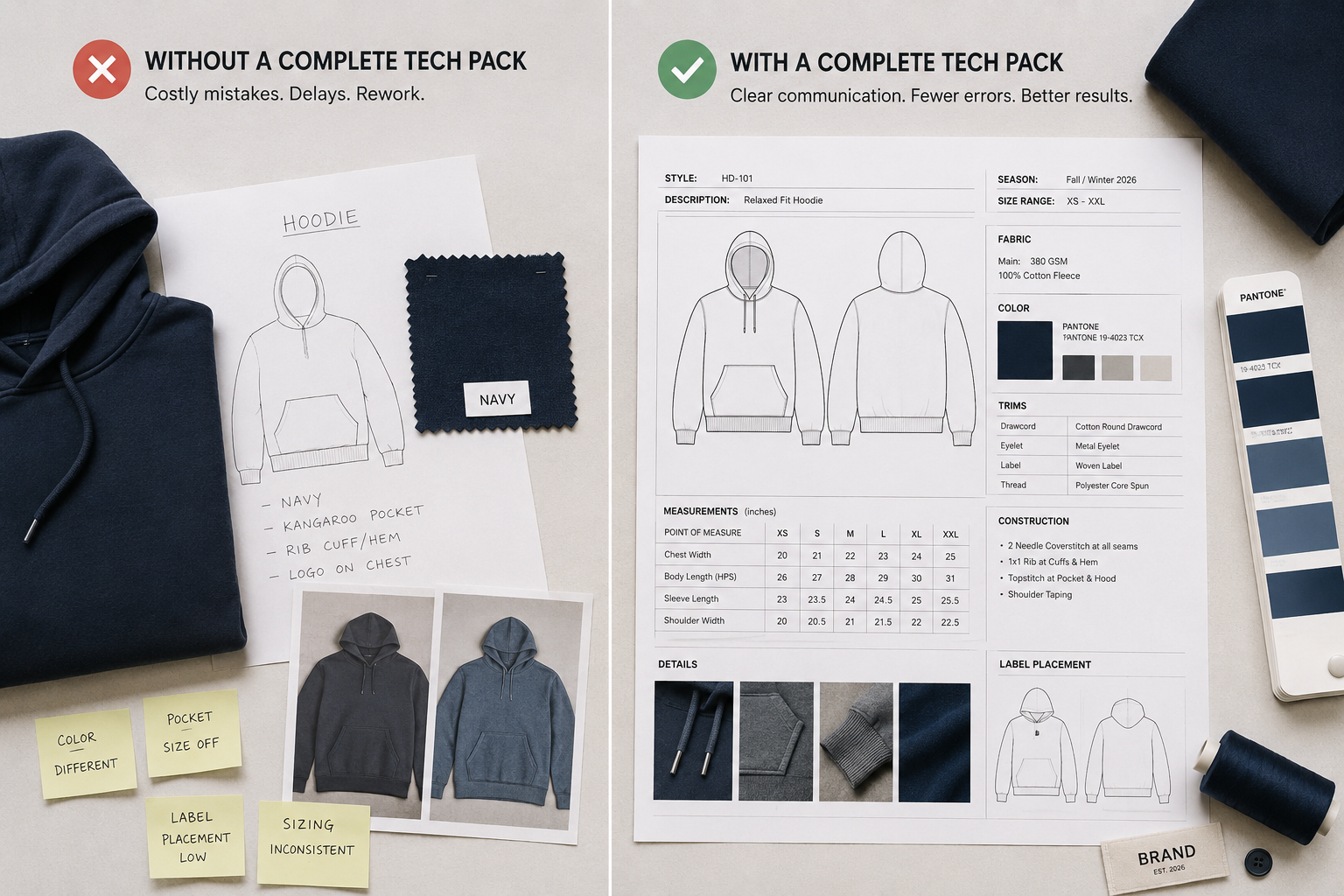
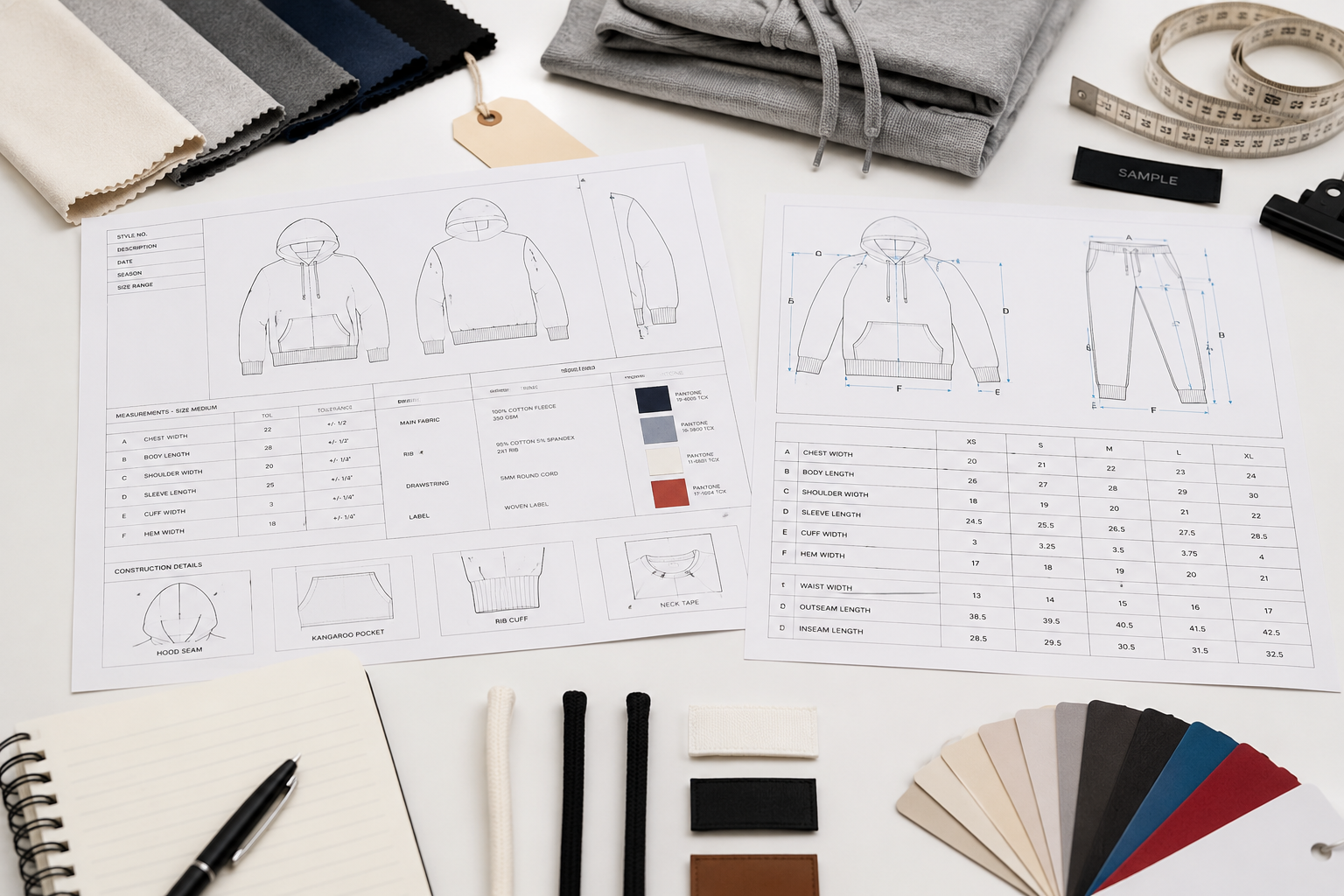
You have finally found a manufacturer you want to work with. Their samples look great. Their MOQ fits your budget. Then they ask for your tech pack — and everything stalls. If you are new to clothing manufacturing, that request can feel like a wall. This guide explains exactly what a tech pack clothing brands need looks like, what goes inside one, and how to create yours before you approach a single factory.
A tech pack is a detailed document that tells a manufacturer everything they need to produce your garment correctly. For clothing brands, this means fewer bad samples, faster production timelines, and significantly less money lost to miscommunication.
In this guide, you will learn what a tech pack includes, why manufacturers require it, how to build one from scratch, and what to do once yours is ready.
What is a Tech Pack for Clothing?
A tech pack is a complete technical specification document that communicates every detail of a garment to a manufacturer. For clothing brands, this means the difference between getting exactly what you designed and receiving a product that misses the mark in ways that cost real money.
Think of it the way you would think of an architect’s blueprint. Architects do not hand a builder a rough sketch and say “figure it out.” You should not hand a manufacturer a mood board and expect a finished garment. The more complete the tech pack clothing manufacturers receive, the closer your first sample is to your vision.
Tech Pack Component | What It Communicates |
Technical sketches | Exact garment shape, front and back |
Measurements / size spec | Graded measurements for each size |
Materials and trims | Fabric type, weight, color codes, hardware |
Construction details | Stitch type, seam allowance, finish |
Colorways | Pantone or exact dye references |
Labels and branding | Placement, size, content of all tags |
Quality standards | Accepted tolerances for fit and finish |
According to the American Apparel and Footwear Association, sampling errors and production miscommunication are among the top causes of delayed product launches for emerging brands. A complete tech pack eliminates most of those gaps before they start.
Why Tech Packs Matter for Brand Owners
Tech packs are not bureaucracy. They are protection. Here is what changes when you have one:
- Factories take you seriously. A brand that arrives with a complete tech pack signals professionalism. Factories know the project will run smoothly. You get better response rates, faster quotes, and more accurate pricing.
- Samples land closer on the first try. Every missing detail in your brief is a decision the factory makes for you, often wrong. A tech pack removes ambiguity and reduces the number of sample rounds you pay for.
- You can compare quotes accurately. Without a tech pack, two different factories might quote the same product using different materials, stitch counts, or finishes. With one, every quote is for the exact same product.
- You own the IP. A tech pack documents your design. If you ever need to switch manufacturers, you take the document with you. The factory does not own your product — you do.
Tech Pack Components: Real Examples
Example: The Missing Measurement Sheet
A Los Angeles swimwear brand spent $2,400 on three sample rounds because their initial brief did not include a graded spec sheet. Each round came back with different hip measurements. Once they provided a full measurement table with a size run from XS to XL, the fourth sample was production-ready. The issue was not the factory. It was the missing document.


You have finally found a manufacturer you want to work with. Their samples look great. Their MOQ fits your budget. Then they ask for your tech pack — and everything stalls. If you are new to clothing manufacturing, that request can feel like a wall. This guide explains exactly what a tech pack clothing brands need looks like, what goes inside one, and how to create yours before you approach a single factory.
A tech pack is a detailed document that tells a manufacturer everything they need to produce your garment correctly. For clothing brands, this means fewer bad samples, faster production timelines, and significantly less money lost to miscommunication.
In this guide, you will learn what a tech pack includes, why manufacturers require it, how to build one from scratch, and what to do once yours is ready.
What is a Tech Pack for Clothing?
A tech pack is a complete technical specification document that communicates every detail of a garment to a manufacturer. For clothing brands, this means the difference between getting exactly what you designed and receiving a product that misses the mark in ways that cost real money.
Think of it the way you would think of an architect’s blueprint. Architects do not hand a builder a rough sketch and say “figure it out.” You should not hand a manufacturer a mood board and expect a finished garment. The more complete the tech pack clothing manufacturers receive, the closer your first sample is to your vision.
Tech Pack Component | What It Communicates |
Technical sketches | Exact garment shape, front and back |
Measurements / size spec | Graded measurements for each size |
Materials and trims | Fabric type, weight, color codes, hardware |
Construction details | Stitch type, seam allowance, finish |
Colorways | Pantone or exact dye references |
Labels and branding | Placement, size, content of all tags |
Quality standards | Accepted tolerances for fit and finish |
According to the American Apparel and Footwear Association, sampling errors and production miscommunication are among the top causes of delayed product launches for emerging brands. A complete tech pack eliminates most of those gaps before they start.
Why Tech Packs Matter for Brand Owners
Tech packs are not bureaucracy. They are protection. Here is what changes when you have one:
- Factories take you seriously. A brand that arrives with a complete tech pack signals professionalism. Factories know the project will run smoothly. You get better response rates, faster quotes, and more accurate pricing.
- Samples land closer on the first try. Every missing detail in your brief is a decision the factory makes for you, often wrong. A tech pack removes ambiguity and reduces the number of sample rounds you pay for.
- You can compare quotes accurately. Without a tech pack, two different factories might quote the same product using different materials, stitch counts, or finishes. With one, every quote is for the exact same product.
- You own the IP. A tech pack documents your design. If you ever need to switch manufacturers, you take the document with you. The factory does not own your product — you do.
Tech Pack Components: Real Examples
Example: The Missing Measurement Sheet
A Los Angeles swimwear brand spent $2,400 on three sample rounds because their initial brief did not include a graded spec sheet. Each round came back with different hip measurements. Once they provided a full measurement table with a size run from XS to XL, the fourth sample was production-ready. The issue was not the factory. It was the missing document.


Example: No Colorway Reference
A Brooklyn-based basics brand launched a two-color hoodie line. The manufacturer used a close-but-not-exact navy that looked noticeably different from the brand’s hero color when photographed. The brand had not included a Pantone reference in their tech pack. Correcting it required a reorder. A single Pantone number in the original document would have prevented the mistake entirely.
Example: Label Placement Not Specified
A Chicago streetwear brand found their woven labels positioned 1.5 inches too low on the neckline after their first production run of 300 units. Nothing in their brief specified exact placement coordinates. A tech pack with a label placement diagram, showing precise measurements from seam to center of label, eliminates this class of error entirely.
How to Create a Tech Pack for Your Brand
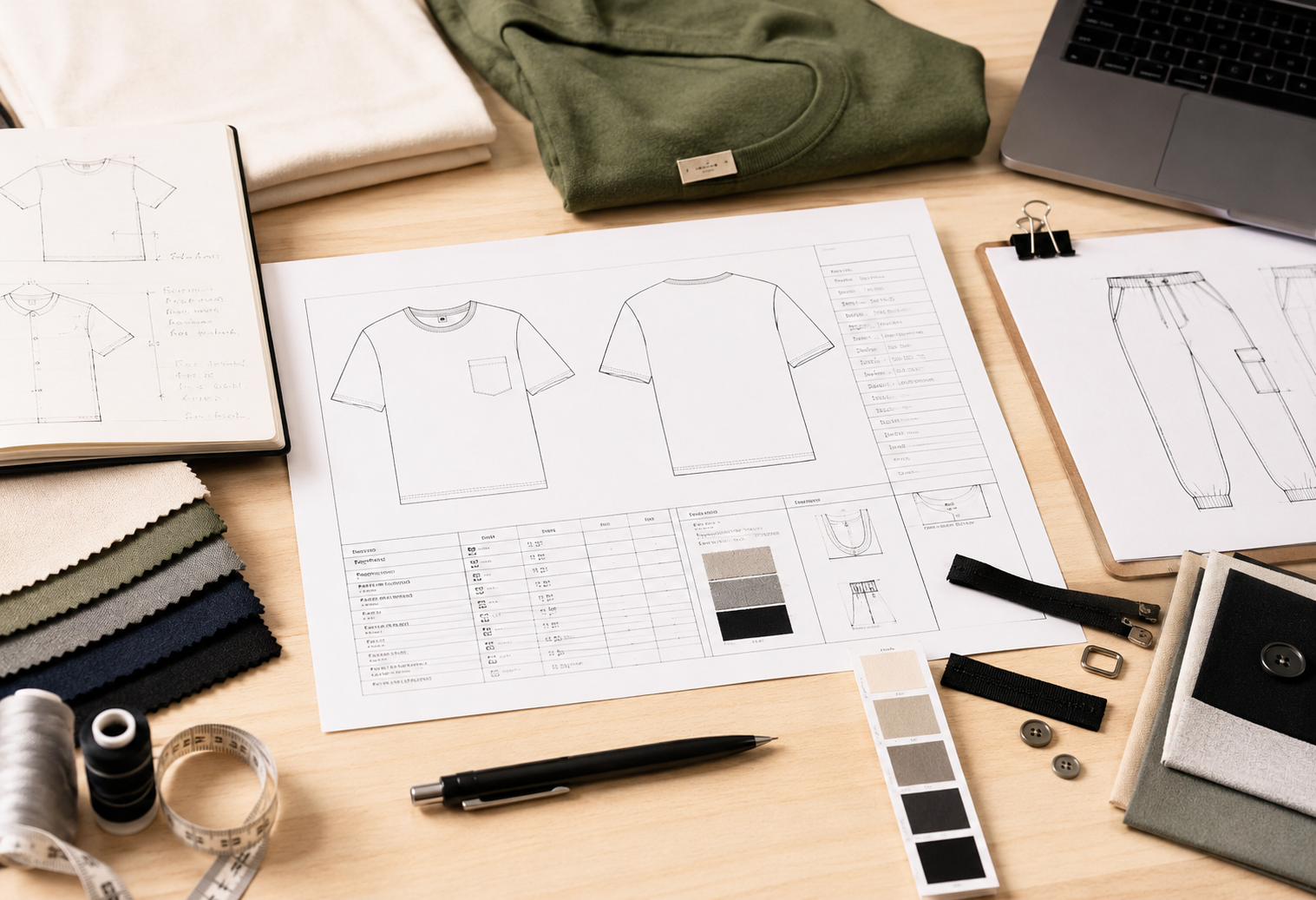
Before you hand off a tech pack clothing factories can actually act on, work through these six steps. You do not need expensive software. You need accuracy.
Step 1: Start with a technical flat sketch. A flat sketch is a 2D drawing of your garment showing the front and back. It does not need to be artistic. It needs to be accurate. Use Adobe Illustrator if you have access to it. If not, hire a freelance technical designer on a per-project basis. Many charge between $50 and $150 per garment for a single tech pack flat.
Step 2: Build your measurement spec sheet. List every measurement that matters for your garment: chest width, body length, sleeve length, armhole circumference, inseam, and so on. Then grade these measurements across your full size run. The AAFA size standards are a useful reference point for US sizing conventions.
Step 3: Specify every material and trim. Name your fabric precisely. “100% cotton jersey” is not enough. Include weight (180gsm, for example), knit type (single jersey vs. interlock), and any certifications required. List every trim: zipper style and length, button size and material, drawcord composition, label content. Use Pantone color references for all colorways.
Step 4: Document construction details. State your stitch type per seam. Specify seam allowance. Note finishing requirements at hems, cuffs, and necklines. If you require flatlock stitching, say so explicitly. If you need a specific thread color, include it.
Step 5: Add label and branding specifications. Diagram the exact placement of every label: main label, care label, size label, hang tag anchor. Provide artwork files for all printed or woven labels. Specify placement in millimeters from reference seams.
Step 6: Define your quality standards. State the tolerance you will accept on key measurements. A common standard is plus or minus 0.5 inches on body measurements. Include pilling, color fastness, and wash test requirements that align with what you will communicate to your customer.
The Small Business Administration recommends that new product businesses document all supplier specifications before sourcing, precisely because it reduces disputes and accelerates production timelines.
Also Read: Are You Ready for a Manufacturer? Clothing Manufacturer Readiness Checklist →

Tech Pack Clothing Manufacturers on Maker’s Row
Finding the right manufacturer is easier when your tech pack is ready to share. On Maker’s Row, brand owners post unlimited manufacturing projects for free and receive bids from verified US manufacturers at no upfront cost. To connect directly, subscription plans give full access.
Describe your product in your project brief, attach the tech pack clothing manufacturers need to quote accurately, and specify your size run, materials, and target MOQ. Manufacturers who work with your garment type respond directly, often within 24–48 hours. No months of cold outreach. No guessing whether a factory works at your scale.
FAQs About Tech Pack Clothing
A tech pack clothing manufacturers work from is a technical specification document that tells a factory exactly how to produce your garment. It includes sketches, measurements, materials, construction details, colorways, and label placement. Factories use it to quote accurately and produce samples that match your design.
Yes. Most professional US manufacturers require or strongly prefer a tech pack before providing a quote. Without one, they cannot price the job accurately, and your samples are likely to miss the mark. A basic tech pack — even a simple flat sketch with a measurements and materials list — is better than no documentation at all.
A freelance technical designer typically charges between $50 and $250 per tech pack depending on garment complexity. Some design agencies offer packages for a full set including graded spec sheets. If you use software like Adobe Illustrator yourself, your cost is time only. Some brands use spreadsheet templates for the specification sections and commission only the flat sketches.
Yes. The specification sections of a tech pack — measurements, materials, construction notes, label placement — can be completed in a spreadsheet or word processor. The technical sketches are the one area where having a designer helps, but even a clear hand-drawn flat can work for an initial sample round with a communicative factory.
A spec sheet is one component of a tech pack. It covers measurements and sizing only. A full tech pack clothing document includes the spec sheet plus sketches, materials lists, colorways, construction details, and branding documentation. Some factories use the terms interchangeably for simple products, but for any garment with trims or multiple components, a full tech pack is expected.
Manufacturers use your tech pack to cost the job, source materials, build a production pattern, and produce your first sample. Their production team refers back to it throughout manufacturing. Any ambiguity in the document becomes a decision they make without you, which is why completeness matters.
An incomplete tech pack leads to assumptions. The factory fills in the gaps with what they have available or what is easiest for them. That usually means the wrong fabric weight, the wrong button, or a measurement that fits their block pattern rather than your design. You pay for sample corrections that a complete tech pack clothing brands send upfront would have prevented.
Ready to Put Your Tech Pack Into Practice?
Your clothing brand is one manufacturer away from becoming real. The factories are on Maker’s Row, ready to bid on your project. Attach your tech pack, describe your product, and let verified US manufacturers come to you.
