Finding a reliable vintage clothing manufacturer in the USA should not take months of dead-end emails and manufacturers who ghost you after the first inquiry. Most brand owners building a retro or heritage aesthetic spend weeks searching, only to find factories that work with massive minimums or do not understand garment-dyed, distressed, or period-accurate construction. This guide cuts through the noise.
Vintage clothing manufacturers are not the same as standard cut-and-sew factories. Building a successful retro brand means finding a production partner who understands garment dyeing, enzyme washing, intentional distressing, and the specific silhouettes that make a piece read as authentic rather than costume. The wrong factory produces pieces that look flat and dated for the wrong reasons.
According to market intelligence firm Precedence Research, the global vintage apparel market was valued at approximately $14.7 billion in 2024 and is projected to grow at a CAGR of 11.2% through 2033. North America holds roughly 38% of that global revenue. That growth is creating real demand for production capacity, and brand owners who move early have a first-mover advantage in their niche.
If you already know your requirements, Start Your Free Project, and verified vintage clothing manufacturers will respond directly.
What to Look for in a Vintage Clothing Manufacturer
The best vintage clothing manufacturers for your brand will have at least a few of these capabilities in-house or through trusted partners:
- Garment dyeing and washing: Vintage aesthetics depend on how the fabric behaves after construction. Factories that dye and wash after sewing produce a truer vintage feel than those applying color to raw fabric before cutting.
- Distressing and specialty finishing: Hand distressing, enzyme washing, and overdyeing require specific equipment and skilled labor. Confirm these capabilities before sampling.
- MOQ flexibility: Retro and heritage brands often launch small. Look for vintage clothing manufacturers in the USA with MOQs of 50–150 units per style, which is realistic for a new brand testing an aesthetic.
- Silhouette knowledge: Boxy 1990s fits, 1970s wide-leg cuts, and 1950s high-waisted silhouettes require pattern makers who understand historical garment construction. Ask to see portfolio samples.
Sample policy: Request a paid sample before committing to any production run. A factory confident in its quality will not hesitate.
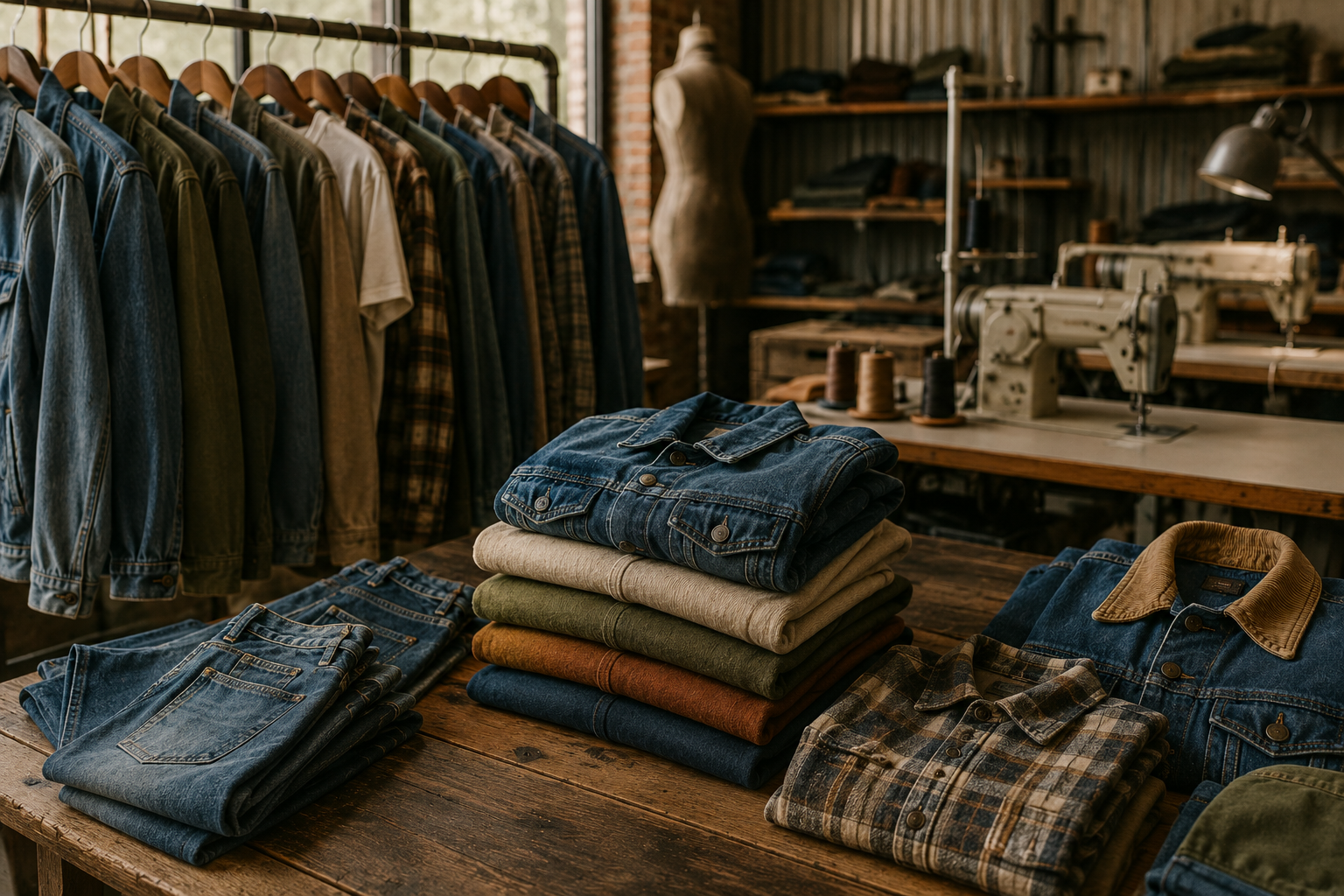
Best Vintage Clothing Manufacturers in the USA (2026)
1. American Apparel (Genus Apparel)
Location: Los Angeles, CA MOQ: 200 units per style (private label); lower for blanks programs Speciality: Heavyweight knits, garment-dyed basics, vintage-inspired silhouettes Best for: Vintage basics brands, collegiate-aesthetic labels, brands targeting the made-in-USA market
Originally known for ethically produced basics with a retro-leaning aesthetic, the Genus-operated American Apparel production operation in Los Angeles continues to produce cut-and-sew knitwear with a heritage sensibility. Their garment-dye program and heavyweight fleece capability make them a natural starting point for brands that want a lived-in, faded-look aesthetic without chasing overseas production.
2. Comfort Colors (Blanks Supply, Domestic Finishing)
Location: South Carolina (domestic finishing via print partners) MOQ: No hard minimum on blanks; custom programs start at 144 units Speciality: Garment-dyed pigment-washed blanks in heavyweight cotton Best for: Vintage-wash graphic tee brands, streetwear labels with a retro color palette
Comfort Colors produces pigment-dyed, garment-washed blanks that have become the standard reference for any brand chasing the authentic vintage-fade aesthetic. Their ring-spun heavyweight cotton softens and fades exactly as expected through wear and washing. Note: Comfort Colors blanks are finished in the USA but sewn offshore. If Made in USA labeling is a brand requirement, combine Comfort Colors with a domestic decorating partner or move to a full-cut-and-sew option.
3. Bayside Apparel
Location: Los Angeles, CA MOQ: 72–144 units for custom programs; blanks available at lower quantities Speciality: Union-made knitwear, 100% USA-manufactured from fiber to finished garment Best for: Brands requiring full Made in USA chain of custody, heritage workwear-inspired labels
Bayside Apparel manufactures entirely in the USA and holds union-made certification. For a vintage clothing brand that wants a genuine “made in America” story at every step of production, Bayside is the strongest option in the knitwear category. Their heavyweight ring-spun cotton and fleece blanks are especially suited to brands building a workwear-inspired or Americana aesthetic.
4. TEG (The Evans Group)
Location: Los Angeles, CA MOQ: 50 units minimum per style Speciality: Cut-and-sew, wovens, specialty finishing, small-run production Best for: Independent vintage brands testing silhouettes, retro woven tops and bottoms
TEG operates as a full-service cut-and-sew manufacturer in LA with experienced pattern makers who regularly work on heritage and fashion-forward silhouettes. Their 50-unit MOQ makes them accessible for a brand that wants to test a 1970s wide-leg trouser or an oversized 1990s flannel before committing to a larger run. TEG’s in-house pattern making is a significant advantage for vintage brands where fit and proportion are central to the brand identity.
5. Good Clothing Company
Location: Boston, MA MOQ: 25 units minimum per style Speciality: Low-MOQ cut-and-sew, ethical production, wovens and knits Best for: Emerging vintage brands, capsule collections, sustainable retro labels
Good Clothing Company has one of the lowest MOQs among USA-based full-service manufacturers, making it a realistic option for a vintage clothing brand at the proof-of-concept stage. Their team works with emerging brands on pattern development and sampling. For a retro-inspired brand building its first seasonal capsule at small quantities, Good Clothing is worth prioritizing in your outreach.
6. Delta Galil (Delta Apparel — US Operations)
Location: Georgia (manufacturing), with domestic distribution MOQ: 500+ units for private label programs Speciality: Knit basics, private label programs, high-volume garment-dyed production Best for: Scaling vintage basics brands, established labels moving into broader distribution
Delta Apparel runs one of the most established private label knitwear programs in the USA, with production infrastructure suited for brands that have graduated past the sampling stage and are ready to scale. Their garment-dyed and pigment-washed capabilities are well-suited to a vintage aesthetic at volume. MOQs are higher than emerging-brand options, making Delta Galil the right fit once your vintage brand has validated its hero products.
7. Los Angeles Apparel
Location: Los Angeles, CA MOQ: 24 pieces per color for blanks; custom cut-and-sew programs start higher Speciality: Heavyweight cotton, garment-dyed blanks, ethical manufacturing Best for: Vintage-aesthetic streetwear brands, Made in LA brands, brands emphasizing ethical production story
Los Angeles Apparel produces heavyweight ring-spun cotton basics in-house in their LA facility with a strong emphasis on domestic manufacturing and ethical wages. Their garment-dyed program uses a range of earth-tone and washed colors that work naturally for a vintage aesthetic. Blanks are available at lower quantities, making them accessible for a new brand testing colorways before committing to custom production.
Vintage Clothing Manufacturer Comparison Table
Manufacturer | Location | MOQ | Speciality | Best For |
American Apparel (Genus) | Los Angeles, CA | 200 units | Garment-dyed knits, vintage silhouettes | Made-in-USA basics brands |
Comfort Colors | SC / domestic finishing | 144 units (custom) | Pigment-washed garment-dyed blanks | Vintage-wash graphic tees |
Bayside Apparel | Los Angeles, CA | 72 units | Union-made USA knitwear | Full Made in USA brands |
TEG (The Evans Group) | Los Angeles, CA | 50 units | Cut-and-sew, wovens, specialty finishing | Heritage silhouette testing |
Good Clothing Company | Boston, MA | 25 units | Low-MOQ cut-and-sew, ethical | Capsule collections, early-stage brands |
Delta Galil / Delta Apparel | Georgia | 500 units | High-volume private label | Scaling vintage basics |
Los Angeles Apparel | Los Angeles, CA | 24 units (blanks) | Heavyweight cotton, garment-dyed | Ethical LA-made streetwear |
Choosing between these vintage clothing manufacturers means weeks of emails, waitlists, and sample rounds. The faster path is letting the right manufacturers come to you.
Find Vintage Clothing Manufacturers on Maker’s Row
Finding the right vintage clothing manufacturer does not have to mean months of cold emails. On Maker’s Row, post your vintage clothing project for free and verified US manufacturers bid directly. Review bids, check profiles, connect when ready.
Most vintage brand owners spend their early weeks trying to identify which factories understand garment dyeing, heritage silhouettes, and specialty finishing. On Maker’s Row, you describe exactly what your brand requires in your project brief and manufacturers who specialize in that process respond directly. You review bids on your timeline, with full profile information and portfolio work visible before you reply.
According to the American Apparel and Footwear Association (AAFA), the US apparel and footwear industry supports more than 3.6 million American workers and contributes over $523 billion in annual retail sales. A meaningful share of that production capacity is available to independent brands today through platforms designed to connect them directly.
How to Choose the Right Manufacturer for Your Brand
Not every vintage clothing manufacturer on this list is the right fit for your brand at this stage. Work through these five questions before reaching out:
- Define your MOQ and budget before outreach. A factory with a 500-unit minimum is not the right partner for a 50-unit test run. Know your numbers before your first email.
- Request samples before committing to production. This is especially critical for vintage clothing, where the wash, distress, and fade results are what your customers are buying. Two factories quoted at the same price can produce dramatically different results.
- Ask about lead times for sampling separately from production. Garment-dyed and specialty-finished styles take longer to sample because the wash and finishing steps add time. Get both timelines in writing.
- Verify finishing capabilities in detail. Ask directly: do they garment-dye in-house, do they outsource washing, and who performs any hand-distressing? Each step that leaves the factory adds lead time and quality variables.
- Start with a small test order before scaling. A vintage brand’s success depends on the product performing exactly as expected through customer washes and wears. A small first production run at 50–100 units per style reduces your financial exposure while you validate quality.
FAQs About Vintage Clothing Manufacturing in the USA
Most vintage clothing manufacturers in the USA set MOQs between 25 and 200 units per style, depending on the production method. Blank-based programs with garment dyeing tend to run lower minimums. Full custom cut-and-sew with specialty finishing typically starts at 50–150 units. Factories with advanced garment-dye equipment may require 200 or more units to run a full dye lot.
Sampling turnaround for vintage clothing manufacturers in the USA typically runs 3–6 weeks for standard cut-and-sew styles. Garment-dyed or specialty-washed styles add 1–2 weeks for the wash and finishing phase. Distressed styles with manual finishing can take longer. Always request a firm sample timeline in your first manufacturer conversation.
Manufacturing costs vary based on construction method, fabric weight, and finishing complexity. A basic garment-dyed heavyweight tee from a US manufacturer typically runs between $8 and $18 per unit at small quantities, depending on the factory and MOQ. Woven styles with more complex construction and specialty finishing can run $20–$40 per unit or more. Request itemized quotes from at least two manufacturers before committing.
Yes. Several manufacturers on this list, including Good Clothing Company and TEG, work with brands at early stages with MOQs starting at 25–50 units per style. The U.S. Small Business Administration (SBA) notes that small-batch manufacturing partnerships are increasingly common as domestic production infrastructure adapts to independent brand demand. Using Maker’s Row to post your project filters responses to manufacturers actively seeking brand clients at your scale.
Cut-and-sew means the manufacturer builds your garment from raw fabric according to your pattern and specifications. This gives you full control over silhouette, construction, and finishing. Private label means you choose from the manufacturer’s existing base styles and add your branding. For vintage clothing brands where fit and proportion are central to the aesthetic, cut-and-sew is usually the right approach, even if the MOQ is slightly higher. Read more in our guide to cut and sew manufacturers in the USA.
Request physical samples before any payment beyond a sample deposit. Ask for references from other brands they have worked with. Verify their address and facility type before committing to production. On Maker’s Row, manufacturers are verified before listing, which removes a significant portion of the due-diligence burden from your first outreach. Review portfolio work visible on their profile before responding to a bid.
Yes, and many successful retro brands launched this way. The key is starting with a clear product brief, ordering samples from at least two manufacturers before choosing one, and starting with a small test production run at 50–100 units per style rather than a full season’s inventory. The SCORE mentorship network offers free manufacturing guidance from experienced business mentors, which can be especially useful when navigating your first production cycle.
Ready to Find Your Vintage Clothing Manufacturer?
Your vintage clothing brand is one manufacturer away from becoming real. The factories are on Maker’s Row, ready to bid.