Finding a genuine military uniform manufacturer in the USA means wading through hundreds of tactical gear resellers before reaching an actual factory. Most brand owners searching this category get lost between government-only contractors and overseas importers using American-sounding names. This guide cuts through the noise.
Military uniform manufacturing in the USA is a small, tightly regulated corner of domestic apparel production. Nearly every serious player works under the Berry Amendment, a federal law requiring the Department of Defense to buy clothing made entirely in the United States, from fiber to finished garment. That single rule shapes who can call themselves a military uniform manufacturer.
According to Grand View Research, the global military personal protective equipment market is projected to reach $29.99 billion by 2033, growing at a 7.1% annual rate from 2026 onward, keeping demand steady for domestic combat and tactical apparel producers. If you already know what you need, Start Your Free Project, and verified military uniform manufacturers will respond directly.
What Should You Look for in a Military Uniform Manufacturer?
The right military uniform manufacturer depends on scale, compliance, and product type before anything else. Confirm these five factors before reaching out to any factory.
- Berry Amendment status. Government contract work requires 100% domestic sourcing. Commercial or tactical-inspired brands have more flexibility, but many manufacturers below take only Berry-compliant work.
- Contract minimums, not typical MOQ. MOQ (minimum order quantity) is the smallest number of units a factory will produce per order. Most companies here run government-scale volumes in the hundreds of thousands, not the 50 to 500 unit range common in apparel manufacturing.
- Fabric and construction specialty. Combat uniforms, flame-resistant apparel, and cold-weather gear require different fabric science and stitching standards.
- Certifications. Look for ISO 9001 certification and, where relevant, ITAR registration (International Traffic in Arms Regulations), required for controlled technical data.
- Commercial versus government focus. Some factories sell directly to the public alongside government work. Others manufacture exclusively for DoD contracts and take no commercial orders.
Best Military Uniform Manufacturers in the USA (2026)
These eight companies are confirmed, currently operating military uniform manufacturers in the USA, each verified through official company sources and government contract records.
1. Propper International (St. Charles, Missouri)
- Location: St. Charles, Missouri
- MOQ: Contact for quote (large-scale government and commercial production)
- Speciality: Combat uniforms, dress uniforms, flight suits, tactical outerwear
- Best for: Brands and agencies needing high-volume, Berry-compliant production with decades of DoD contract history
Propper has manufactured combat and tactical apparel for the US military since 1967 and has supplied more than 160 million garments to the Department of Defense, more than any other manufacturer. The company also sells commercial tactical apparel through its own retail channel, a path to Propper-made gear without a government contract.
2. American Apparel Inc (Selma, Alabama)
- Location: Selma, Alabama (with additional plants in Opp, Centre, and Oneonta, Alabama)
- MOQ: Contact for quote (government contract scale)
- Speciality: Combat and utility uniforms, all-weather coats, blouses and trousers for the Army, Marine Corps, Air Force, and Coast Guard
- Best for: Organizations sourcing large production runs of combat and utility apparel under active Defense Logistics Agency (DLA) contracts
American Apparel Inc has operated as a dedicated combat uniform manufacturer since 1987 and runs four automated facilities across Alabama. The company holds multiple active DLA contracts, including a 2024 award for tropical combat uniform blouses and trousers, and received federal investment to expand production capacity.
3. Bluewater Defense (San Lorenzo, Puerto Rico)
- Location: San Lorenzo, Puerto Rico (additional facilities in Cidra, Corozal, and Yabucoa)
- MOQ: Contact for quote (multi-million unit contract capacity)
- Speciality: Army Combat Uniform trousers and coats, extreme cold weather parkas, duffel bags
- Best for: Very high-volume combat apparel programs requiring Berry Amendment compliance through a US territory facility
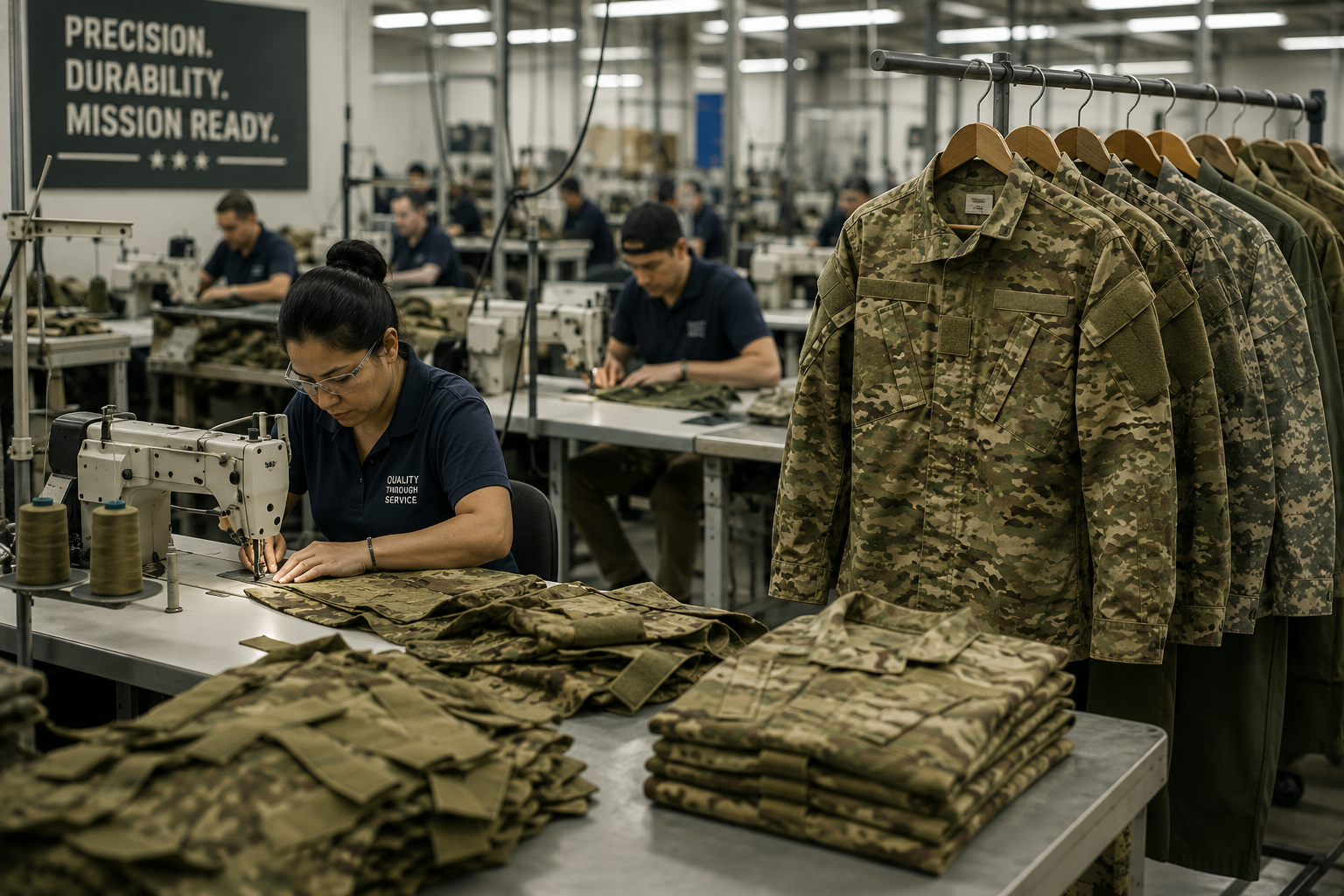
Bluewater Defense has produced more than 20 million garments and equipment items across its DoD contract history, including 7.2 million combat trousers and 5.8 million coats. As a Puerto Rico-based manufacturer, it qualifies as a domestic source under Berry Amendment rules while operating one of the largest dedicated military garment workforces in the country.
4. Crye Precision (Brooklyn / Long Island City, New York)
- Location: New York, New York
- MOQ: Contact for quote (commercial and government orders)
- Speciality: Combat and field apparel, plate carriers, load-bearing gear
- Best for: Brands and agencies needing technically engineered combat apparel with in-house design and testing
Crye Precision operates from a 56,000 square foot facility with roughly 150 employees and built its reputation on the G3 and G4 combat uniform lines used widely by special operations units. Unlike some manufacturers here, Crye sells finished apparel commercially, making it accessible outside a formal defense contract.
5. Short Bark Industries (Vonore, Tennessee)
- Location: Vonore, Tennessee (manufacturing facility in Guánica, Puerto Rico)
- MOQ: Contact for quote
- Speciality: Combat uniforms, tactical gear, made-in-America strategic apparel
- Best for: Agencies and organizations needing a Tennessee-headquartered supplier with dedicated Berry-compliant manufacturing
Short Bark Industries is headquartered in Vonore, Tennessee and runs manufacturing through a Puerto Rico facility, giving it a domestic supply chain spanning the continental US and a US territory. The company positions itself as a made-in-America tactical supplier.
6. Tru-Spec, Atlanco (Kings Mountain, North Carolina)
- Location: Kings Mountain, North Carolina
- MOQ: Contact for quote (commercial and dealer distribution available)
- Speciality: Tactical uniforms, combat-inspired apparel, public safety and outdoor clothing
- Best for: Brands wanting tactical-style apparel with an established dealer and retail network
Tru-Spec, owned by Atlanco, relocated its headquarters to Kings Mountain, North Carolina in 2024 and operates an 85,000 square foot distribution center in nearby Grover. The brand built its name on meeting government mil-spec fabric standards and now sells across military, law enforcement, and commercial tactical categories.
7. FirstSpear (Fenton, Missouri)
- Location: Fenton, Missouri
- MOQ: Contact for quote
- Speciality: Tactical apparel, plate carrier platforms, load-bearing equipment
- Best for: Brands needing American-made tactical gear engineered alongside apparel
FirstSpear manufactures tactical apparel and load-bearing systems from its Fenton, Missouri facility and holds multiple patents on its gear platforms. The company markets to military and law enforcement professionals while also selling commercially, a realistic point of contact for smaller brands.
8. Massif (Ashland, Oregon)
- Location: Ashland, Oregon
- MOQ: Contact for quote
- Speciality: Flame-resistant combat shirts, base layers, and cold-weather technical apparel
- Best for: Brands or agencies needing flame-resistant military apparel built to Berry Amendment standards
Massif has supplied the Army Combat Shirt, a flame-resistant garment authorized for wear in combat zones, since its founding in 1999. Massif remains headquartered in Ashland, Oregon and produces its proprietary flame-resistant fabrics with a Los Angeles textile mill partner, giving it a fully domestic fiber-to-garment supply chain.
Military Uniform Manufacturer Comparison Table
Comparing these eight manufacturers side by side highlights how location, contract scale, and specialty differ.
Manufacturer | Location | MOQ | Speciality | Best For |
Propper International | St. Charles, MO | Contact for quote | Combat and dress uniforms | High-volume, decades of DoD history |
American Apparel Inc | Selma, AL | Contact for quote | Combat and utility uniforms | Active DLA contract production |
Bluewater Defense | San Lorenzo, PR | Contact for quote | ACU trousers, coats, parkas | Very high-volume combat apparel |
Crye Precision | New York, NY | Contact for quote | Combat and field apparel | Commercially accessible technical gear |
Short Bark Industries | Vonore, TN | Contact for quote | Combat and tactical gear | Continental US headquarters |
Tru-Spec (Atlanco) | Kings Mountain, NC | Contact for quote | Tactical and combat-inspired apparel | Dealer and retail distribution |
FirstSpear | Fenton, MO | Contact for quote | Tactical apparel, load-bearing gear | Commercial and government buyers |
Massif | Ashland, OR | Contact for quote | Flame-resistant combat apparel | FR technical apparel specialists |
Choosing between these manufacturers means navigating contract minimums, compliance rules, and specialties that vary widely by company. The faster path for a commercial project is letting manufacturers built for smaller runs come to you.
Find Military Uniform Manufacturers on Maker’s Row
Most primary military uniform manufacturers are built around Department of Defense contracts, not startup-scale private label orders. If your brand needs a military uniform manufacturer for tactical-style or technical apparel without a formal government contract, Maker’s Row connects apparel brand owners with verified manufacturers in the USA experienced in performance fabrics and heavy-duty construction.
Describe your tactical or technical apparel requirements in your project brief, and manufacturers who work with those materials respond directly. Factories on Maker’s Row are active and responsive, and many reply within 24 to 48 hours of a posting. For brands building a technical line, the guide to cut and sew manufacturers in the USA covers factories equipped for custom construction at commercial-scale minimums.
How Do You Choose the Right Military Uniform Manufacturer for Your Brand?
The right choice depends on whether your project is a government contract, a tactical-style commercial line, or somewhere between. Work through these questions before committing to a factory.
- Define whether your project requires Berry Amendment compliance. Government and DoD-adjacent work requires full domestic sourcing. Commercial tactical-style apparel does not, opening up standard cut and sew factories, meaning contractors who build a garment from raw fabric using your own patterns.
- Request samples before committing to full production. Technical and flame-resistant fabrics behave differently than standard apparel fabrics. A sample confirms fit and construction quality first.
- Ask about contract minimums separately from standard MOQ. A factory built for 100,000-unit DoD orders will not take a 200-unit private label order.
- Verify certifications relevant to your category. ISO 9001 and, for controlled technical apparel, ITAR registration matter more here than in general apparel manufacturing.
- Start with a small test order before scaling. Even manufacturers open to commercial work benefit from a trial run that confirms quality first.
FAQs About Military Uniform Manufacturing in the USA
Most military uniform manufacturers are built for government contract scale, often runs in the tens or hundreds of thousands of units, rather than a published MOQ. Brand owners seeking smaller commercial runs should look for cut and sew factories specializing in technical fabrics instead of primary DoD contractors.
Sample timelines vary by manufacturer and product complexity, and most companies require a direct conversation to confirm one. Flame-resistant and technical fabrics often add development time versus standard cut and sew apparel due to specialized testing.
Cost depends on fabric type, certification requirements, and order volume, and manufacturers typically quote per project rather than publish standard pricing. Bureau of Labor Statistics data shows US apparel and textile manufacturing employs over 250,000 workers across more than 11,000 establishments, reflecting the domestic capacity available for tactical apparel.
Yes, though most primary DoD contractors here are not set up for small orders. Crye Precision and Tru-Spec sell commercially alongside government work, and Maker’s Row can connect brand owners with cut and sew manufacturers experienced in technical fabrics, including regional options through the guide to clothing manufacturers near you, at commercial-scale minimums.
Berry Amendment compliance requires every textile component, including fiber, yarn, fabric, and thread, to be sourced and produced within the United States, not just the final assembly. Standard domestic manufacturing may use imported fabric or trim even if the garment is cut and sewn in the USA. This distinction matters for any product sold into a government contract.
Cross-reference the company’s claims against contract award records from the Defense Logistics Agency or SAM.gov, confirm the factory’s address independently, and check for ISO 9001 certification. The American Apparel and Footwear Association notes that verifying a domestic supply chain claim requires documentation and traceability, so ask for contract history before committing.
Yes, but expect a steeper learning curve than standard apparel because of fabric testing, certification requirements, and construction standards specific to technical and flame-resistant materials. The SBA recommends starting new manufacturer relationships with a small test order regardless of category, which applies directly here.
Ready to Find Your Military Uniform Manufacturer?
Your tactical or technical apparel brand is one military uniform manufacturer away from becoming real, and the right factory is easier to find when manufacturers come to you.