You have narrowed your search down to three manufacturers who look promising. Now each one wants something before they will talk pricing: a request for quotation. If you have never sent one before, that single line can stall a conversation that was otherwise moving fast. This guide explains exactly what an RFQ is, what to put inside one, and how to create one that gets a real, comparable quote back instead of a vague reply or no reply at all.
A request for quotation (RFQ) is a formal document you send to a manufacturer that lists your exact product specifications, order quantity, and the specific pricing information you need back, so multiple factories can respond with numbers you can directly compare. For clothing brands, this means the difference between three apples-to-apples quotes and three unrelated guesses. Manufacturers cannot price what they do not fully understand, and a vague email produces a vague, unusable answer.
This guide covers what belongs in an RFQ, why it matters for a first-time clothing brand, real scenarios showing it in action, and the exact steps to build one before you send your first message to a factory.
What Is a Request for Quotation? (Definition)
A request for quotation (RFQ) is a formal document you send to a manufacturer that spells out your product specifications, order quantity, and the exact pricing details you need returned, so you can compare multiple factories on equal terms. It is not a purchase order and it does not commit you to buying anything. It is a structured ask for a number.
An RFQ is one of three related sourcing documents, and confusing them wastes time on both sides. A request for information (RFI) asks a manufacturer general questions about capability before you know exactly what you need. A request for proposal (RFP) asks a manufacturer to propose how they would approach a complex project, not just a price. An RFQ is the most direct of the three: your specifications are already locked, and you are asking one thing, what will this cost.
Document | Best Used When | What You Get Back |
RFI (Request for Information) | You are still exploring what is possible | General capability and material information |
RFP (Request for Proposal) | Your project is complex or not fully defined | A proposed approach plus estimated pricing |
RFQ (Request for Quotation) | Your specs and quantity are locked | A direct, comparable price quote |
For a first production run of a clothing item, most brand owners should skip the RFI and RFP stages entirely and go straight to an RFQ once a tech pack (the specification document that tells a manufacturer exactly what to make) is ready. According to the Small Business Administration (SBA), connecting with verified domestic manufacturers early in the sourcing process is one of the clearest ways a new product-based business can reduce sourcing risk before committing capital.
Why Does a Request for Quotation Matter for Brand Owners?
An RFQ matters because it is the single document that turns a vague factory conversation into a comparable set of real numbers, and skipping it is one of the most common reasons new brand owners waste weeks on sourcing.
- It makes quotes comparable. When every manufacturer receives the same specifications, quantity, and requested cost breakdown, you are comparing like for like instead of guessing which factory quoted what for.
- It protects your budget. A clear RFQ forces a manufacturer to price your actual garment, not a rough estimate based on a two-line email, which prevents budget surprises after you have already committed time to a factory relationship. According to the American Apparel & Footwear Association (AAFA), domestic apparel production carries higher per-unit costs than overseas manufacturing, which is exactly why a precise, itemized quote matters more for a US sourcing decision than a rough estimate would.
- It speeds up manufacturer response. Factories reply faster to an inquiry that already answers their standard intake questions. An incomplete request usually triggers a round of clarifying emails before any price appears.
- It creates a paper trail. A written RFQ and the response you receive give you something to reference if a quoted price or lead time changes later in the relationship.
Request for Quotation in Practice: Real Examples
Example: The Chicago streetwear brand that compared four hoodie factories at once A Chicago-based streetwear founder sent the same one-page request for quotation, fabric weight, GSM, print method, and a 150-unit quantity, to four cut-and-sew manufacturers in one week. Three responded with directly comparable per-unit pricing within five business days. The fourth quoted a range because the founder’s document had left out trim details, which delayed that one factory’s response by ten days.
Example: The Austin swimwear brand that caught a costly gap before committing An Austin swimwear founder built her RFQ around a specific 4-way stretch fabric and a 200-unit MOQ (minimum order quantity, the smallest number of units a manufacturer will produce per order). Two manufacturers quoted within her target range. A third came back nearly 40% higher because their standard process required a minimum fabric roll purchase her quantity did not reach. Seeing that gap in writing, before any sample was ordered, let her adjust her first order size instead of discovering the cost mismatch mid-production.

How to Create a Request for Quotation for a Manufacturer
Creating an RFQ is a document-building exercise, not a negotiation. Get the specifics locked before you send anything, and every manufacturer you contact will price the same product.
- Start with your tech pack or a detailed spec sheet. A tech pack is the specification document that tells a manufacturer exactly what to make, fabric, measurements, construction, and trim. If you do not have a full tech pack yet, a one-page spec sheet with sketches and material references is the minimum a factory needs to quote accurately.
- Set your target quantity and any tiers you want priced. State your minimum order quantity, then ask for pricing at two or three quantity tiers, for example 100, 250, and 500 units, so you can see how price scales before you commit to a number.
- List exactly what you want quoted. Ask for unit cost, sample cost, any setup or pattern fee, lead time for sampling and for production separately, and payment terms. Leaving any of these off the request means you will chase it down later, one email at a time.
- Set a response deadline. Give manufacturers a specific date, typically five to seven business days, to respond. A deadline signals a serious inquiry and filters out factories that will not prioritize your request.
- Send it to multiple manufacturers at once. An RFQ only works as a comparison tool if more than one factory receives the identical document. Sending it to three to five manufacturers in your category gives you a real range to evaluate.
RFQ Section | What to Include |
Product Specs | Fabric, construction, trims, and measurements from your tech pack |
Quantity | Target order size, plus 2–3 tiers if you want scaled pricing |
Requested Pricing | Unit cost, sample cost, setup/pattern fees, shipping |
Timeline | Sampling lead time and production lead time, listed separately |
Payment Terms | Deposit percentage and balance terms expected |
Deadline | Specific response date, typically 5–7 business days |
The Small Business Administration (SBA) notes that early, structured contact with verified domestic manufacturers is one of the most effective ways a small brand can reduce onshoring risk before signing a production agreement.
Request for Quotation on Maker’s Row
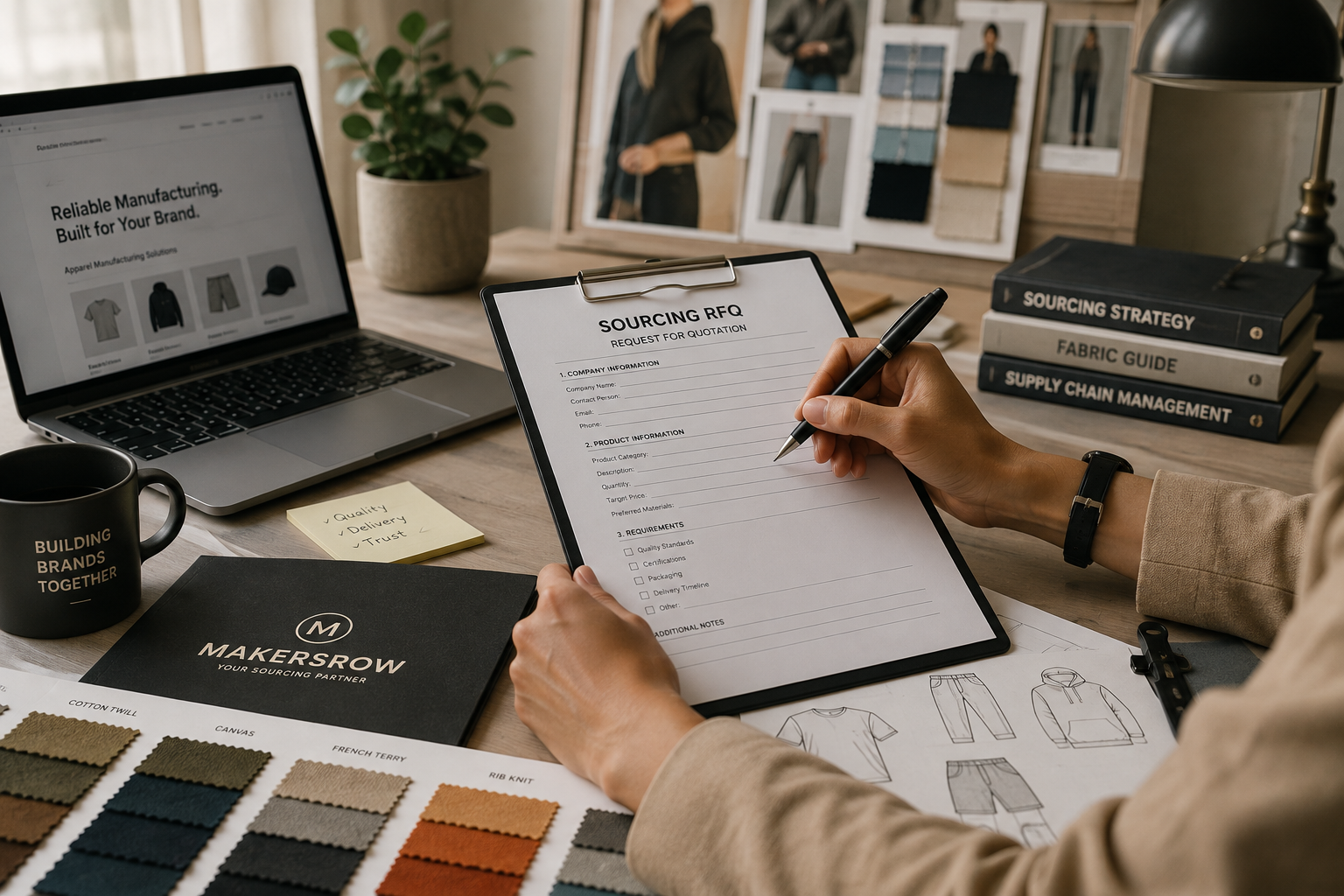
Maker’s Row is a marketplace connecting apparel brand owners with verified US manufacturers, and it removes most of the manual work of sending an RFQ to multiple factories one at a time. Instead of emailing five separate manufacturers and tracking five separate replies, you describe your product, quantity, and specifications once in a project brief on Maker’s Row, and verified US manufacturers who match your requirements respond directly with their own quotes.
This works the same way a traditional RFQ does, the same specifications reach every manufacturer, but factories come to you instead of the other way around. Many respond within 24 to 48 hours of a new project being posted. For a full directory of vetted options by category, browse the clothing manufacturers on Maker’s Row before you post.
FAQs About Request for Quotation
An RFQ is a formal document you send to a manufacturer asking for an exact price on a product you have already fully specified. It is the sourcing equivalent of asking several stores for their exact price on the identical item, so you can compare the numbers directly rather than comparing different offers.
An RFQ asks for a direct price on a product whose specifications are already locked, while a request for proposal (RFP) asks a vendor to propose how they would approach a more complex or less-defined project. Clothing brands with a finished tech pack almost always want an RFQ, not an RFP, since the design work is already done.
A complete tech pack is strongly recommended before sending an RFQ, since manufacturers cannot quote accurately without exact fabric, measurement, and construction details. A detailed one-page spec sheet with sketches can work for an early informal quote, but expect a wider price range and more follow-up questions than a full tech pack would generate.
Most US clothing manufacturers respond to a complete RFQ within five to seven business days, though Bureau of Labor Statistics data shows the domestic apparel manufacturing workforce has narrowed to roughly 71,800 workers across about 6,199 private establishments as of July 2026, which means factory capacity and response times vary more than they once did. Build a specific deadline into your RFQ rather than assuming a standard turnaround.
No, an RFQ is not a purchase order and does not commit you to buying anything. An RFQ only asks for pricing information; a purchase order is the separate, binding document you send once you have chosen a manufacturer and are ready to place the order.
Ready to Send Your First Request for Quotation?
Your clothing brand is one manufacturer away from becoming real. The factories are on Maker’s Row, ready to bid.