You have found a manufacturer you like. Their samples look exactly right. Then you see it in their reply: MOQ 300 units. If you are new to clothing manufacturing, that number can feel like a wall between you and your first production run. This guide explains exactly what MOQ means, why manufacturers use it, and how to find manufacturers whose minimums actually fit where your brand is today.
What is MOQ?
MOQ — minimum order quantity — is the smallest number of units a manufacturer will produce in a single order. For clothing brands, this means you cannot order fewer pieces than that number, regardless of how simple the garment or how small your budget.
MOQ is set per style, not per total order. A manufacturer with a 200-unit MOQ means you need 200 pieces of each style, colorway, or SKU — not 200 total across your whole collection.
MOQ Type | What It Means | Common Range |
Per style | Minimum units of one garment design | 50–500 units |
Per colorway | Minimum units of one color within a style | 25–200 units |
Per fabric roll | Minimum yardage for custom fabric | 100–500 yards |
Per order value | Minimum spend per production run | $2,000–$10,000 |
According to the American Apparel and Footwear Association (AAFA), domestic apparel production costs are higher per unit than overseas, which is one reason US manufacturers maintain MOQ thresholds to stay profitable.
Why Manufacturers Set MOQs
Every manufacturer has an MOQ for a practical reason, not an arbitrary one. Understanding the reason changes how you approach the conversation.
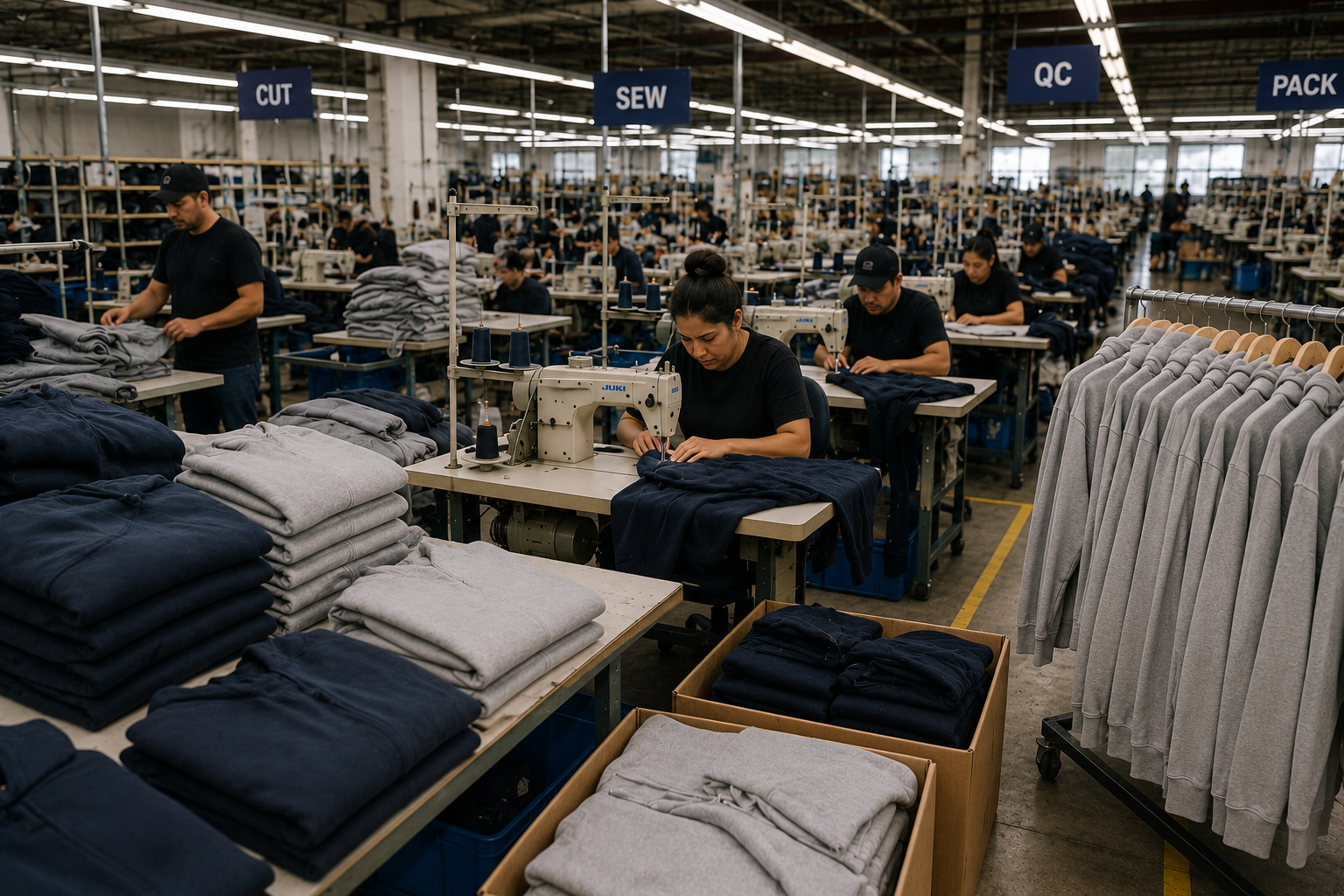
- Setup cost recovery. Every production run requires machine setup, thread changes, and pattern cutting. These costs are fixed regardless of how many pieces you make. A 50-unit run has the same setup cost as a 300-unit run. The manufacturer needs enough units to spread that cost across and turn a profit.
- Fabric purchasing minimums. Fabric mills sell by the roll or by minimum yardage. If your order is too small, the manufacturer cannot justify purchasing the minimum fabric run and absorbs dead inventory.
- Labor efficiency. Production lines run most efficiently in batches. Small orders interrupt line flow, slow output, and cost the factory more per piece than the order earns.
- Risk management. A manufacturer who takes a 30-unit order from an unknown new brand is taking on significant risk for minimal reward. MOQ filters for clients whose orders justify the relationship.
MOQ in Practice: Real Examples
Example: The startup that miscalculated per-style MOQ A Chicago-based streetwear brand planned a 5-piece collection. They found a Los Angeles cut-and-sew manufacturer with a 100-unit MOQ. They assumed that meant 100 units total — 20 per style. The manufacturer clarified: 100 units per style. Producing all 5 pieces meant 500 units minimum. That was three times their budget. They pivoted to launching with one hero hoodie instead, hit their MOQ, and used sell-through data to fund the next style.
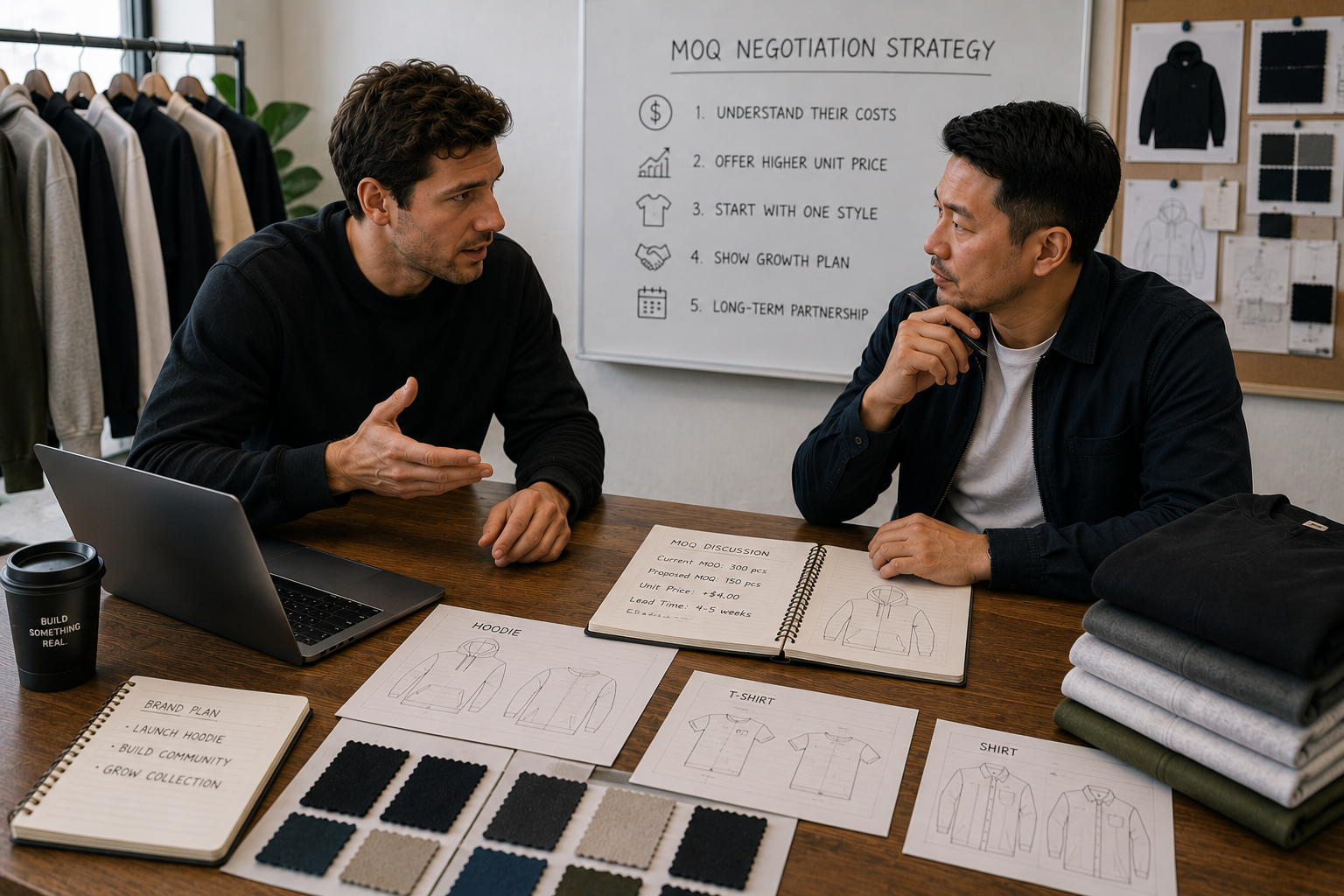
Example: Negotiating down from a high MOQ A Brooklyn activewear founder approached a New Jersey manufacturer quoting a 300-unit MOQ. She offered to pay a higher per-unit price in exchange for a 150-unit run. The manufacturer agreed. Her landed cost per unit was $4 higher, but she launched with $6,000 less upfront capital and validated the product before scaling.
Example: Using MOQ to choose between manufacturers A Phoenix accessories brand was deciding between two bag manufacturers. One quoted a 200-unit MOQ at $18 per unit. The other quoted 50 units at $28 per unit. At 200 units the first was cheaper total, but the brand had not yet tested the market. They chose the 50-unit manufacturer for the first run, sold through in 6 weeks, and moved to the higher-volume partner for the reorder.
How to Negotiate MOQ with a Manufacturer
MOQ is not always fixed. Many US manufacturers will adjust for the right brand with the right approach. Here is how to negotiate effectively.
- Understand their reason first. Before asking for a lower MOQ, ask why they have it. Setup cost, fabric minimums, and labor efficiency each have different solutions. A setup cost problem can be solved with a surcharge. A fabric minimum problem may be solved by choosing an in-stock material.
- Offer a higher price per unit. Manufacturers set MOQs to hit a revenue threshold. If you pay more per piece, you can sometimes reach that threshold with fewer units. Ask: “If I pay a higher unit price, what is the lowest quantity you would consider?”
- Start with one style, not a collection. Manufacturers are more likely to lower an MOQ for a single, simple product than for a complex multi-piece collection. Launch one hero product well before adding SKUs.
- Show your growth plan. A manufacturer taking a risk on a small first order wants confidence in a future. Come with a 12-month production roadmap. Show them what the relationship looks like at scale, not just today.
- Look for shared-run arrangements. Some manufacturers run similar garment types together and can absorb a smaller order into a larger batch. Ask if that is an option for your product category.
The Small Business Administration (SBA) notes that supplier negotiation skills are one of the highest-value competencies for product-based startups — worth developing before your first manufacturing conversation.
Also Read: Apparel Manufacturers USA: 7 Pricing and MOQ Strategies →
MOQ on Maker’s Row
Finding the right clothing manufacturer does not have to mean months of cold emails. On Maker’s Row, post your clothing project for free and verified US manufacturers bid directly. Review bids, check profiles, connect when ready.
When you post your project on Maker’s Row, you can state your target order quantity upfront. Manufacturers who respond have already seen your quantity and chosen to bid — so you are not negotiating from zero. Many reply within 24–48 hours of a project being posted.
For brands still researching which MOQ range is realistic for their product, browsing manufacturer profiles on Maker’s Row shows verified MOQs alongside speciality and location — so you can filter before you ever reach out.
FAQs About MOQ in Clothing Manufacturing
MOQ stands for minimum order quantity. It is the smallest number of units a manufacturer will produce in a single production run for one style. MOQ protects manufacturers from unprofitable small orders by ensuring each run covers setup, labor, and material costs.
MOQ for US clothing manufacturers typically ranges from 50 to 500 units per style, depending on the manufacturer’s size, speciality, and production method. Small-batch and cut-and-sew manufacturers often start at 50–100 units. Larger facilities may require 300–500. According to AAFA industry data, domestic manufacturers generally have higher per-unit costs than overseas producers, which influences where they set their minimums.
Yes. Many manufacturers will negotiate, especially for brands with a clear growth roadmap. Common approaches include offering a higher per-unit price, reducing your SKU count to one style, or proposing a setup surcharge. The Maker’s Row platform has a dedicated guide to working with minimum order quantity clothing manufacturers that covers negotiation frameworks in detail.
Most manufacturers will decline an order below their MOQ or quote a higher per-unit surcharge to compensate for the lost efficiency. A small number offer true low-minimum or no-minimum production, but these typically carry premium pricing. The Maker’s Row blog covers no-minimum manufacturing in detail if that is the direction you need to explore.
MOQ reflects each factory’s cost structure. A small US cut-and-sew studio with low overhead can profitably run 50 units. A larger facility with high fixed costs may need 300+ units to break even on a style. Product complexity also matters — a simple tee has a lower MOQ than a structured jacket with multiple components.
Usually, yes. Most manufacturers apply MOQ per colorway, not just per style. A 100-unit MOQ on a tee shirt in three colors typically means 100 units per color — 300 total. Always confirm this before committing to a multi-color run.
MOQ is the multiplier on your per-unit cost. A $25 unit cost at 200-unit MOQ means $5,000 in production spend before marketing, shipping, or packaging. According to SBA small business planning guidance, new product brands should calculate their total landed cost — production plus shipping plus duties — before committing to any MOQ.
Ready to Put MOQ Into Practice?
Your clothing brand is one manufacturer away from becoming real. The factories are on Maker’s Row, ready to bid.
State your target order quantity in your project brief and manufacturers who work within your range respond directly — no negotiating from scratch, no cold emails ignored.