You open a quote from a jewelry factory and see one line: “925, cast, oxidized, MOQ 100.” Every word in that line changes your cost, your product label, and how your customer sees the piece. This guide explains which types and finishes exist, what each costs you in production, and how to brief a factory without guessing.
A sterling silver charm is a small decorative pendant made from an alloy that is at least 92.5% silver and attaches to a bracelet, necklace, earring, or keychain.
If you are launching your first jewelry line, you need this term pinned down because purity, construction, and finish each set your price and your legal wording. A factory that receives a precise spec quotes faster and surprises you less.
Below, we cover the definition, types, finishes, uses, worked examples, a six-line spec, and how to post your project on Maker’s Row.
What Is a Sterling Silver Charm?
A 925 sterling charm is a small pendant that hangs from a chain, bracelet, or ring. For your jewelry brand, this means every piece carries a legal purity standard and a construction method that sets your price.
Sterling silver is an alloy with 925 parts per thousand pure silver, and the balance is usually copper. Pure silver is too soft for small, detailed pieces, so the added metal gives a charm the strength to survive daily wear. The FTC Jewelry Guides say a product should not be called silver, solid silver, or sterling unless it is at least 925/1,000 pure silver.
Every charm you order needs the same six fields on its spec. The values below are examples.
Spec field | What it tells the factory | Example value |
Purity | The legal metal standard | 925 sterling |
Size | Height and width in millimeters | 17 mm by 13 mm |
Weight | Grams of metal per piece, which drives metal cost | 1.5 g |
Construction | How the charm is made | Cast, solid |
Finish | The surface look | Oxidized |
Attachment | How the charm connects to a chain | Soldered bail |
What Types of Sterling Silver Charm Exist?
Sterling charms fall into five types by how they are made, and the method decides detail, weight, and unit cost. Casting is a process where molten sterling silver is poured into a mold to form a charm. Die striking is a process where a steel die presses sheet silver into shape.
Type | How it is made | Best for | Cost signal |
Cast | Molten silver poured into a mold | 3D shapes and fine detail | Moderate: mold cost, then low labor per piece |
Die-struck | Sheet pressed between steel dies | Crisp, flat designs at higher volume | Higher tooling, lower cost per piece at volume |
Hollow (puff) | Two struck halves joined | Bold look with less metal | Lower metal use, extra joining step |
Hand-fabricated | Sawn, shaped, and soldered by hand | One-of-a-kind and very small runs | Highest labor |
Engraved or enamel | Any base charm plus engraving or color fill | Initials, names, color accents | Extra finishing step |
Cost signals are relative, because no US industry body publishes per-charm pricing. Ask each factory for an itemized quote.
What Finishes Does a Sterling Silver Charm Come In?
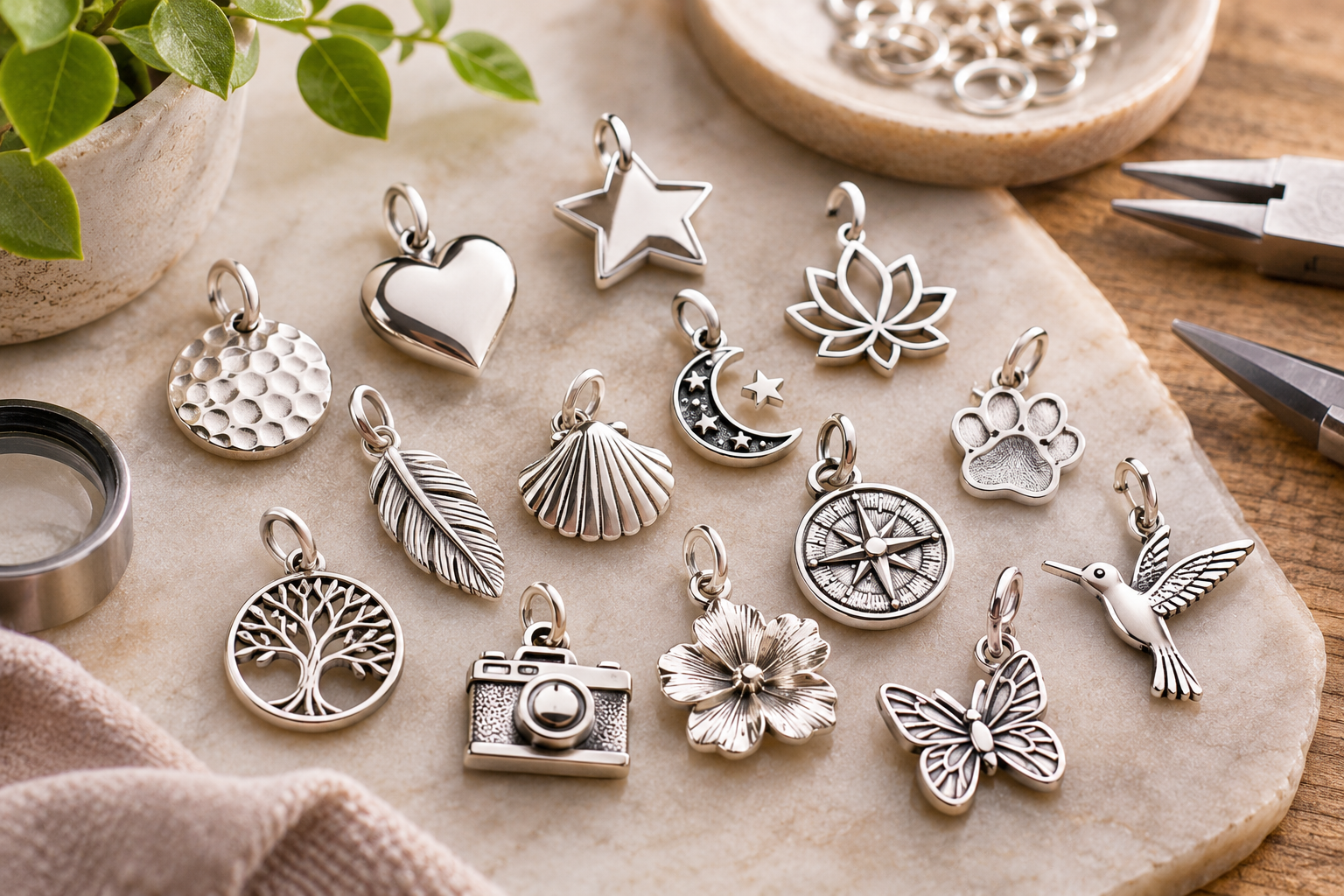
Sterling charms usually come in five finishes: polished, satin, oxidized, rhodium-plated, and gold-plated or vermeil. Oxidizing is a chemical treatment that darkens the recessed areas of a charm so raised details stand out. Rhodium plating is a thin coating of rhodium that makes silver brighter and slows tarnish. Vermeil is gold-coated sterling silver, and the FTC Jewelry Guides reserve the word for a gold layer of at least 10 karat and 2.5 microns thick.
Finish | Look | Best for | Production note |
Polished | Mirror shine | Simple, modern shapes | Shows scratches fastest |
Satin | Soft brushed glow | Minimalist designs | Hides fingerprints |
Oxidized | Dark recesses, antique look | Detailed or vintage designs | High points lighten with wear, so specify depth |
Rhodium-plated | Bright white | Tarnish resistance | Adds a plating step |
Gold-plated or vermeil | Gold color on a silver base | Warm look at a sterling core | Name must match coating thickness |
What Is a Sterling Silver Charm Used For?
Sterling charms go on charm bracelets, necklaces, earrings, anklets, and keychains, and often as a personalized gift. How it attaches decides where it can go:
- Bail and jump ring dangle: A bail is the small loop on a charm that lets it hang from a chain or ring. This is the most common format for necklaces and bracelets.
- Lobster clasp (clip-on): The charm clips onto a bracelet or keychain with no tools.
- Threaded or bead-style: The charm slides onto a bracelet core, so the hole size must match.
Why Does a Sterling Silver Charm Matter for Brand Owners?
Sterling charms matter because purity, weight, finish, and minimums each change your quote and your listing. Four decisions get easier once you know them:
- Purity is a legal claim. A piece listed as sterling must meet the 925 standard, and a plated or base-metal piece cannot carry that word.
- Weight drives metal cost. Every gram of sterling holds 0.925 grams of fine silver, so a charm that is 20% heavier carries 20% more metal.
- Finish adds steps. Oxidizing, rhodium plating, and gold plating each add an operation, so a finish change can move your quote even when the shape stays the same.
- Minimums vary. MOQ (minimum order quantity) is the smallest number of units a factory will produce per order. Some factories count it per design or per finish, so ask which applies. Our guide on what MOQ means shows how to plan around it.
Sterling Silver Charm in Practice: Real Examples
These three examples show how weight, finish, and labeling change an order. All use example inputs, not client cases or market prices.
Example: A Nashville initial charm order. A Nashville brand orders 200 initial charms at an assumed 1.5 grams each. That is 300 grams of sterling, or about 9.6 troy ounces (300 ÷ 31.1035), holding 277.5 grams of fine silver (300 × 0.925). Trimming each charm to 1.2 grams cuts the metal to 240 grams, a 20% saving before labor.
Example: A Los Angeles finish split. A Los Angeles brand wants 150 charms, 75 polished and 75 oxidized. The factory counts minimums per finish at 100 pieces, so both 75-piece lots fall short. The brand switches to 150 oxidized charms and adds polished in the next run.
Example: An Austin gold-look charm. An Austin brand wants a gold color on a sterling base. The factory quotes a gold coating of an assumed 0.5 microns, which is thinner than the 2.5 micron vermeil standard. The brand lists it as gold-plated sterling silver instead of vermeil.
How Do You Specify a Sterling Silver Charm to a Manufacturer?
You specify a sterling charm by sending the factory six details: purity, size, weight, construction, finish, and attachment. Register your business before you place a first order. The SBA’s 10 steps to start a business cover structure, registration, and tax IDs.
- State purity in writing. Ask for “925 sterling” and have the factory confirm every metal part, including the bail and jump ring.
- Give size and weight. List height and width in millimeters and a target weight in grams.
- Pick the construction. Choose cast for 3D detail, die-struck for crisp flat shapes at volume, or hollow to save metal.
- Name one finish per design. For oxidized charms, say how dark the recesses should look.
- Measure the attachment. Give the bail opening or hole size in millimeters so it fits your chain or bracelet core.
- Order a paid sample first. Weigh it, check the stamp, and view the finish in daylight before you approve bulk.
Our guide to how manufacturing jewelers work explains what happens after you send your spec. If you want a factory to adapt an existing design, read about private-label jewelry manufacturers.
Also Read: Top 10 Jewelry Manufacturers in USA for Custom & Small Batch Production (2026) →
Sterling Silver Charm on Maker’s Row
Maker’s Row is a marketplace connecting brand owners with verified US manufacturers, and you can use it to find a factory that makes your charm.
Finding the right sterling charm manufacturer does not have to mean months of cold emails. On Maker’s Row, post your charm project for free and verified US manufacturers bid directly. Review bids, check profiles, connect when ready.
Put the purity, weight, finish, and quantity from your six-line spec in the project brief. Every bid then prices the same charm, so you compare factories on price and lead time instead of guesses. Brand owners post unlimited manufacturing projects for free and receive bids from verified US factories at no upfront cost. To reply to factories directly, subscription plans give full access.
FAQs About Sterling Silver Charms
These six answers cover purity, tarnish, plating, cost, small orders, and bracelet use.
The number 925 means the charm is 925 parts per thousand pure silver, or 92.5%. The remaining 7.5% is usually copper. The FTC Jewelry Guides use the same 925/1,000 threshold for calling a product sterling.
Yes, sterling tarnishes because silver reacts with sulfur compounds in the air, and the copper in the alloy speeds the darkening. Rhodium plating, an anti-tarnish coating, and dry storage all slow it. An oxidized finish is dark by design.
A sterling charm is solid 925 alloy throughout, while a silver-plated charm is a thin silver layer over a base metal. A plated piece should be described as plated, never as sterling. Ask your factory to confirm the base metal in writing.
Cost depends on weight, construction, finish, and quantity, so no single price applies. One US maker, Charm Factory in New Mexico, lists retail charms at $5 to $25 each. Request an itemized factory quote that separates metal, labor, and finishing.
Yes, small brands can order charms from US jewelry makers, though minimums vary by factory and design. As of May 2023, the Bureau of Labor Statistics counted 21,810 employees in US jewelry and silverware manufacturing, including 6,460 jewelers and precious stone and metal workers. Our guide to small batch jewelry manufacturers is a good place to start.
Yes, sterling silver suits charm bracelets because the alloy is hard enough for daily wear and polishes back to a shine. Hollow charms keep bracelets light, while solid cast charms feel heavier. Choose based on how many charms your customer will stack.
Ready to Put a Sterling Silver Charm Into Practice?
You now have the purity rule, the five types, the finishes, and a six-line spec, which is enough to brief a factory.
Your jewelry brand is one manufacturer away from becoming real. The factories are on Maker’s Row, ready to bid.