Picking the wrong tote bag manufacturer can cost you months of delays and a stack of bags you cannot sell. It happens to first-time founders every week, and it is avoidable. These 7 tips give you a checklist you can use today. A tote looks simple, so founders often under-plan the sourcing. Handles, stitching, fabric weight, and print method all decide which tote bag manufacturer can build your bag well.
If you are launching your first line on a small budget, this guide is for you. It fits canvas, cotton, leather, and printed totes made in the USA. You will leave with seven tests to run on every factory and a clear path to bids from US manufacturers.
1. Write a Tote Spec Before You Contact Anyone
Write a one-page spec first, because factories can only quote what they can see on paper. A tech pack is the document that tells a factory how to build your product. Maker’s Row explains the sections in its tech pack guide, which is written for apparel but carries over to bags.
For a tote, list the finished size in inches, handle length, fabric, lining, closure, stitching, and print method. Add the gusset, which is the folded panel that gives a tote its depth. Then state your target quantity.
A vague brief gets a vague quote. Every tote bag manufacturer you contact should price the same document, so you can compare bids fairly.
2. Match the Factory to Your Tote Construction
Choose a tote bag manufacturer that builds your type of tote every week, not one that could probably figure it out. A shop that sews canvas totes daily will handle your design better than a generalist.
Ask each factory to show two or three totes it has made with construction close to yours. Then ask which part of your design it would change first. The answer shows you what the factory builds best.
Tote type | Build detail that matters | Ask the factory |
Cotton or canvas tote | Handle attachment and seam strength | How do you reinforce handles? |
Leather or leather-trim tote | Hide selection and edge finishing | Who cuts and finishes the leather? |
Lined zip-top tote | Lining, zipper, interior pockets | Can I see a lined tote you made? |
Screen-printed tote | Print placement and ink | Do you print in-house or outsource? |
3. Confirm the MOQ: How Many Totes Must You Order?
US custom handbag factories typically require 50 to 300 units per style, so expect a similar range for totes and get each minimum in writing. MOQ (minimum order quantity) is the smallest number of units a factory will produce in one run. Maker’s Row’s 2026 guide to custom handbag manufacturers reports that range, and its 2026 small batch guide reports typical small batch runs of 25 to 500 units.
Minimums can change your whole plan. In 2015, Maker’s Row and MSNBC’s Your Business connected bag designer Janet Goodman of Yadabags with the US factory Unionwear, as the Yadabags case study reports. The article does not name the factory’s city.
Detail | Figure |
China route, minimum order | 1,000 bags |
Unionwear (US), minimum order | 300 units |
Original cost per bag | $60 |
Cost per bag at Unionwear | $47 |
Unionwear cut almost sixty production steps to lower the price, according to the case study. Ask every tote bag manufacturer how it keeps small runs affordable.
4. Order Samples From at Least Two Factories
Order a sample from at least two tote bag manufacturers before any production order, because a sample reveals what no quote can. Maker’s Row’s 2026 handbag guide reports that standard samples take two to four weeks. Plan your calendar around that.
Load each sample with the heaviest items your customer will carry. Then check the handle attachment, seam finish, and fabric after a week of real use. Compare both samples against your spec, side by side. The better tote bag manufacturer is the one whose sample matches the spec with the fewest fixes.
Maker’s Row’s guide on why you need a sample explains how a sample catches design problems before production starts. Treat the sample fee as part of your vetting budget.
5. Test Your Materials and Prove Every Claim
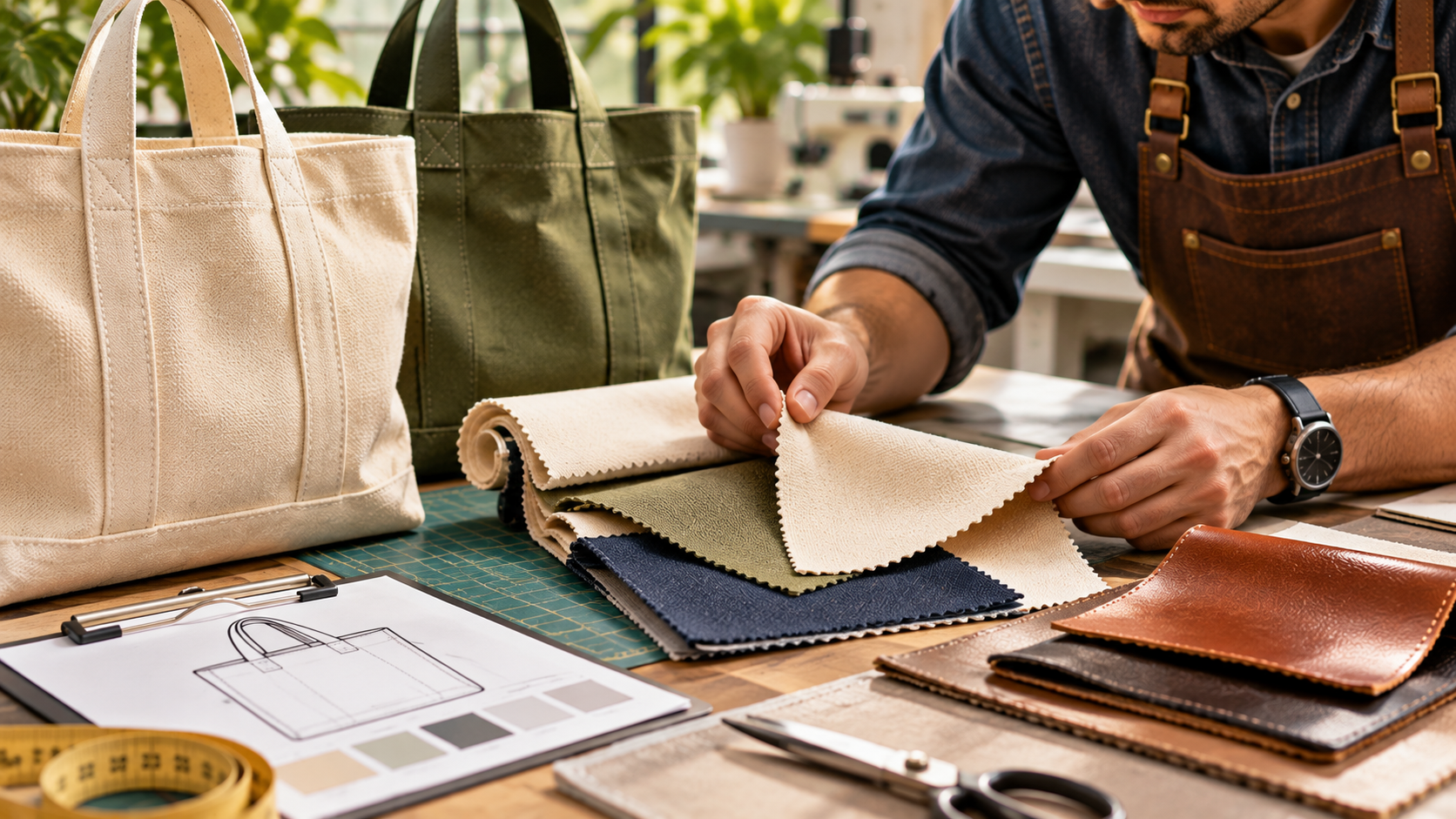
Test every fabric on a swatch, and prove every claim you plan to print on a label. Canvas weight is the fabric’s weight per square yard, usually measured in ounces. Heavier canvas is usually stiffer and sturdier, so ask for swatches and then scrape, soak, and fold them.
Material choices also control cost. The Barkeeper Co. team switched from all leather to waxed canvas with leather trim and a 420 denier interior to cut costs, per Maker’s Row’s 2014 Barkeeper Bag story.
Claims need proof. The FTC says an unqualified Made in USA claim requires a product to be all or virtually all made in the United States. Textile Exchange says its Organic Content Standard uses third-party certification to verify organic content. Ask your factory for the certificate before you print “organic.”
6. Vet the Factory: What Red Flags Should You Watch For?
Vet a tote bag manufacturer by checking references, asking who owns quality, and noting how it talks about past mistakes. Maker’s Row’s guide to vetting factories for quality suggests asking for a client list and calling references about quality problems and how they were resolved. It also recommends confirming that the factory has a designated quality manager.
Treat two answers as red flags. One is a factory that claims it has never had a quality issue. The other is a factory that blames clients for problems, so walk away from any tote bag manufacturer that does either.
SCORE advises that you check references thoroughly and look for a manufacturer with a record of on-time delivery that owns its mistakes, per its product sourcing tips.
7. Start Early and Treat Your Factory as a Partner
Start talking to a tote bag manufacturer months before your launch, and plan for a relationship rather than a one-off order. The Barkeeper team locked down its manufacturer only the Thursday before its Kickstarter launched. It also advises treating manufacturers as long-term partners, per the same 2014 story.
Ask each factory for written dates covering sample approval, material arrival, and shipping. Then add the two to four weeks each sample round takes. Ask whether the factory will run your first order at its lowest minimum, and reorder as sales prove demand.
How Maker’s Row Helps You Find a Tote Bag Manufacturer
Maker’s Row is a marketplace connecting brand owners with verified US manufacturers across apparel, accessories, and soft goods. Several tips above come down to one job: getting quotes from factories that fit your tote.
On Maker’s Row, brand owners post unlimited manufacturing projects for free and receive bids from verified US factories at no upfront cost. To connect directly, subscription plans give full access.
Attach your spec, state your quantity, and compare the bids from each tote bag manufacturer. If your tote is leather, start with these verified leather bag and belt manufacturers.
FAQs About Choosing a Tote Bag Manufacturer
Post your project with a clear spec, then compare quotes and samples from at least two factories. You can use a marketplace such as Maker’s Row or contact factories directly. Either way, send every factory the same spec sheet.
Minimums vary by factory and construction. Maker’s Row’s 2026 guides report 50 to 300 units per style for custom handbags and 25 to 500 units for small batch runs. Ask each tote bag manufacturer for its minimum in writing.
Standard samples typically take two to four weeks, according to Maker’s Row’s 2026 handbag guide. That figure covers handbags, so confirm the timeline for your tote. Leather trim or custom hardware may take longer.
Only if the tote is all or virtually all made in the United States. The FTC requires that standard for unqualified claims, so check where your fabric, handles, and zippers come from before you print the label.
A reliable one passes reference checks, names who owns quality, and admits past mistakes. SCORE advises looking for an on-time delivery record, and Maker’s Row recommends confirming a designated quality manager.
Start Applying These Tote Bag Tips Today
Your tote bag brand is one manufacturer away from becoming real. The factories are on Maker’s Row, ready to bid.