You have found a fabric that stops people in their tracks. The richness, the depth of colour, the way it catches light. Then you look at what it takes to actually manufacture velvet clothing, and the questions start piling up. Which type of velvet works for your product? Which US factories handle it? What MOQs are you looking at? This guide answers all of it.
Velvet clothing is having a real commercial moment that goes beyond the holiday season. Velvet blazers and velvet dresses are showing up in year-round collections, luxury streetwear drops, and premium casualwear lines. If you are building a brand in this space, understanding exactly what velvet clothing is, what makes it different to manufacture, and how to find the right US factory is the knowledge that separates a great collection from an expensive sample pile.
This guide covers the definition of velvet clothing, why it matters for production decisions, the types that work for different brand categories, and how to approach US manufacturing for velvet apparel.
What is Velvet Clothing? (Definition)
Velvet clothing is apparel made from velvet fabric, a densely woven textile with a cut pile that creates a soft, plush surface with a characteristic sheen and directional nap. For clothing brands, this means working with a specialty material that commands premium positioning, requires specific cutting and sewing techniques, and carries real production implications around MOQ, pressing, and quality control.
Velvet is not a single fabric. It is a construction method. The pile is created by weaving two layers of fabric simultaneously, then cutting between them to produce the raised surface that defines the material. That pile can be made from silk, polyester, rayon, cotton blends, or stretch synthetics, and each fibre base changes the price, care requirements, and production complexity considerably.
According to market research from Valuates Reports, the global velvet fabric market was valued at $265 million in 2023 and is projected to reach $377 million by 2030, growing at a 5.2% CAGR. The largest application category is clothing, which makes velvet apparel a growing production category rather than a fading niche.
Velvet Type | Fibre Base | Typical Use in Clothing | Cost Range (per yard) |
Silk Velvet | Silk | Luxury eveningwear, couture | $30–$80+ |
Stretch Velvet | Polyester/Spandex | Bodysuits, dresses, casualwear | $8–$18 |
Velveteen | Cotton | Blazers, trousers, children’s wear | $6–$15 |
Burnout/Devore Velvet | Rayon/Polyester | Blouses, occasion wear | $12–$25 |
Crushed Velvet | Polyester | Casualwear, loungewear, accessories | $5–$14 |
Why Velvet Clothing Matters for Brand Owners
Velvet clothing has returned to relevance across a broader range of product categories than its traditional occasion-wear positioning. Search data shows “velvet dress” was the top-performing velvet apparel query across 2024–2025, peaking during Q4 but maintaining year-round interest. Velvet blazers and velvet jackets have seen consistent search performance outside seasonal spikes, which signals that velvet apparel is moving from occasion-only to broader casualwear territory for brand owners to take seriously.
For your brand, that shift creates four specific commercial advantages.
Premium positioning at accessible price points. Stretch velvet and velveteen give you the visual richness of velvet at fabric costs that support mid-tier retail pricing. A well-executed velvet jacket or velvet dress does not need silk construction to read as elevated.
Differentiation from core basics. Velvet garments stand out on the rack and in product photography. For emerging brands competing for attention in crowded categories, that is a real commercial advantage that lower-complexity fabrics cannot replicate.
Seasonal anchor and year-round extension. Velvet apparel anchors Q4 collections, but crushed velvet and stretch velvet extend naturally into spring lines. Building velvet clothing into your range gives you a high-impact seasonal piece and a year-round capsule option.
Production complexity as a competitive barrier. Velvet cuts, presses, and sews differently from standard wovens. Brands who invest in understanding those requirements and finding the right manufacturer have a product that is genuinely harder to copy at fast-fashion speed.
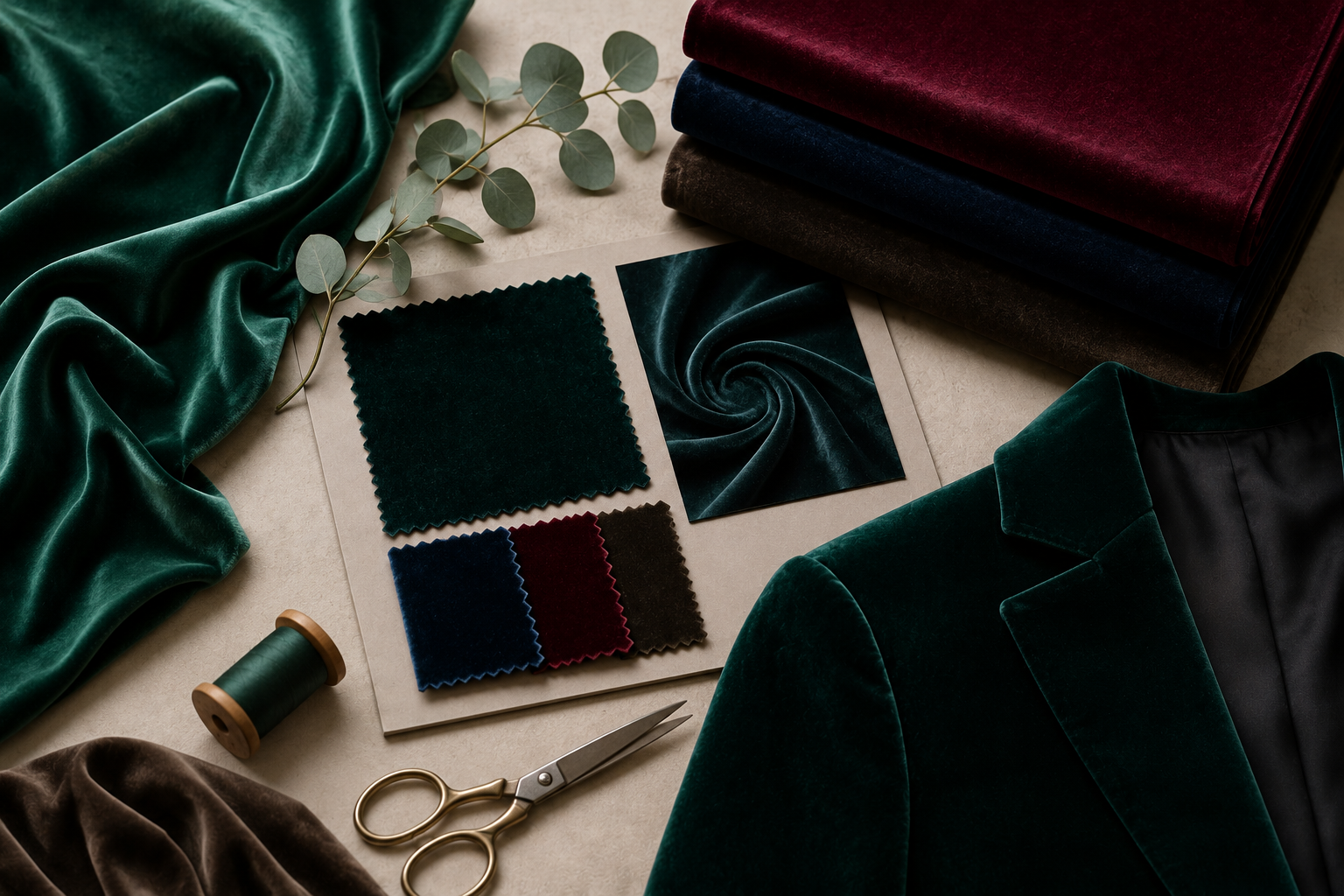
[IMAGE: brand owner reviewing velvet fabric swatches | ALT: velvet clothing brand owner manufacturing USA]
Types of Velvet Used in Clothing
Understanding which velvet type fits your product is the first manufacturing decision you need to make. Each type has different cut-and-sew requirements, and US factories that work with one type may not work with all of them.
Stretch Velvet is the most manufacturer-accessible velvet for new US brands. Made from polyester-spandex blends, it works well for form-fitting styles, bodysuits, and casual dresses. MOQs at US cut-and-sew factories for stretch velvet typically start at 50–100 pieces per style. Fabric costs run $8–$18 per yard. If you are building your first velvet product, this is the most practical starting point.
Velveteen is a cotton-based fabric that mimics velvet’s pile but uses a simpler weave construction. It is more forgiving to cut and sew than woven velvet, presses more reliably, and works well for structured pieces like blazers, trousers, and children’s wear. Fabric costs run $6–$15 per yard.
Burnout Velvet (Devore) uses a chemical process to dissolve part of the pile, leaving a pattern of sheer and plush sections. It requires specialist knowledge to cut without distorting the pattern alignment at seams. US factories with devore experience are fewer. Budget for at least two sampling rounds.
Crushed Velvet is a permanently textured velvet with an irregular pile direction. It is easier to care for than traditional velvet, less sensitive to crushing from handling, and works well for casualwear and loungewear. US factory availability is moderate.
Silk Velvet is the highest-quality and most expensive category. It requires luxury-level cutting and pressing skills, and US factories that handle silk velvet correctly are rare. If you are building a couture or luxury eveningwear line, expect MOQs of 100–200 pieces minimum and longer lead times for sampling.
See our guide to types of clothing fabric for a broader comparison of specialty fabrics and their US production implications.
Velvet Clothing in Practice: Real-World Examples
Example: Stretch Velvet Dress, Small Batch Launch
A Los Angeles-based eveningwear brand launched a stretch velvet midi dress as their hero product. They sourced a domestic polyester-spandex velvet at $12 per yard, worked with a cut-and-sew manufacturer in downtown LA with a minimum of 50 units per style, and priced the finished garment at $185 retail. The velvet’s visual richness at that price point outperformed their cotton styles in first-season sell-through by 40%.
Example: Velveteen Blazer, Direct-to-Consumer Brand
A Brooklyn-based menswear label introduced a velveteen blazer in three colourways as a holiday capsule. They worked with a New York cut-and-sew factory experienced with structured suiting fabrics. MOQ was 75 units per colour, fabric cost $11 per yard. The blazer became their highest-reviewed product and extended into a permanent line the following season.
Example: Burnout Velvet Top, Contemporary Women’s Brand
A Chicago women’s brand sampled a burnout velvet blouse through a specialty cutter in Los Angeles. First-pass sample issues with pattern alignment at seams required two rounds of corrections. Total sample investment was $420 for the corrected style. Production MOQ was 100 units. The lesson: burnout velvet needs experienced pattern cutters, and sampling budgets need to account for a second round.
How to Source and Manufacture Velvet Clothing in the USA
Finding the right manufacturer for velvet clothing is harder than for standard fabrics. Factory availability is narrower, sample complexity is higher, and the consequences of choosing a factory without the right equipment are visible in every garment. These five steps help you get it right.
Step 1 — Choose your velvet type before you choose your factory.
Your velvet type determines which factories can actually produce your product. A factory experienced with stretch velvet jersey production may not have the pressing equipment or cutting knowledge for woven silk velvet. Define your fabric construction first, then search for manufacturers who specifically list specialty fabric experience in their profiles.
Step 2 — Budget fabric cost from the start.
Velvet is a specialty category. Fabric costs range from $8–$25 per yard depending on construction, and US manufacturers who work with velvet are fewer than for standard fabrics. Build that into your cost-per-unit calculation before you approach a factory. Avoid the common mistake of getting excited about a style before you know whether it can be produced at a sustainable margin.
Step 3 — Plan for extra sampling rounds.
Velvet cutting requires nap direction consistency across all pattern pieces. Pressing velvet incorrectly crushes the pile permanently. First samples from a factory unfamiliar with your specific velvet type often need correction. Plan for two sampling rounds minimum, and brief your manufacturer on nap direction requirements clearly in your tech pack.
Step 4 — Verify pressing and finishing capability before you commit.
Many cut-and-sew factories press garments with standard irons. Velvet requires either steam pressing on the reverse side, or a velvet needle board that lifts the pile rather than crushing it. Ask this question directly before committing to a production run: “How do you press velvet garments during and after assembly?” The answer will immediately indicate whether this factory has genuine velvet experience.
Step 5 — Start with a low-MOQ test run.
Velvet garments sell well but colour preference is harder to predict than for basics. Crushed velvet and stretch velvet offer the most flexibility for low-MOQ production. Request a test run of 50–100 units before committing to full-season quantities. For more on the cut-and-sew process for specialty fabrics, see our guide to cut and sew manufacturers in the USA.
Also Read: Garment Fabric Manufacturers in the USA: Top Facts and FAQs →
Velvet Clothing on Maker’s Row
Finding a velvet clothing manufacturer does not have to mean months of cold emails and unreturned calls. On Maker’s Row, post your velvet clothing project for free and verified US manufacturers bid directly. Describe your velvet type, target product, and MOQ range in your brief, and factories with the specific equipment and experience to handle your construction respond without you searching them out one by one.
Many specialty fabric manufacturers, including those experienced with burnout velvet and silk velvet, do not maintain strong web presences. Posting a project on Maker’s Row surfaces these factories, including ones that would never appear in a standard Google search. On Maker’s Row, brand owners post unlimited manufacturing projects for free and receive bids from verified US factories at no upfront cost. To connect directly, subscription plans give full access.
FAQs About Velvet Clothing
Velvet clothing is made from velvet fabric, which uses a cut-pile weaving technique to create a raised, plush surface. The pile can be made from silk, polyester, rayon, cotton, or synthetic blends. The fibre base determines price, care requirements, and production complexity. Most commercially produced velvet clothing today uses polyester or polyester-spandex constructions, which are more durable and cost-effective than silk velvet at scale.
Velvet is more expensive to produce than standard wovens because the pile construction uses more yarn per yard, requires more precise cutting to maintain nap direction, and demands specialist pressing equipment during assembly. Fabric costs range from $6 per yard for basic velveteen to $80 or more per yard for luxury silk velvet. Higher material costs combined with lower US factory availability and greater production complexity drive the premium retail price.
Yes. Velvet clothing has moved beyond purely seasonal and occasion-focused use. Velvet blazers, velvet jackets, and velvet trousers have established year-round presence in premium casual and smart-casual categories. Search trend data shows interest in velvet dress and velvet blazer styles maintained consistent volume throughout 2024–2025 outside the typical Q4 spike, indicating sustained consumer demand rather than a peak-and-decline trend.
Velvet is woven on a double-cloth loom and the pile is cut between two layers, producing a pure pile structure with high sheen. Velveteen is a cotton fabric with a shorter pile made through a cut-weft construction, which makes it easier to sew and press, slightly less lustrous, and considerably less expensive. For brand owners, velveteen is typically the better starting point for structured velvet pieces like blazers and trousers.
Yes, though factory options are more limited than for standard woven fabrics. According to our guide on types of clothing fabric, velvet and other specialty fabrics require factories with specific machinery, cutting knowledge, and pressing capability. US cut-and-sew manufacturers who work with stretch velvet and velveteen are more widely available than those handling silk or devore velvet. Posting your project on Maker’s Row is the most efficient way to identify which US factories work with your specific velvet construction.
MOQ for velvet clothing at US cut-and-sew factories typically ranges from 50–150 units per style for stretch velvet and velveteen. For more complex constructions like burnout or devore velvet, expect MOQs of 100–200 units due to specialist cutting and finishing requirements. Silk velvet couture production at US factories often requires 100–300 units minimum. Platforms like Maker’s Row allow you to specify your MOQ range and receive bids from factories that match.
It depends on the fibre base. Silk velvet is a natural fibre with biodegradability advantages, but comes at significant cost and supply chain complexity. Polyester-based velvet is durable but derived from petroleum. Cotton velveteen offers a more natural-fibre option with lower environmental processing inputs. For brands pursuing responsible sourcing, Textile Exchange provides standards and guidance on preferred fibre choices, including recycled polyester options applicable to stretch velvet production.
Ready to Put Velvet Clothing Into Practice?
Your velvet clothing brand is one manufacturer away from becoming real. The factories are on Maker’s Row, ready to bid.