Leather belts for men look simple, but each type carries real production decisions. The style changes the hardware. The hide changes the cost. Together they set your unit price and your first order size. This guide covers 15 types of leather belts for men, grouped into eight styles and seven materials. You also get a comparison table with US retail price ranges and five questions for choosing the right belt for your brand.
Why Do Leather Belts for Men Come in So Many Types?
Leather belts for men come in many types because style, hide and hardware each change how a factory builds the belt. Two leather belts for men can share a name, yet a dress belt and a gun belt need different leather weights, buckles and labor.
MOQ (minimum order quantity) is the smallest number of units a manufacturer will produce per order. Our guide to minimum order quantity explains how factories set that number.
Leather weight, measured in ounces (oz), is the thickness of the hide. The Hanks Gunner Belt uses 14 oz leather, about 0.21 to 0.23 inches thick, according to RifleConfigurator’s listing. That is far heavier than a slim dress belt.
What Are the 15 Types of Leather Belts for Men?
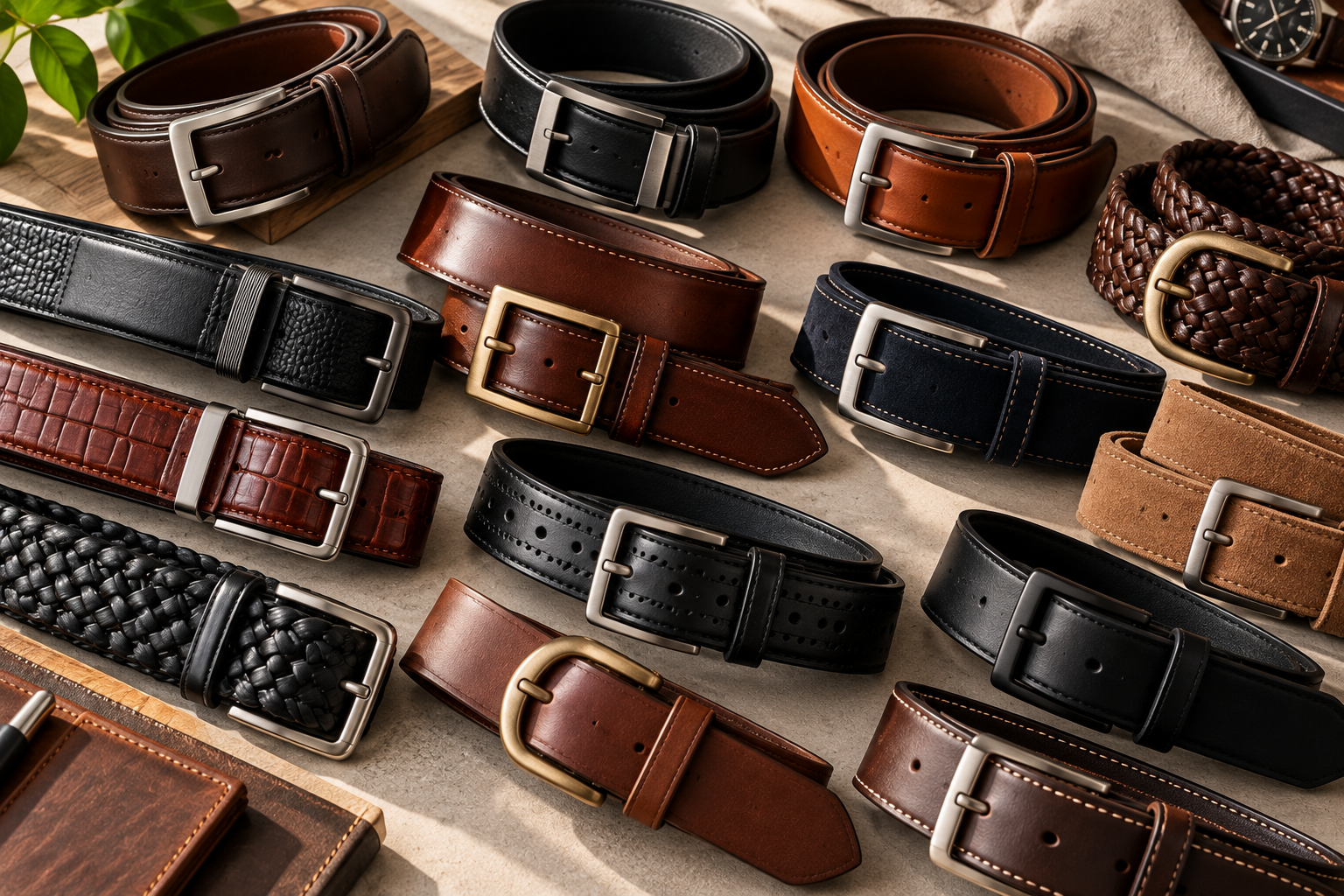
The 15 types of leather belts for men split into eight styles and seven materials. Styles describe how the belt is built and worn. Materials describe the leather itself. Each entry below shows who it suits and what it means for production. Price ranges sit in the comparison table that follows.
Part 1: Eight Styles of Leather Belts for Men
1. Dress Leather Belt
A dress belt is a slim, smooth leather strap with a polished buckle, made to match formal shoes.
Best for: Suits and tailored trousers. Properties: About 1 to 1.25 inches wide, smooth finish. Production note: Smooth hides show flaws, so ask how the factory grades hides.
2. Casual Leather Belt
A casual belt is a wider, sturdier strap made for jeans and chinos.
Best for: Denim and everyday wear. Properties: Usually 1.5 inches wide, matte or pebbled grain. Production note: Tanner Goods’ Standard Belt uses snaps, so buyers can swap buckles. That lets you order straps and hardware as separate lines.
3. Reversible Leather Belt
A reversible belt has a rotating buckle and two finished faces, usually black on one side and brown on the other.
Best for: Travel and small wardrobes. Properties: Two-sided finish, swivel buckle. Production note: Two finished faces mean extra dye and edge work. Ask whether the strap is one piece or two glued layers.
4. Braided Leather Belt
A braided belt weaves thin leather strips into a flexible strap that sits softer than a solid belt.
Best for: Chinos, shorts and summer outfits. Properties: Woven texture, flexible strap. Production note: Weaving adds labor, so ask whether the factory braids in house or outsources. That answer drives your lead time.
5. Ratchet Leather Belt
A ratchet belt, also called a click belt, replaces punched holes with a notched strap and an automatic buckle.
Best for: Comfort, golf and gift sets. Properties: Adjusts in small steps, and many are cut to fit. Production note: One cut-to-fit strap can cover many waist sizes, which shrinks your size run.
6. Western Tooled Leather Belt
A Western belt is a tooled or stamped leather strap with an oversized buckle, made for boots and jeans.
Best for: Boots and ranch wear. Properties: Around 1.5 inches wide, tooled pattern, removable buckle. Production note: Rockmount, a US Western brand, sets a 30-piece minimum on custom belts and 24 pieces on custom buckles.
7. Suede Leather Belt
A suede belt uses leather finished with a brushed, napped surface instead of a smooth grain.
Best for: Smart-casual outfits. Properties: Soft nap, and marks show more easily than on smooth leather. Production note: Suede and nubuck differ. Our leather sourcing guide explains the surfaces, so name yours in your brief.
8. Gun Belt
A gun belt is a thick, stiff leather belt, usually 14 oz, built to carry a holster without sagging.
Best for: Concealed carry and heavy workwear. Properties: 14 oz leather, about 1.5 inches wide, sometimes with a steel core. Production note: Heavy hides need heavy-duty stitching and cutting equipment, so confirm the factory has it.
Part 2: Seven Materials Used in Leather Belts for Men
9. Full-Grain Leather Belt
Full-grain leather comes from the outermost layer of the hide, with its natural grain left unsanded.
Best for: Daily-wear belts meant to last years. Properties: Most durable layer, visible natural marks, develops a patina. Production note: Sellers use “full-grain” loosely, so ask for hide samples and a written leather spec.
10. Top-Grain Leather Belt
Top-grain leather is the top layer of the hide after sanding to remove blemishes, then finished.
Best for: Dress and casual belts that need even color. Properties: More uniform than full-grain, less natural texture. Production note: A finished surface helps color match from batch to batch, which matters when a retailer reorders.
11. Genuine Leather Belt
Genuine leather is real leather, but the label does not say which layer of the hide was used.
Best for: Entry-level lines and gifts. Properties: Real leather, lower price tier, construction varies. Production note: Put construction in your spec, such as one-piece strap or layered strap. That changes durability more than the label does.
12. Bonded Leather Belt
Bonded leather is a composition material made from ground leather fibers held together with non-leather substances.
Best for: Lowest-price and promotional belts. Properties: Uniform surface, made from fibers rather than a whole hide. Production note: The FTC’s Leather Guides call for disclosing the leather and non-leather content of bonded material. That duty applies to you.
13. Vegetable-Tanned Bridle Leather Belt
Bridle leather is plant-tanned leather finished with waxes, a style long used in saddlery.
Best for: Heritage belts and long-term daily wear. Properties: Stiff, 10 to 11 oz, burnished edges, darkens into a patina. Production note: Tanner Goods cuts its Standard Belt from 11 oz bridle leather in Portland, Oregon. Hand finishing adds labor per belt.
14. Exotic Leather Belt
An exotic leather belt is cut from alligator, crocodile, ostrich, lizard or snake skin instead of cowhide.
Best for: Statement dress belts and luxury positioning. Properties: Distinct scale or quill pattern, smaller skins than cowhide. Production note: Ask every supplier for documentation proving legal sourcing, because exotic species can fall under international trade rules.
15. Embossed Leather Belt
An embossed belt is real leather pressed with a pattern, such as alligator, that is not its natural grain.
Best for: An exotic look at a lower price. Properties: Repeating pattern, consistent from belt to belt. Production note: Embossing needs press equipment, so confirm the factory does it in house. The FTC says to disclose the true leather type when leather is embossed to look like another.
Two of these leather belts for men need a label check. Read the FTC’s Leather Guides announcement before you write product copy.
Comparison Table: Leather Belts for Men at a Glance
This table compares all 15 types of leather belts for men by use, properties, US retail price range and US availability. Ranges come from US retail listings checked in October 2026, including Walmart, Boot Barn, J.Crew Factory, Men’s Wearhouse and Tanner Goods. Exotic and embossed ranges also draw on Etsy and eBay listings.
Type | Best For | Properties | Cost Range | USA Availability |
Dress | Suits, formal wear | 1 to 1.25 in, smooth | $28 to $70 | Not confirmed in our check |
Casual | Jeans, chinos | 1.5 in, snap-on buckle | $13 to $100 | Tanner Goods, Rogue Industries |
Reversible | Travel | Two faces, swivel buckle | $10 to $21 | Not confirmed in our check |
Braided | Shorts, chinos | Woven strips, flexible | $16 to $80 | Not confirmed in our check |
Ratchet | Comfort, golf | Notched strap, cut-to-fit | $6 to $35 | Not confirmed in our check |
Western tooled | Boots, ranch wear | Tooled, 1.5 in | $25 to $150 | Rockmount (30-piece custom MOQ) |
Suede | Smart casual | Napped surface | $35 to $70 | Not confirmed in our check |
Gun belt | Carry, heavy duty | 14 oz, 1.5 in | $45 to $89 | Hanks Belts, Vedder Holsters |
Full-grain | Daily wear | Outer hide layer | $28 to $175 | Hanks Belts, Tanner Goods |
Top-grain | Even color | Sanded, finished | $18 to $43 | Not confirmed in our check |
Genuine | Entry price tier | Real leather, layer unstated | $6 to $20 | Not confirmed in our check |
Bonded | Promo, lowest price | Ground fibers plus binder | $13 to $27 | Not confirmed in our check |
Bridle | Heritage, long wear | 10 to 11 oz, waxed | $115 to $252 | Tanner Goods (Portland, Oregon) |
Exotic | Statement belts | Scale or quill pattern | $98 to $260 | Not confirmed in our check |
Embossed | Exotic look, lower price | Pattern pressed in | $47 to $67 | Not confirmed in our check |
Prices change often, so treat each range for leather belts for men as a planning guide, not a quote. “Not confirmed in our check” means we did not find a US maker, not that none exists.
How Do You Choose the Right Leather Belt for Your Brand?
You choose the right leather belt by matching use, leather grade, price tier, MOQ and labeling rules to your customer. Ask these five questions before you brief a factory on leather belts for men.
- Who wears it, and where? Different leather belts for men need different hides, so name the use first.
- How long should it last? Daily-wear belts point to full-grain or bridle leather. Gift lines can use genuine leather if you label it honestly.
- Which price tier will you compete in? Read the Cost Range column. All American Made’s USA belt roundup lists Rogue Industries at $60 to $100 and Journeyman at $60 to $90.
- What can you afford to order? Maker’s Row’s guide to custom leather manufacturers says custom leather shops commonly set MOQs of 25 to 100 units, and full-package factories ask for 250 or more.
- How will you label it? Bonded and embossed belts need disclosure under the FTC’s Leather Guides, so decide before you design packaging.
If you are weighing hand against machine construction, read our comparison of hand-stitched and machine-sewn leather techniques. For hide and tanning basics, see our guide to what leather is and how it is made.
Also Read: Best Custom Leather Bag Manufacturers in the USA →
Find Leather Belt Manufacturers on Maker’s Row
Finding the right leather belt manufacturer does not have to mean months of cold emails. On Maker’s Row, post your leather belt project for free and verified US manufacturers bid directly. Review bids, check profiles, connect when ready.
Name your leather weight, buckle style and finish in your brief, so bidders making leather belts for men know what you need. You can also browse the leather bag and belt manufacturers page and the wider Maker’s Row brand page.
On Maker’s Row, brand owners post unlimited manufacturing projects for free and receive bids from verified US factories at no upfront cost. To connect directly, subscription plans give full access.
FAQs About Leather Belts for Men
The main types of leather belts for men are dress, casual, reversible, braided, ratchet, Western, suede and gun belts by style. By material, they are full-grain, top-grain, genuine, bonded, bridle, exotic and embossed leather. Style sets where the belt is worn, and material sets durability and price.
Full-grain leather, including vegetable-tanned bridle leather, is the best choice for daily wear. It uses the hide’s most durable layer and develops a patina. Top-grain suits belts that need even color across a run.
No. Genuine leather is real leather, but the label does not name the layer of the hide. Full-grain comes from the outermost layer with its natural grain intact. Ask for hide samples and a written spec.
Dress belts are usually 1 to 1.25 inches wide, and casual and work belts are usually 1.5 inches. Check your customer’s trouser loops before you fix a width.
Custom leather MOQs commonly run from about 25 to 100 units, according to Maker’s Row’s custom leather guide. Rockmount sets 30 pieces for custom belts. Full-package factories may ask for 250 units or more.
Yes, US factories still make leather belts for men. As of the first quarter of 2026, the U.S. Bureau of Labor Statistics counted 1,545 private-industry establishments in leather and allied product manufacturing, a group that also includes footwear. The SBA also publishes resources for businesses that manufacture in the US.
Now You Know the Types, Here Is Your Next Step
Your next step with leather belts for men is to post one belt project with your type, leather weight and target quantity. Your leather belt brand is one manufacturer away from becoming real. The factories are on Maker’s Row, ready to bid.