Your factory asks for a tech pack, so you download the first tech pack template you find and leave half the boxes empty. Then the sample comes back wrong, and you pay for another round. These 7 ways to fill it in fix that before you send a single file.
A tech pack template is a pre-built document with fixed sections for the drawings, measurements, materials, and construction details a factory needs to quote and sample one garment. A blank one does nothing until you complete it correctly.
US factories are small shops. As of September 2026, preliminary BLS data show about 71,400 apparel manufacturing employees across 6,199 private establishments (first quarter of 2026). Dividing one figure by the other gives about 12 people per site, and small teams cannot guess what an empty box means.
If you are launching your first line, these seven ways show you how to complete each section and what each mistake costs.
What Should a Tech Pack Template Include?
A tech pack template should include eight sections: cover page, technical drawings, measurements, materials list, color codes, construction notes, labels, and quality standards. Each one answers a question your factory would otherwise guess at.
Section | What you enter | Mistake it prevents |
Cover page | Style name, season, size range, version date | Factory works from an old file |
Technical drawings | Front and back views with callouts | Wrong silhouette |
Measurements | Every size, with a tolerance per row | Fit that drifts between samples |
Materials list | Fabric, weight, trims, supplier codes | Wrong or substituted materials |
Color codes | One Pantone code per color | Off-shade product |
Construction notes | Stitch type, seam finish, hem method | Factory sewing assumptions |
Labels | Content, placement, artwork | Misplaced or noncompliant labels |
Quality standards | Tolerances, wash and colorfastness tests | Disputes at inspection |
Choose a Template Format You Will Actually Finish
Choose a spreadsheet for the measurement, materials, and label sections, and a design tool or technical designer for the drawings. Maker’s Row’s guide to tech pack clothing says those written sections fit in a spreadsheet or word processor, while drawings are where a designer helps. A freelance technical designer charges $50 to $250 per tech pack, depending on garment complexity, according to the same guide.
Use one layout for every style so factories learn where to look. Test your tech pack template on your simplest style first, such as a tee. If you need the basics first, read what a tech pack is. Export the final file as one PDF and keep the editable source separate.
Fill In Every Measurement Before You Send It
Fill in every point of measure and every size before a factory sees your tech pack template. A point of measure (POM) is a named spot on the garment, such as chest width, where a factory checks fit. List each POM across your full size run, from XS to XL if that is your range. Grading is the process of scaling a pattern across sizes, and this guide to apparel grading explains it.
Add a tolerance to every row. A tolerance is the allowed gap between your spec and the finished garment. The guide cites plus or minus 0.5 inch on body measurements as a common standard, so ask your factory for theirs.
A Los Angeles swimwear brand spent $2,400 on three sample rounds because its brief had no graded measurement table. That averages $800 per round. Once it sent an XS to XL table, the fourth sample was production-ready.
Name Every Material and Color Exactly
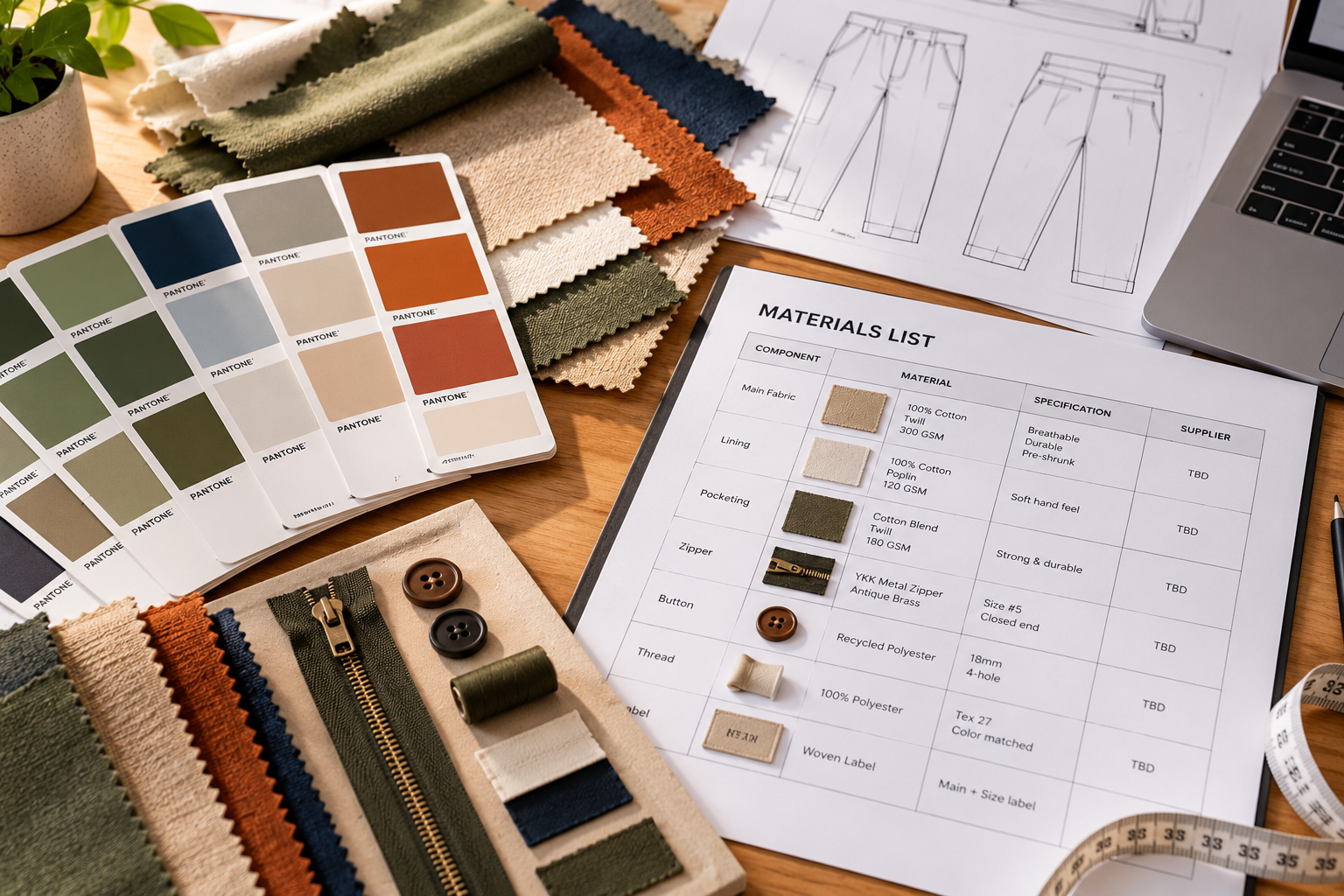
Name every material by fiber, weight, and knit or weave, and give every color a Pantone code. A bill of materials (BOM) is the list of every fabric, trim, and component in one style, with specs. “100% cotton jersey” is not enough. Add the weight, such as 180 gsm (grams per square meter), and the knit type, such as single jersey or interlock. List each zipper, button, and drawcord with its size and material.
A colorway is one color combination of a style. Give each colorway a Pantone reference, not a color name. A Brooklyn basics brand’s two-color hoodie arrived in a close-but-wrong navy because the file had no Pantone code. Fixing it required a reorder, per the same guide.
Draw Flats That Match Your Measurements
Draw front and back flats that show every seam, pocket, and closure, then letter each callout to match a row in your tech pack template. A flat sketch is a two-dimensional line drawing of a garment that shows its seams and details. It does not need to be artistic. It needs to be accurate. For more on drawing them, see what a flat sketch is.
Mark points A, B, and C on the drawing, then list A, B, and C in your measurement table. Add a separate view for linings, facings, and inside pockets. If you cannot draw, hire a technical designer for the drawings only.
Spell Out Construction, Not Just Style
Spell out the stitch type, seam finish, and hem method for every seam in your tech pack template, because factories treat silence as permission to choose. Stitches per inch (SPI) is the number of stitches in one inch of seam. Tell the factory to match the SPI of your approved sample, and name specialty finishes such as flatlock by name.
Every operation also costs labor. BLS reports a 2025 median wage of 17.37perhourforsewingmachineoperators,whichisabout29centsperminute(17.37 ÷ 60 = $0.2895). A two-minute operation you did not need adds roughly 58 cents per garment in direct labor, before fabric and overhead.
Add Labels and Compliance Details Up Front
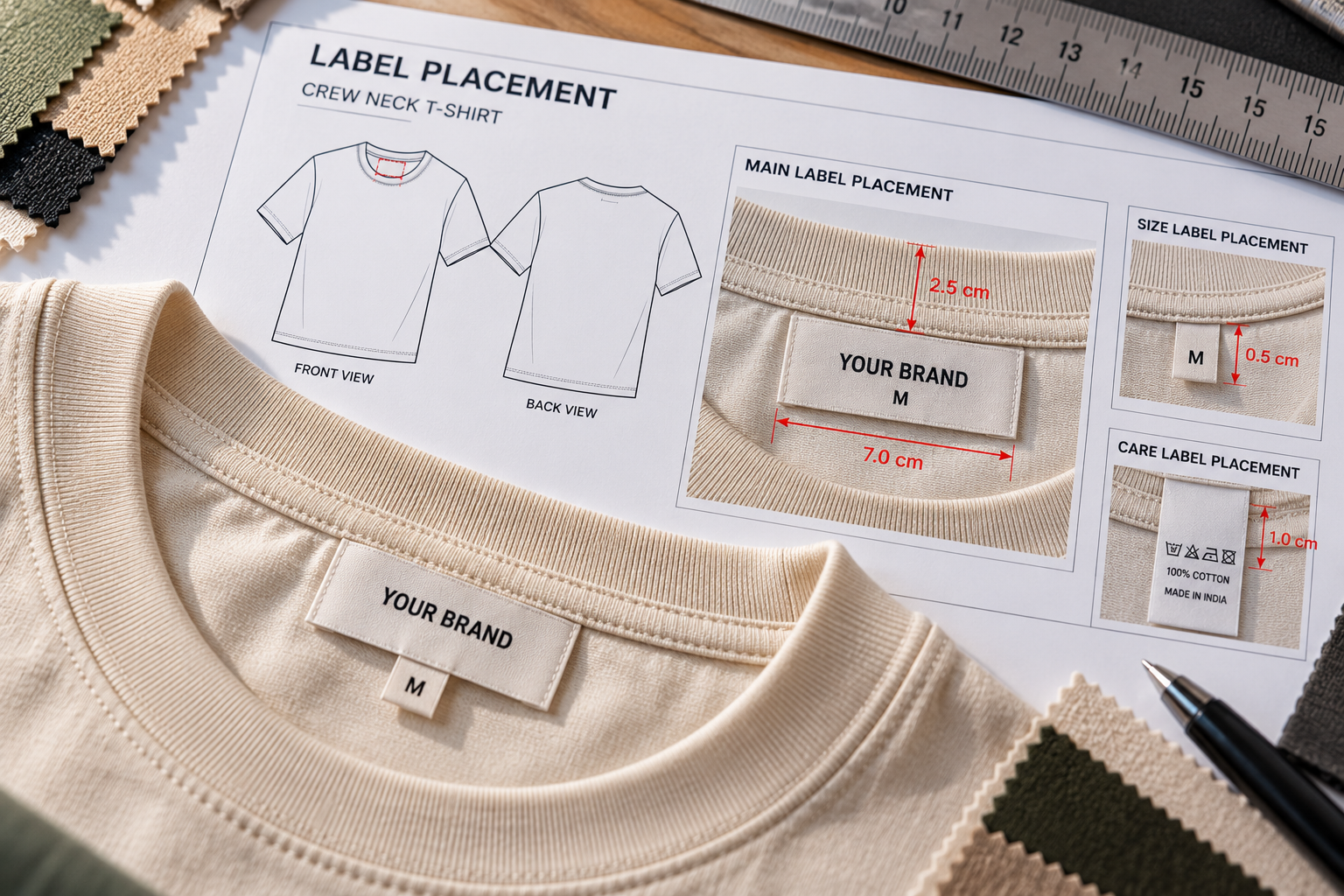
Add label content, placement, and artwork to your tech pack template, because federal rules require specific information on every garment. The FTC’s labeling guide for textile and wool products says most textile products need a label listing fiber content, country of origin, and the business responsible. A Registered Identification Number (RN) is an FTC-issued number a business can print on a label instead of its name. The FTC’s Care Labeling Rule also requires manufacturers and importers to attach care instructions that are permanent, secure, and legible for the product’s useful life.
Diagram each label and measure its placement from a reference seam. A Chicago streetwear brand found its woven labels 1.5 inches too low across a first run of 300 units because the brief had no placement coordinates. For plain-English rules, see FTC label requirements.
Version Every Revision and Protect Your File
Version every tech pack template revision with a number and date, and share the file only with factories you have vetted. Put the version on the cover page and in the file name, such as style-014_v3_2026-10-26. Add a change log row for each edit so the factory sees what moved. A factory working from an old file repeats the old mistake.
A tech pack protects accuracy, not your design rights. The USPTO says a design patent protects the way an article looks, and its rights extend only within the United States. Read the USPTO design patent guide, ask each factory to sign a nondisclosure agreement, and see how to protect clothing designs. This is general information, not legal advice, so check with an attorney.
How Can Maker’s Row Help You Get Accurate Samples Faster?
Maker’s Row is a marketplace connecting apparel brand owners with verified US manufacturers, and a finished tech pack template lets them bid on the same specs. Finding the right clothing manufacturer does not have to mean months of cold emails. On Maker’s Row, post your clothing project for free and verified US manufacturers bid directly. Review bids, check profiles, connect when ready.
Attach your finished file, name your fabric, and state your target quantity in the project brief. Brand owners post unlimited projects for free and receive bids at no upfront cost. To connect directly, subscription plans give full access.
FAQs About Tech Pack Templates
A tech pack template is a pre-built document with fixed sections for drawings, measurements, materials, construction, colors, and labels. You fill it in once per style, and the factory uses it to quote, source materials, and sew your sample.
Yes, you can build the written sections in a spreadsheet, including measurements, materials, construction notes, and label placement. Drawings are the one part where a design tool or technical designer helps. A clear hand-drawn flat can work for a first sample round with a responsive factory.
A freelance technical designer typically charges $50 to $250 per tech pack, depending on garment complexity. If you use a template and design software yourself, your cost is time only. Ask for a flat per-style quote so you can compare designers.
Yes, most professional US manufacturers require or strongly prefer a tech pack before they quote. Without one, they cannot price accurately, and your samples are likely to miss. A simple flat sketch with a measurement table and materials list beats no documentation.
A spec sheet is one part of a tech pack that covers measurements and sizing only. A full tech pack adds drawings, materials, colorways, construction details, and label specs. Most garments with trims need the full document.
Start Applying These Strategies Today
Using a tech pack template well takes one layout, one test style, and one afternoon. Your clothing brand is one manufacturer away from becoming real. The factories are on Maker’s Row, ready to bid.