You are sourcing your first knitwear collection and a manufacturer mentions they use a “3D knitting machine.” You nod. You leave. Then you spend two hours trying to figure out what that actually means and whether it changes anything about how you work with them. This guide gives you the complete answer. It covers what 3D knitting is, why it matters for your production costs and waste footprint, and how to find US manufacturers who use it.
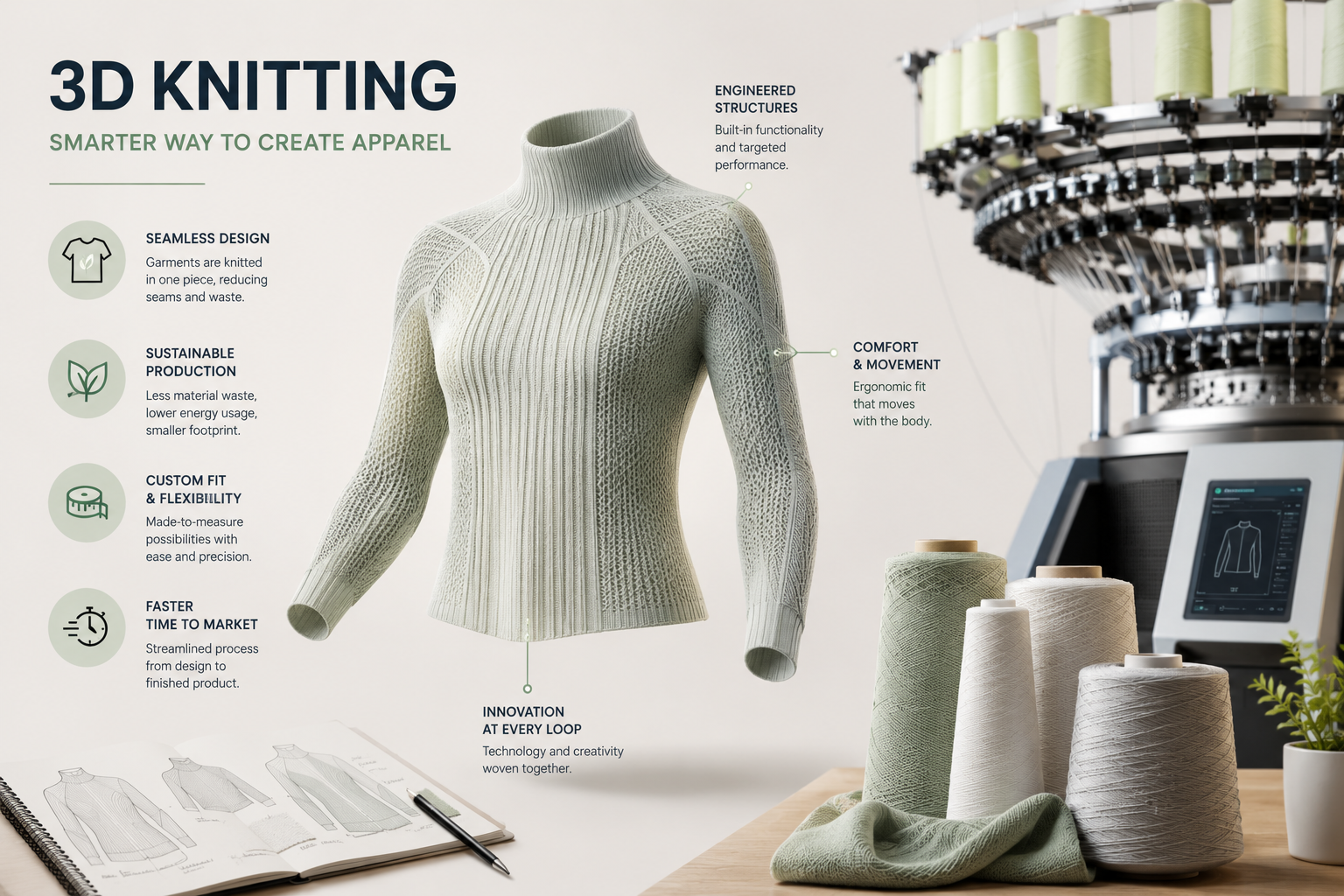
3D knitting is a manufacturing process that builds a finished garment or textile directly from yarn, without cutting or sewing separate fabric panels together. For clothing brands, this means fewer steps between raw material and finished product, and significantly less wasted fabric at every stage.
Designers and production teams who understand this technology arrive at manufacturer conversations with better questions, clearer briefs, and a stronger sense of what they are paying for. This guide covers all of it.
What is 3D Knitting?
3D knitting is a computerized textile manufacturing method that produces a finished garment or fabric structure in a single continuous process, using a flat-bed or circular knitting machine programmed to shape the piece in three dimensions directly from yarn. For clothing brands, this means the machine builds the garment, including shaping, structure, and sometimes pockets or panels, without cutting from a flat sheet of fabric.
Traditional cut-and-sew manufacturing starts with 2D fabric in rolls or bolts. A factory cuts individual panels from those rolls and sews them together. That cutting process always leaves offcuts: unusable scraps of fabric. According to Textile Exchange, conventional cut-and-sew methods typically generate 10–15% fabric offcuts from every roll used in production. On a 500-unit production run, that adds up fast.
This technology eliminates that cutting step. The machine programs exactly how many stitches to place and where, building the garment shape directly as it knits. The result is a finished or near-finished piece with minimal leftover material.
The two most recognized systems in commercial use are Shima Seiki’s WHOLEGARMENT technology and Stoll’s flat-bed knitting systems. Shima Seiki’s WHOLEGARMENT machines produce complete seamless garments in a single process. Stoll builds advanced flat-bed machines used for shaped panels and structured knitwear that require minimal assembly. Both approaches fall under the seamless and shaped-knit umbrella but differ in the degree of seamlessness they achieve.
Method | Seams Required | Best For | Waste Level |
Traditional cut-and-sew | Yes | Most fabric types, high volume | 10–15% offcuts |
Shaped flat-bed knitting | Minimal | Structured knitwear, activewear | Under 5% offcuts |
WHOLEGARMENT 3D knitting | None | Seamless tops, knitwear, footwear | Near zero offcuts |
Why 3D Knitting Matters for Brand Owners
This technology is not just a factory efficiency story. It changes what is possible for your brand in four concrete ways.
Waste reduction you can market. The Sustainable Apparel Coalition tracks lifecycle environmental impact across fashion supply chains. Brands that reduce manufacturing waste at the source have a measurable advantage under standard lifecycle assessment metrics. A garment made via seamless knitting carries a lower waste footprint from day one, which matters if your brand communicates sustainability values to customers.
Fewer production steps mean faster sampling. In a conventional cut-and-sew workflow, a sample requires pattern cutting, panel sewing, finishing, and quality review. With computerized knitting, the machine produces the sample directly from programmed specifications. Manufacturers using Shima Seiki’s SDS-ONE APEX4 design system can generate virtual 3D samples before any yarn is loaded, so you can review fit and structure digitally before committing to a physical sample round.
Seamless construction means better fit. There are no seam lines where panels join. For activewear, base layers, and knitwear, this improves comfort and reduces the chafing or distortion that sewn seams can cause. This is a real product quality difference, not just a manufacturing detail.
Customization at lower cost per variation. Because the machine is programmed digitally, changing a size run, adjusting a colour, or modifying a structural detail requires a software change rather than new pattern pieces. For brands launching a range of sizes or running limited seasonal drops, this reduces the setup cost per variation.
3D Knitting in Practice: Real Examples
Example: Activewear brand reducing sample rounds
A Los Angeles activewear brand developing a seamless sports bra line used a manufacturer with WHOLEGARMENT knitting capability. Instead of ordering three rounds of cut-and-sew samples to refine panel placement and seam comfort, they approved the design after two digital virtual samples and one physical sample. The brand cut sample costs by roughly one-third and reduced their pre-production timeline by six weeks.
Example: Knitwear label eliminating offcut waste
A New York knitwear brand producing 300 units of a merino wool crewneck switched from a cut-and-sew facility to a 3D knitting manufacturer. The previous method generated around 18 kg of merino offcuts per run, some of which went into landfill. The shaped-knit production run produced near-zero offcuts. For a brand using premium yarn at a high cost per kilogram, the material savings partially offset the higher per-unit machine cost.
Example: Emerging brand testing on-demand production
A small knitwear startup launched with a 50-unit test run using a computerized knitting facility. Because the machines can switch between programmed styles without new tooling or pattern cutting, the manufacturer ran two colourways of the same base design in a single session. The brand launched two limited SKUs, tested sell-through before committing, and re-ordered the better performer at 200 units the following season.
How to Evaluate Whether 3D Knitting Is Right for Your Brand
Computerized seamless knitting is not the right choice for every product or every production stage. Here are four practical questions to ask before pursuing it.
- Is your product knit-based?
This technology applies specifically to knitwear: sweaters, base layers, seamless activewear, socks, and structured knitwear pieces. If your hero product is woven (denim, chino, canvas), this is not relevant to your production decision. If you make knitwear or are considering adding it, this is the right category to investigate. - What is your MOQ reality?
3D knitting machines require programming time and setup, which adds a cost per style that is spread across your order. At very low quantities, the per-unit cost is higher than cut-and-sew. Most manufacturers using this equipment are accessible at 50–200 units per style depending on the facility, though some accept smaller runs for sampling. Confirm actual minimums before committing. See low-MOQ clothing manufacturers in the USA for a broader comparison of minimum order options. - Do you need seamless construction specifically?
Full WHOLEGARMENT 3D knitting produces truly seamless garments. Structured flat-bed knitting still produces shaped panels that require minimal assembly. If seamlessness is a core product feature, confirm which method the manufacturer uses and what seam count the finished garment actually has. - Can your design be programmed accurately?
This process requires a digital design brief or tech pack that the manufacturer can convert into machine-readable knitting instructions. If your design involves complex woven elements or non-knit embellishments, the manufacturer will need to solve those separately. Discuss technical requirements upfront. Reviewing US apparel manufacturing cost structures can also help you benchmark what you should expect to pay at different volume levels.
3D Knitting on Maker’s Row
Finding the right manufacturer for seamless knitwear does not have to mean months of cold emails to factory floor managers who may never reply. On Maker’s Row, post your knitwear project for free, specify that you are looking for 3D knitting or seamless knitting capability, and verified US manufacturers bid directly. Review bids, check profiles, connect when ready.
When you post your project, describe your product category, target MOQ, and whether you need WHOLEGARMENT seamless construction or structured flat-bed knitting. Manufacturers who specialise in exactly those capabilities will respond, which filters out the wrong conversations before they start.
On Maker’s Row, brand owners post unlimited manufacturing projects for free and receive bids from verified US factories at no upfront cost. To connect directly, subscription plans give full access.
FAQs About 3D Knitting
3D knitting is a process where a computerized knitting machine builds a finished or near-finished garment directly from yarn, without cutting fabric from flat rolls. The machine programs the shape, structure, and size into the knitting process itself, so the garment emerges already shaped.
Conventional cut-and-sew manufacturing cuts panels from bolts of fabric, always leaving unusable offcuts. This technology uses only the yarn needed to construct the garment according to its programmed specification. There are no cut edges and no leftover panels. According to Textile Exchange, this can reduce per-garment fabric waste from the typical 10–15% offcut range to near zero.
Not exactly. Seamless knitting is one form of the technology, specifically the method that builds a complete garment without any seams. Shima Seiki’s WHOLEGARMENT technology is the most commercially established example. Some processes using shaped knitting still produce panels that require minimal seaming, so the two terms are related but not interchangeable.
Currently, the most common applications are knitwear tops and sweaters, seamless activewear and base layers, technical socks and footwear uppers, sports gloves and headwear, and some structured accessories. It is best suited for products where the knit structure is inherent to the design and where seamless construction adds genuine product value.
The technology typically carries a higher per-unit cost at low quantities because of machine programming and setup time. At higher volumes, the cost gap narrows or can reverse, as the elimination of sewing labour and panel cutting reduces per-unit time. The right comparison is total landed cost including material waste, sample rounds, and production time, not just per-unit manufacturing cost. For US industry context, AAFA’s resources cover apparel manufacturing cost benchmarks.
Yes, but plan your product line around it. Small brands entering computerized knitting production typically start with one or two styles, confirm the design works at sample stage, then scale. Many US manufacturers offering this capability accept lower minimums for sampling runs. Be clear about your quantities and timeline when you post your project.
Specify “seamless knitting” or “3D knitting” and your product category in your project brief. On Maker’s Row, manufacturers with that specific capability will self-select by responding to your project. The Bureau of Labor Statistics publishes data on the US knitted fabric and apparel manufacturing sector if you want context on the scale of domestic knitwear production.
Ready to Put 3D Knitting Into Practice?
Your knitwear brand is one manufacturer away from becoming real. The factories with seamless knitting capability are on Maker’s Row, ready to bid on your project.