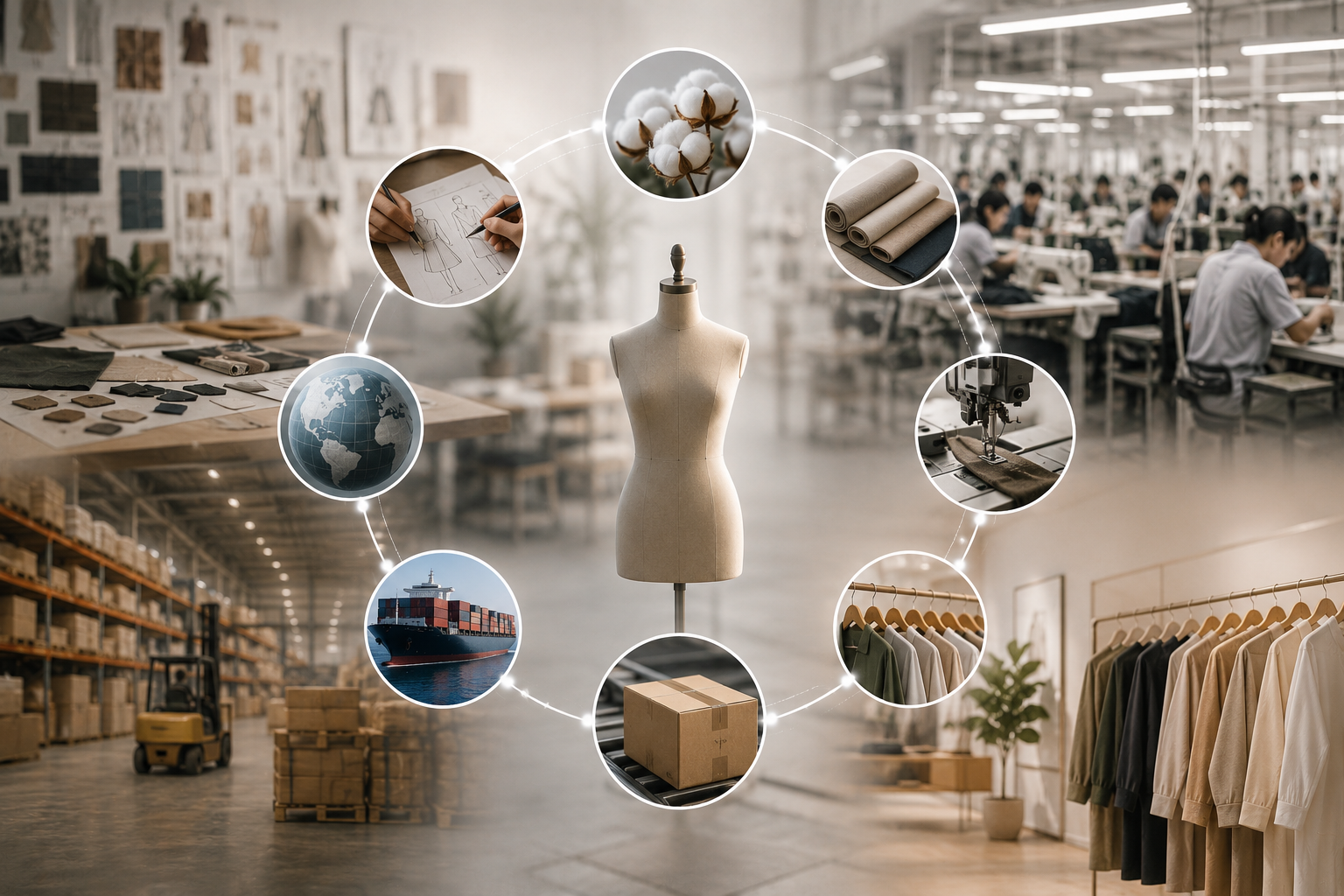
Every clothing brand hits the same wall eventually. Sourcing one bolt of fabric is easy. Running a dependable fashion supply chain that gets samples right, keeps costs predictable, and delivers product on time is not. Most founders build one broken piece at a time, discovering each gap only after it costs them money. This guide gives you a repeatable framework, built from your first fabric order through your third production run, whether you have zero manufacturing experience or you are formalizing a process that has grown ad hoc.
A well-built fashion supply chain touches every part of your business. It determines how fast you can restock a bestseller, how much cash you tie up in inventory, and whether a single late shipment sinks a launch. According to the American Apparel and Footwear Association (AAFA), the US apparel and textile industry supports a network of thousands of domestic manufacturers, giving founders more sourcing options inside the country than most new brand owners realize. Bureau of Labor Statistics (BLS) data shows US apparel and textile manufacturing employs more than 250,000 workers across thousands of active establishments, meaning real domestic capacity exists in almost every product category.
Most first-time brand owners run into the same three obstacles when they try to build one from scratch. Sourcing is fragmented across dozens of unverified suppliers. Vetting a manufacturer takes weeks of guesswork. Logistics, inventory, and reorder timing get handled reactively instead of planned in advance. Left unaddressed, any one of these problems can stall a launch or drain a season’s budget.
This guide solves all three. It walks through seven steps for building a fashion supply chain that holds up as your brand grows, from mapping your sourcing requirements through planning for scale.
Step 1: Map Your Product and Sourcing Requirements
Before you contact a single factory, define exactly what your fashion supply chain needs to deliver. Write down your hero product, your target fabric composition, your trims, and your first-season unit goal. This document becomes the reference point every supplier conversation returns to.
Good example: “Write a one-page sourcing brief listing fabric type, weight in GSM, target unit cost, and first-order quantity for your hero product.” Bad example: “Figure out what fabric to use.” The first gives you something to act on. The second leaves you guessing at every step.
Include your certifications early if they matter to your brand. If you plan to market organic or recycled materials, note the Textile Exchange standards you intend to meet, since retrofitting certification later is far more expensive than planning for it up front. If your product involves a novel construction detail, the USPTO provides guidance on design protection worth reviewing before you share specifications widely with suppliers.
Also Read: What Is MOQ? A Brand Owner’s Guide to Minimum Order Quantities →
Step 2: Choose Your Fashion Supply Chain Model
Your fashion supply chain model shapes every decision that follows. The two most common paths for a new brand are cut and sew, where a factory builds your garment from your own pattern, and private label, where you customize an existing base style.
Cut and sew gives you full control over silhouette and construction but requires a complete tech pack and a longer development runway. Private label moves faster and typically carries a lower minimum order quantity, which makes it a common entry point for a first season before a brand has proven demand.
Domestic and overseas production each carry tradeoffs. Overseas manufacturing can lower your stated per-unit price, but shipping, duties, and longer lead times often narrow that advantage once landed cost is calculated. Domestic manufacturing shortens your feedback loop: you can visit a factory, approve a sample in person, and correct an error in days rather than weeks.
Step 3: Build Your Tech Pack and Quality Standards


A tech pack is the single document that keeps your fashion supply chain accurate from sample to bulk production. It tells every manufacturer in your sourcing process exactly what to build: measurements, materials, construction details, and label placement.
Without one, two factories quoting the same design will price different products, because each will fill in missing details differently. A complete tech pack removes that guesswork and gives every link in the chain the same reference point.
Set your quality tolerances at this stage too. Decide the acceptable measurement variance for your garments, typically plus or minus half an inch on body measurements, and put it in writing before you approach a manufacturer. This single step prevents most of the disputes that slow down an early-stage brand.
Also Read: Tech Pack Clothing: What It Is and How to Create One →
Step 4: Find and Vet Your Manufacturing Partners
This is where most brand owners get stuck, and it is the step that determines whether your fashion supply chain actually functions once orders start coming in.
The old way means cold-emailing factories from a search engine, attending trade shows, and waiting weeks for a reply that may never come. Most unsolicited outreach to unfamiliar factories goes unanswered, and the manufacturers in the usa who do respond are not always vetted for domestic production or verified physical addresses. That is a slow and unreliable way to build a network you can depend on.
What to look for in a manufacturing partner: minimum order quantity that matches your budget, location and typical lead time, sample policy, and communication responsiveness during the inquiry stage. A factory that takes five days to answer a first email will take longer once a real production problem appears. For a full breakdown of the vetting process, read the Maker’s Row guide on how to find a clothing manufacturer in the USA.
Finding the right clothing manufacturer does not have to mean months of cold emails. On Maker’s Row, post your fashion project for free and verified US manufacturers bid directly. Review bids, check profiles, and connect when ready.
Describe your product, target MOQ, and fabric requirements in your project brief. Manufacturers who work with your product category and can support your fashion supply chain respond directly, often within 24 to 48 hours of a new project being posted.
Step 5: Plan Logistics, Shipping and Fulfillment
Once your manufacturer is confirmed, the next link in your fashion supply chain is getting finished goods from the factory floor to your customer’s door. Decide early whether you will hold inventory yourself, use a third-party logistics provider, or ship directly from your manufacturer’s facility.
Map your full timeline backward from your launch date: production time, quality inspection, transit time, and any customs or freight steps if a portion of your sourcing touches an overseas supplier. Build in a buffer of at least two weeks for the first production run, since first-time coordination between a new factory and a new logistics partner rarely runs exactly on schedule.
Confirm packaging requirements with your manufacturer before the first shipment leaves the factory. Poly bags, hang tags, and folding specifications that are agreed in writing prevent a bottleneck at the exact moment your product is ready to sell.
Step 6: Set Up Quality Control and Inventory Systems
Quality control is not a single inspection. It is a checkpoint built into every stage, from incoming fabric to a pre-shipment inspection of finished units. Confirm with your manufacturer whether they conduct in-line inspections during production or only a final check before shipping.
For inventory, decide on a reorder trigger before you sell your first unit. A common approach is setting a reorder point at 25 to 30 percent of your remaining stock, which gives you enough lead time to place a reorder before you run out. Waiting until a style sells out before reordering creates a gap in availability that competitors are happy to fill.
Track your defect rate by manufacturer and by production run. A rate higher than 2 to 3 percent defects on a given style signals a conversation with your factory about tolerances, not just a one-off correction. If your unit costs are running higher than expected at this stage, the Maker’s Row guide to reducing clothing manufacturing costs covers seven ways to bring per-unit pricing down without sacrificing quality.

Step 7: Build a Fashion Supply Chain That Scales
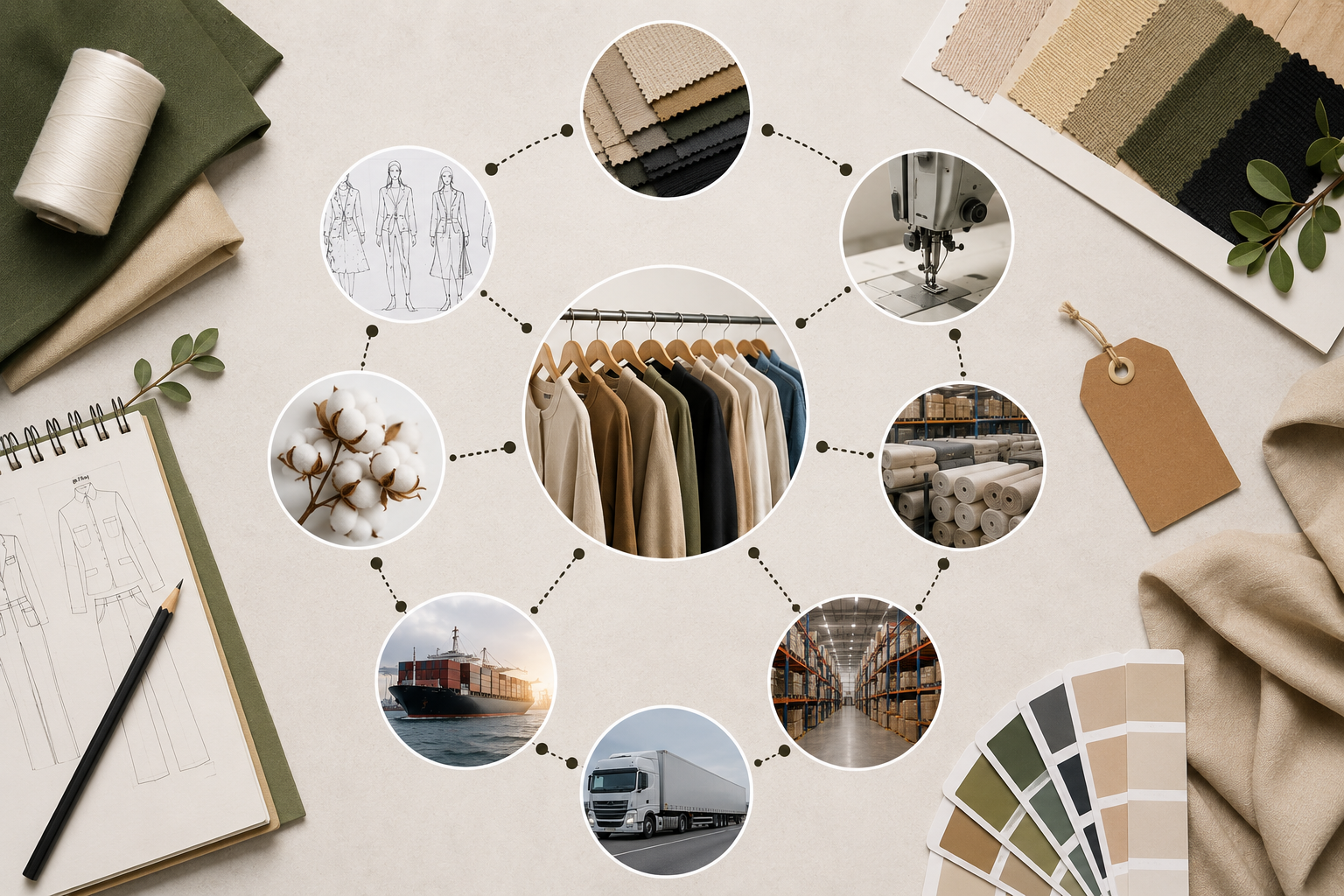
A fashion supply chain built for 200 units does not automatically work at 2,000. Before you scale, confirm your manufacturer’s capacity for a larger order, and ask directly whether their pricing or lead time changes at higher volumes.
Diversify where it makes sense. Relying on a single factory for your entire sourcing network creates real risk if that factory experiences a delay, a closure, or a capacity conflict with another client. Many established brands maintain a primary manufacturer and a qualified backup for their highest-volume styles.
The Small Business Administration (SBA) recommends that growing product businesses formally document supplier agreements and lead times as order volume increases, since informal arrangements that worked at a small scale often break down without warning once volume grows. SCORE mentorship resources are also worth exploring at this stage, since a free mentor with sourcing experience can flag risks before they become costly. Treat every production run as a data point that improves the next one.

FAQs About Building a Fashion Supply Chain
A fashion supply chain is the full sequence of steps and partners involved in turning a clothing design into a finished product a customer can buy. It includes raw material sourcing, manufacturing, quality control, logistics, and fulfillment. For a clothing brand, understanding each link lets you catch problems before they become delays.
Most new clothing brands need 12 to 20 weeks to establish a working setup for a first product, covering tech pack development, manufacturer vetting, sampling, and a first production run. Complex garments with multiple components or overseas sourcing can extend that timeline significantly.
Yes. A tech pack is the reference document every manufacturer in your sourcing network uses to quote and produce your garment accurately. Approaching factories without one leads to inconsistent quotes and samples that miss your intended specifications.
The stated per-unit price is often higher domestically, but landed cost, which includes shipping, duties, and correction expenses for specification errors, frequently narrows that gap. Domestic sourcing also shortens your feedback loop for sample corrections and quality issues.
A single manufacturer works for most first-season brands. As volume grows, a primary manufacturer plus one qualified backup protects you against a single point of failure, such as a delay or capacity conflict at your main factory.
Skipping the tech pack and quality tolerance step is the most common and costly mistake. According to AAFA industry guidance, incomplete specifications are a leading cause of production delays for emerging apparel brands, and the cost of fixing a specification error after full production is far higher than catching it before sampling begins.
Yes. Most brand owners who successfully build one start with no prior manufacturing background. What matters is a clear product spec, a realistic MOQ budget, and manufacturing partners willing to guide first-time brands through sampling and production.
Your Fashion Supply Chain Is One Manufacturer Away
You now have the framework: map your sourcing requirements, choose your model, build your tech pack, vet your manufacturer, plan logistics, control quality, and build for scale. Every clothing brand with a dependable fashion supply chain started with exactly these steps.
Your clothing brand is one manufacturer away from becoming real. The factories are on Maker’s Row, ready to bid.
