A clothing manufacturer’s price quote is typically broken into four parts: unit cost (labor, materials, and overhead), one-time sampling and development fees, minimum order quantity requirements, and shipping or logistics charges. Together, these line items make up the total cost of manufacturing clothes for your brand, and each one moves independently, so brands can negotiate them differently. A basic cut-and-sew quote for a 200-unit run of a simple garment typically lands between $15 and $45 per unit, plus $250 to $700 in one-time pattern and sample fees.
Getting a factory quote back with five or six unfamiliar line items is a common point where new brand owners stall. A quote that looks expensive is not always a bad deal, and a cheap one is not always good. Knowing what each line represents shows you where there is room to negotiate and where the number is fixed.
This guide breaks down every standard component of a US clothing manufacturer’s quote and which parts you can realistically push back on.
How Is the Cost of Manufacturing Clothes Calculated?
Total unit cost in a quote is calculated by adding CMT labor, raw materials, and a share of factory overhead, then applying the factory’s margin on top of that total. CMT (cut, make, trim) is the labor charge for cutting fabric, sewing the garment, and finishing details like trims and labels, and it is usually quoted separately from materials because the two move independently.
For a basic knit T-shirt, CMT typically runs $4 to $8 per unit, while fabric adds $3 to $7 per yard, with most tees using 1.5 to 2 yards. A structured jacket with lining and hardware can push CMT to $20 or more. Overhead, rent, machine maintenance, and compliance costs, is rarely itemized on its own; it is folded into the CMT rate, which is why two factories quoting the “same” garment can land $10 or more apart. As of 2026, Bureau of Labor Statistics data shows the US apparel and textile manufacturing sector employs over 250,000 workers, the labor pool CMT rates are built on.
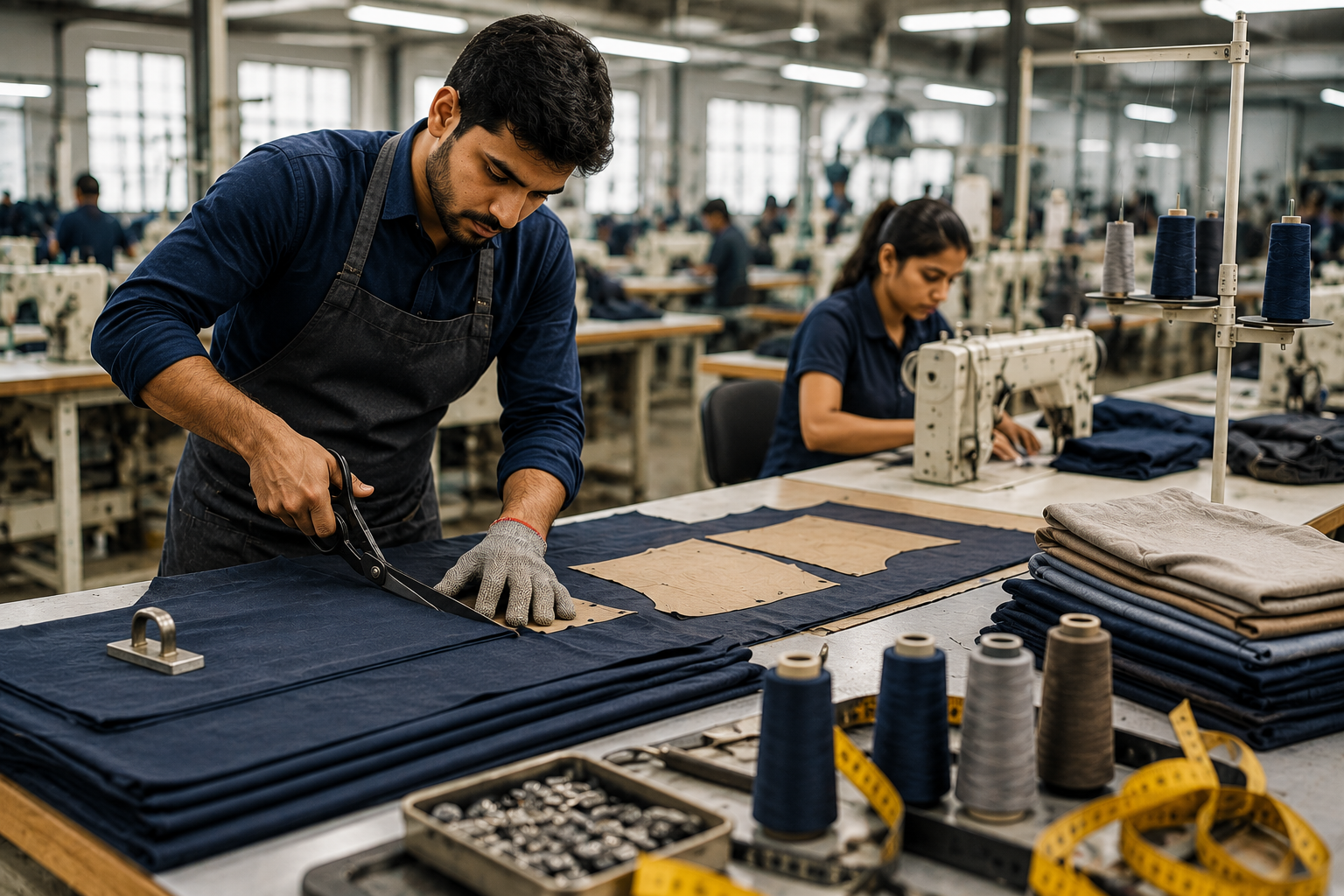
Sampling and Development Fees Explained
Sampling and development fees appear as a separate line because they are one-time charges tied to building your pattern and first sample, not the production run itself. They sit outside the recurring cost of manufacturing clothes at scale, which is why they are billed once.
Pattern making typically costs $150 to $400 per style. Sample production, sewing a prototype garment, usually runs $100 to $300 per piece, and most brands need two or three rounds before approval. A tech pack is the specification document that tells a factory exactly what to make, and a complete one reduces costly revisions. Some manufacturers credit the sample fee toward your first order; many do not, so ask before you commit.
How MOQ Affects Your Quote
MOQ affects your quote because factories spread fixed setup costs, machine configuration, thread changes, and fabric cutting, across your total unit count, so a smaller order raises the cost of manufacturing clothes per piece. MOQ, or minimum order quantity, is the smallest number of units a manufacturer will produce in a single run, and in the USA it typically ranges from 50 to 500 units per style.
A factory quoting $18 per unit at a 300-unit MOQ might quote $28 or more at 100 units, since setup labor is now divided across fewer garments.
Example: A Denver swimwear brand got quotes of $22/unit at 250-unit MOQ from one factory and $31/unit at 100 units from another. By offering a 20% deposit instead of 10%, the founder got the second factory down to 150 units at $26/unit, cutting her upfront capital need by nearly $2,000.
Quote Line Items at a Glance
Every quote breaks the cost of manufacturing clothes into a few standard line items. Here is how they compare at a glance.
Quote Line Item | What It Covers | Typical Range | Negotiable? |
Unit cost (CMT + materials) | Labor, fabric, trims per garment | $15–$80 per unit | Somewhat, with volume or simpler construction |
Pattern and sample fees | First pattern draft and sample rounds | $250–$700 per style | Rarely, though some credit it to production |
MOQ-driven setup cost | Machine setup and line preparation | Built into unit price | Yes, via negotiation or a per-unit surcharge |
Shipping and freight | Delivery of finished goods | $2–$8 per unit domestic | Yes, by carrier and shipping method |
Payment terms | Deposit structure before production | 30%-50% upfront typical | Yes, especially with a repeat-order history |
What’s Negotiable in a Manufacturer’s Quote?
Several parts of a manufacturer’s quote are negotiable, including MOQ, payment terms, and per-unit pricing at higher volumes, while pattern and sample fees are usually fixed because they reflect real, one-time labor. Negotiating these levers is the most realistic way to lower your total cost of manufacturing clothes without cutting quality.
Three approaches tend to work. A faster payment timeline, net-15 instead of net-60, gives cash-strapped factories a reason to lower unit price. Committing to a second order within six months gives a factory confidence to accept a smaller MOQ. Simplifying your design, fewer colorways or panels, lowers the factory’s real setup cost. The Small Business Administration lists supplier negotiation among the highest-value startup skills. See 30 Questions to Ask Clothing Manufacturers for what else to confirm before signing.
Find Clothing Manufacturers on Maker’s Row
Comparing quotes gets easier when more than one factory is bidding on the same brief. On Maker’s Row, a marketplace connecting apparel brand owners with verified US manufacturers, brand owners post a project for free and receive itemized bids that break down the cost of manufacturing clothes directly from factories that match their product and MOQ.

For a deeper look at what drives the unit cost itself, see Apparel Manufacturing Cost USA: What to Expect, and for a full walkthrough of the MOQ line specifically, read What Is MOQ? A Complete Guide for Brand Owners.
FAQs About Manufacturer Price Quotes
A standard quote includes unit cost (labor, materials, overhead), one-time pattern and sample fees, MOQ terms, and often shipping and payment terms. Together these line items make up the total cost of manufacturing clothes. Some factories itemize each piece; others bundle unit cost and list fees separately.
Cut-and-sew production in the USA typically runs $15 to $80 per unit depending on complexity, fabric, and order size, per benchmarks from the American Apparel and Footwear Association. A basic T-shirt sits at the lower end; a structured jacket sits higher.
Yes, though not every line item equally. MOQ, payment terms, and per-unit pricing at higher volumes are the most negotiable parts. Pattern and sample fees are usually fixed since they reflect real one-time labor.
CMT stands for cut, make, trim. It is the labor portion of unit cost, covering cutting, sewing, and finishing details like labels and trims, quoted separately from raw material cost.
Sample fees cover one-time development work before any production units exist. Some factories credit this toward your first order, but most treat it as separate, non-refundable.
Most US quotes stay valid for 30 to 60 days before the factory may revise pricing due to fabric cost changes. Confirm the expiration date before finalizing your budget.
A quote is an estimate provided before production begins and can still be negotiated. An invoice is a finalized bill issued after the factory confirms your order, with fixed terms.
When You’re Ready to Get a Quote
Understanding the cost of manufacturing clothes is the first step. Getting a quote from a factory that fits your product and order size is the next.
When you are ready, Create Your Project Free Today and describe your product, target MOQ, and budget so manufacturers send you an itemized bid to compare.