You finally landed a meeting with a boutique buyer. She asks you to send over your line sheet before she can place an order. If you have never made one, that request can stall a sale you already had in hand. This guide breaks down exactly what a line sheet needs to include, gives you a template you can copy, and shows real examples of what separates a line sheet that gets orders from one that gets ignored.
A line sheet is a one- or two-page sales document that shows a wholesale buyer every style in your collection, along with photos, pricing, and ordering details, in a single place. For a clothing brand, this means a buyer can place an order without emailing you back with basic questions, which shortens your sales cycle and reduces the chance they move on to the next designer in the pile. This guide covers what to include, a template breakdown you can build from today, and the exact steps to put one together.
What Is a Line Sheet?
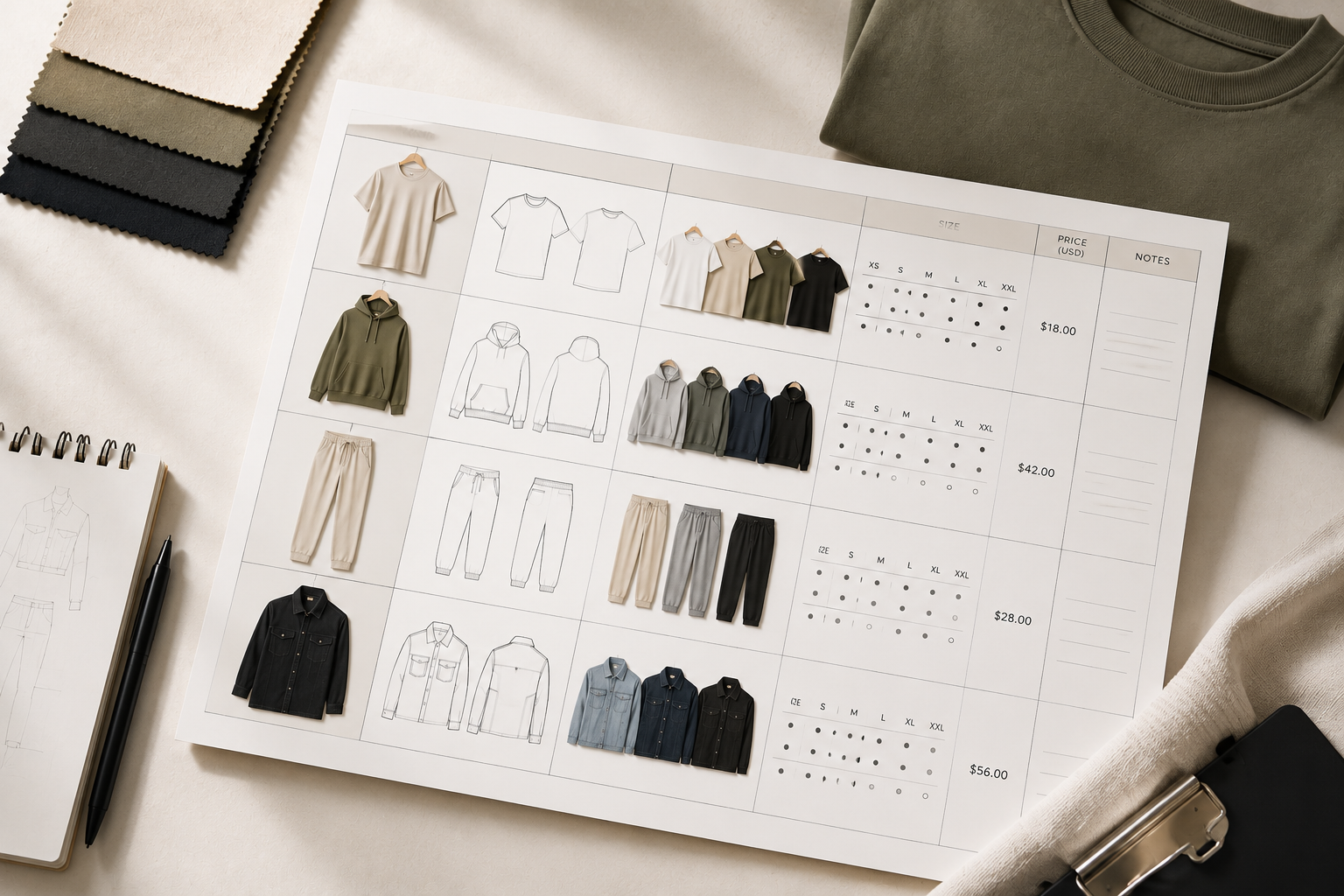
A line sheet is a sales tool that lists your products with photos, style numbers, pricing, and ordering information so a wholesale buyer can decide what to order without contacting you first. For clothing brands, this means the difference between a buyer placing an order tonight and a buyer setting your collection aside because a detail was missing.
A line sheet is not the same as a lookbook. A lookbook is a styled, editorial set of images built to communicate brand mood and inspire a customer or buyer, while a line sheet exists purely to close a wholesale order. Buyers do not buy from lookbooks. They buy from line sheets, because a line sheet answers the practical questions a lookbook was never built to answer: what does this cost, what sizes exist, and how many can I order.
Document | Purpose | Audience |
Line sheet | Communicate ordering details to close a sale | Wholesale buyers, retail buyers |
Lookbook | Communicate brand mood and styling | Press, customers, social media |
Tech pack | Communicate construction specs to a factory | Manufacturers |
Why a Line Sheet Matters for Your Brand
A disorganized line sheet costs you real orders, not just a bad first impression.
- It removes friction at the exact moment of purchase. Buyers place wholesale orders on tight schedules, sometimes at midnight before a trade show deadline. A line sheet with a gap forces a follow-up email that a busy buyer often will not send.
- It protects your margins. Listing wholesale price, MSRP, and MOQ clearly means you are not renegotiating terms after the fact or accepting an order size that loses you money.
- It signals professionalism to a first-time buyer. A clean, complete line sheet tells a retailer you understand wholesale, which matters more the earlier your brand is.
- It speeds up reorders. Once a buyer has your line sheet on file, a reorder becomes a quick reference check instead of a new round of questions. The SBA’s guidance on small business record keeping notes that organized, easy-to-retrieve sales documents directly support faster repeat transactions, which is exactly what a consistent line sheet template does season over season.
What Should Your Line Sheet Template Include?
Every line sheet template needs eight core elements, regardless of your product category. Skipping any one of these is the most common reason a buyer stalls on placing an order.
Element | What It Communicates | Example |
Product photo or sketch | What the item looks like | Straight-on product shot, no styling |
Style number | A unique reference for ordering | “TS-104” |
Style description | Key construction details, short | “Cropped boxy tee, French terry” |
Available sizes | Size range the buyer can order | XS–XL |
Available colors | Colorway options | Black, Ecru, Rust |
Wholesale price / MSRP | What the buyer pays and can resell for | $18 wholesale / $38 MSRP |
MOQ and case pack | Minimum units per style or color | 6-unit case pack, 2 per size |
Delivery date and contact | When the order ships, who to contact | Ships 11/1/26, orders@yourbrand.com |
MOQ (minimum order quantity) is the smallest number of units a buyer must order per style to place a wholesale order. State this plainly on your line sheet so a small boutique can immediately see whether your minimums fit their store size.
According to the American Apparel & Footwear Association, the US apparel and footwear industry contributes more than 3.6 million American jobs and over $523 billion in annual retail sales as of 2026, a sector built almost entirely on wholesale relationships between brands and the retailers who buy their lines. A line sheet is the document that makes those relationships function at scale.
Real Line Sheet Examples
Example: The Missing MOQ
A Portland-based knitwear brand sent a line sheet to a five-store boutique chain without listing a minimum order quantity. The buyer assumed she could order single units per style and built a proposed order around that assumption. When the brand came back with a 12-unit case minimum, the buyer had to rework her entire budget and pushed the order to the following season instead. A single line on the template would have prevented the delay.
Example: No Style Numbers
A Nashville accessories brand used product names instead of style numbers on its line sheet, calling one bag “The Weekender” and a near-identical version “The Weekender II.” A buyer’s warehouse team logged both under the same SKU during receiving and the order arrived short on the second style. Assigning simple numeric style codes, one per SKU, closes this gap entirely.
Example: Clear Pricing Won the Order
A Denver activewear brand rebuilt its line sheet to list wholesale price and MSRP side by side for every style, instead of “contact for pricing.” A regional gym retail chain told the founder directly that the transparent pricing was the reason they moved forward without a call, since their buyer could calculate margin on the spot. Pairing a strong line sheet with solid in-person habits matters too. The guide to handling your first appointment with a retail buyer covers what to expect once a buyer is ready to sit down with your line sheet in hand.
How to Create Your Line Sheet, Step by Step
Building your first line sheet takes a working afternoon, not a design degree.
- Choose your format. A simple, well-organized PDF or spreadsheet works fine for a first line sheet. Dedicated line sheet tools exist, but a clean layout in Google Sheets, Canva, or Illustrator is enough to start selling.
- Shoot or source straightforward product photos. Flat-lay or ghost-mannequin shots on a plain background work best. Save styled, moody photography for your lookbook instead.
- Assign a style number to every SKU. Keep numbers short, five digits or fewer, and use the same numbering system across every season so your records stay consistent.
- List sizes and colors available per style. Be specific. “One size” or a defined range like XS–XL removes any guesswork for the buyer.
- Set your wholesale price and MSRP. Finalize your cost sheet first, including fabric, trim, cut and sew, and shipping, before you commit to a price you can profitably fill. The guide to pricing your garment walks through the margin math in more detail if you have not set your numbers yet.
- Add your MOQ, case pack, and delivery date. State these plainly rather than “contact us,” which is the single line most likely to lose you an order from a buyer working against a deadline.
- Include your contact information and payment terms. A buyer placing a first order needs to know exactly who to email and what payment terms you require, net 30 or otherwise. SCORE’s guide to working with wholesale partners recommends tracking your full costs against your terms so your margins stay intact once orders start coming in.
- Proofread against a real order. Before sending your line sheet out, try placing a mock order using only the document. If you have to guess at anything, a buyer will too.
Your pricing accuracy on the line sheet only holds up if your production costs are confirmed with a real manufacturer, not estimated. If you have not yet locked in a US production partner, Maker’s Row’s clothing manufacturers directory lists verified US factories by category, so you can confirm real cost and MOQ numbers before your line sheet goes out to buyers.
Also Read: Tech Pack Clothing: What It Is and How to Create One →
Line Sheets and Manufacturing on Maker’s Row
Maker’s Row is a marketplace connecting apparel brand owners with verified US manufacturers, and it is where the numbers on your line sheet get confirmed before you send it to a single buyer. On Maker’s Row, brand owners post unlimited manufacturing projects for free and receive bids from verified US factories at no upfront cost. To connect directly, subscription plans give full access.
Describe your product and target order volume in your project brief, and manufacturers who work at your MOQ respond directly. Confirming real production cost and minimums before finalizing your line sheet means the pricing you send a buyer will not need to change mid-negotiation.
FAQs About Creating a Line Sheet
A line sheet should include a product photo, style number, style description, available sizes and colors, wholesale price and MSRP, MOQ, delivery date, and your contact information. Missing any of these is the most common reason a wholesale buyer stalls on placing an order. Keep the layout to one or two pages per category so buyers can scan it quickly.
A line sheet is a sales document built to close a wholesale order, while a lookbook is a styled set of images built to communicate brand mood. Buyers use line sheets to place orders because it answers pricing and sizing questions a lookbook does not address. Many brands use both together, sending the lookbook first and the line sheet once a buyer wants to order.
You can create a line sheet for free using tools you likely already have, such as Google Sheets, Canva’s free tier, or a basic PDF layout in a word processor. The template only needs eight core elements, so a simple spreadsheet or slide layout is enough for a first version. Paid line sheet software becomes worth it once you are managing multiple seasons and dozens of SKUs.
No, a line sheet and a tech pack serve different audiences. A tech pack goes to your manufacturer to specify construction, while a line sheet goes to wholesale buyers to sell finished product. Most brands finalize their manufacturer relationship and confirmed pricing first, then build a line sheet using the real cost numbers.
There is no fixed number, but most brands organize a line sheet by category or collection rather than listing every SKU on one page. A focused line sheet of 8 to 15 styles per season is easier for a buyer to scan and order from than a dense, 40-item catalog.
Common options include Canva, Adobe Illustrator, Google Sheets, and dedicated line sheet platforms like Joor or NuOrder for brands managing larger wholesale accounts. For a first line sheet, the software matters far less than including all eight core elements clearly.
A line sheet template is a reusable layout with placeholder fields for photo, style number, description, sizing, pricing, and ordering details that you update each season with new products. Building one template once and reusing it season after season keeps your line sheets consistent and saves you from rebuilding the layout from scratch every time.
Ready to Put Your Line Sheet Into Practice?
Your line sheet is only as strong as the production numbers behind it. Confirm your real manufacturing costs and MOQ with a verified US factory before your next line sheet goes out to buyers.