Walk into any lingerie sourcing meeting and you will hear a dozen cup names, band terms, and wire shapes. For a founder, that vocabulary is expensive to get wrong. This guide covers the eight types of bras that matter most, what each one demands from a factory, and which suit a first collection.
These styles differ in construction, not just in looks. A bralette and an underwire full-coverage bra share a name but need different trims, machines, and fit testing.
Knowing the style changes your first call with a manufacturer. You can state the cup style, wire choice, and fabric in one message and get a real quote instead of a list of questions.
Below, we walk through each style and what it means for minimums, US availability, and production cost.
Why Do Types of Bras Matter for Brand Owners?
The different types of bras matter because each one fixes your pattern complexity, your parts list, and the number of fit rounds before production. A tech pack is the document that lists every measurement, material, and construction detail a factory needs to build your style. Our guide to tech packs shows what goes in one, and a bra needs more detail than a tee.
In 2016, Sumiyyah Rashed, founder of ANN NAHARI in Decatur, GA, documented on Maker’s Row an 18-month path for a 3-part cut and sew bra. Her team ran a 12 to 24 piece sample run before approving production. Pick a simpler style and you shorten that road. Each style below sits somewhere on that road.
Complete List: 8 Types of Bras
The eight types of bras every brand owner should know are the T-shirt bra, push-up bra, plunge bra, balconette bra, full-coverage bra, sports bra, bralette, and strapless bra. An underwire is a curved metal or plastic support sewn into a channel under each cup to lift and separate the breasts. Several styles use one, and each wired style adds a trim and a fit variable.
MOQ (minimum order quantity) is the smallest number of units a factory will produce per style per order. MOQ varies by factory, so each entry below flags what the type means for your minimum. Each entry ends with a relative cost tier and a US availability note, both explained under the table.
1. T-Shirt Bra
A T-shirt bra is a smooth-cup bra built to disappear under fitted knit tops.
Best for: Everyday wear under tees and thin jersey.
Properties: Molded or spacer-fabric cups, no visible seams, light lining, offered wired or wireless.
Common use in fashion: Core basics and everyday collections.
Ask each factory whether it molds cups in house or buys pre-molded cups, because that answer sets your minimum and lead time. Relative cost tier: Moderate, driven by cup material and lining. US availability: Maker’s Row’s 2026 brassiere list names Seam Apparel in Los Angeles for seamless and padded styles.
2. Push-Up Bra
A push-up bra is a padded bra that lifts the bust and moves volume upward and inward.
Best for: Low necklines and customers who want added shape.
Properties: Graduated padding, thicker at the bottom and sides of each cup, angled cup shape, usually underwired.
Common use in fashion: Going-out, occasion, and fashion-forward lingerie lines.
Padding is an extra component and fit variable, so lock padding thickness before you approve the fit sample. Relative cost tier: Higher, because of the padding insert, wire, and trims. US availability: Seam Apparel lists push-up and padded construction.
3. Plunge Bra
A plunge bra is a wired bra with a deep V-shaped center panel and cups angled toward the sides.
Best for: Low-cut dresses, deep V necklines, and wrap tops.
Properties: Low center gore, wide-set angled cups, usually underwired.
Common use in fashion: Evening and occasion collections.
Gore height sets how the bra sits under a neckline, so state it in your tech pack. Relative cost tier: Higher, because the gore and wire shape need precision. US availability: Underwire-capable factories such as ARGYLE Haus in San Fernando, CA and Argus Apparel in Los Angeles appear on Maker’s Row’s 2026 list.
4. Balconette Bra
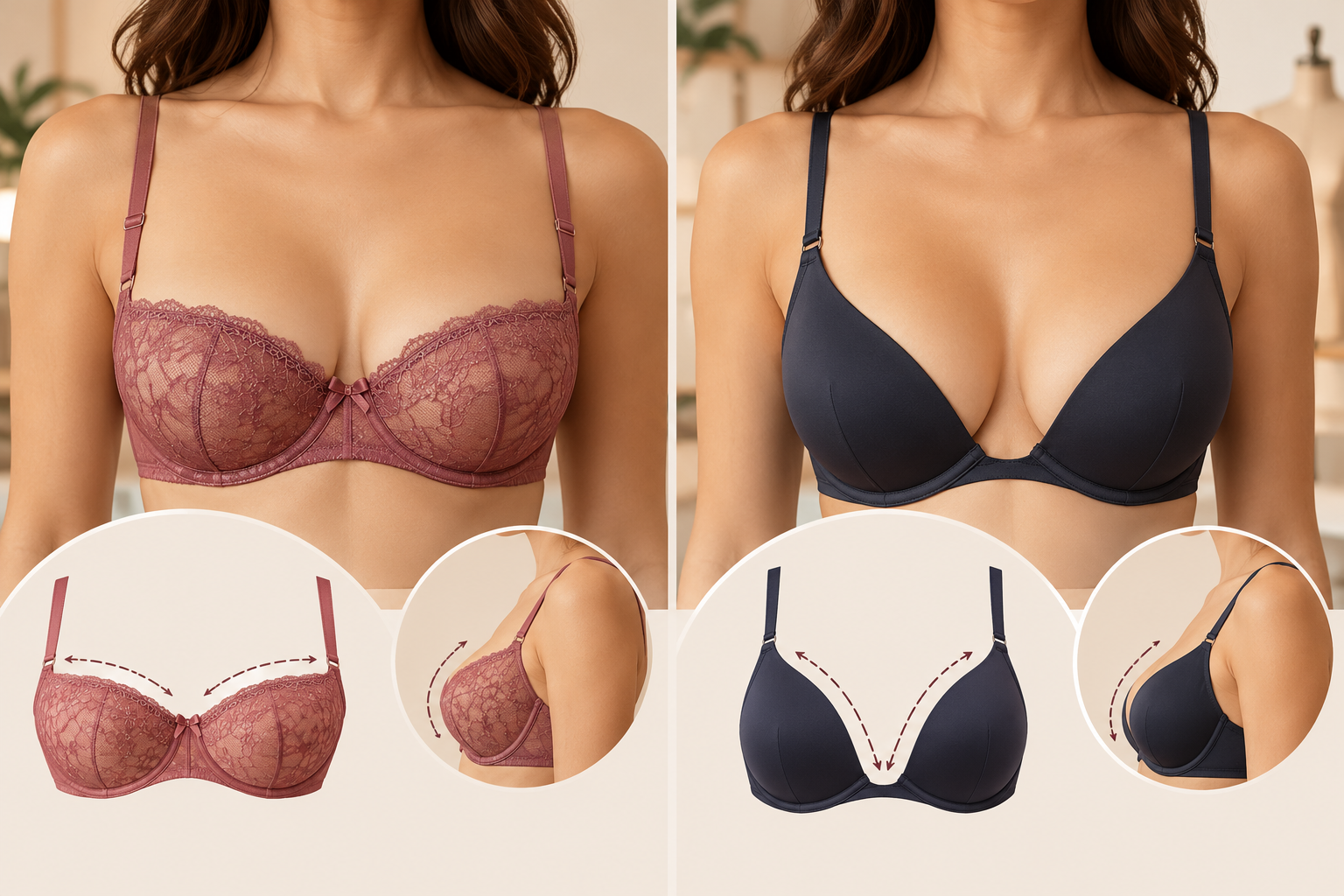
A balconette bra is a half-cup wired bra with wide-set straps and a straight-across neckline.
Best for: Square, scoop, and wide necklines.
Properties: Horizontal cup edge, wide-set straps, underwire, often lace or mesh uppers.
Common use in fashion: Lace-forward lingerie sets and fashion collections.
Lace drives the risk here. A lingerie founder writing on Maker’s Row recommends measuring lace, steaming it heavily, and measuring again to catch shrinkage before you cut. Relative cost tier: Higher, from lace, wire, and paneling. US availability: the same underwire-capable factories listed for plunge bras.
5. Full-Coverage Bra
A full-coverage bra is a supportive bra with tall cups that cover the whole breast, plus a wide band and wide straps.
Best for: Fuller busts, daily support, and comfort-first brands.
Properties: Tall cups, wider band and straps, often underwired, often built from cut and sew cups. A cut and sew cup is a cup assembled from flat fabric panels stitched together instead of molded in one piece.
Common use in fashion: Core support lines with extended size ranges.
Grading is the process of scaling a base pattern into every size in your range while keeping fit and proportions. Apparel grading multiplies cost here, because every band and cup combination is a separate size. Rashed drafted band sizes 38, 40, 42, 44, 46, and 50 across all cup sizes. She noted that this lengthened her design process. A 50-unit minimum spread across 12 size combinations leaves about 4 pieces per size. Relative cost tier: Higher, from extra panels and a wider size range. US availability: the same underwire-capable factories listed for plunge bras.
6. Sports Bra
A sports bra is a bra built to limit breast movement during exercise, usually from stretch knit fabric.
Best for: Training, running, and yoga, with support matched to impact level.
Properties: Compression or encapsulated cups, wide straps, racerback or hook-back designs, nylon or polyester blended with spandex.
Common use in fashion: Activewear and athleisure lines.
Many brands label sports bras low, medium, or high impact. Ask how the factory tests support before you print that claim on a hang-tag. Stretch fabric also needs careful sewing. Maker’s Row’s cost guide puts activewear at roughly 15 to 25 sewing operations. Relative cost tier: Moderate to Higher, from stretch handling and seam work. US availability: Cord Apparel in Missouri City, TX lists custom and sports bras.
7. Bralette
A bralette is a soft, unstructured bra with no underwire and usually no molded padding.
Best for: Comfort-first lines, loungewear, layering, and first collections.
Properties: Lace, mesh, or jersey, pullover or hook-back, light lining or none, shape from stretch.
Common use in fashion: Loungewear, sleepwear sets, and everyday comfort lines.
Among all the types of bras listed here, the bralette has the simplest build, so it samples faster and needs fewer trims. Many bralettes use letter sizes, so a 50-unit minimum across five sizes leaves about 10 pieces per size. Relative cost tier: Lower, from the fewest trims and the shortest sewing sequence. US availability: Argus Apparel in Los Angeles lists bralette styles.
8. Strapless Bra
A strapless bra is a bra that stays in place through its band alone, with removable or no straps.
Best for: Strapless dresses, off-shoulder tops, and occasion wear.
Properties: Silicone gripper elastic on the band edge, boning or underwire, a wide band, often convertible straps.
Common use in fashion: Occasion and bridal collections.
Of the types of bras covered here, this one has the tightest band fit tolerance, so budget extra fit rounds and source gripper elastic early. Relative cost tier: Higher, from gripper elastic, boning, and wire. US availability: Seam Apparel lists strapless construction.
Fabric sits under all eight styles above. Textile Exchange’s Materials Market Report 2025 found that polyester made up 59% of global fiber production in 2024, with cotton at 19%. Ask each factory for the fiber content of every fabric.
The FTC also shapes your bra labels. Under its textile labeling guidance, most clothing must carry a label listing fiber content, country of origin, and the identity of the manufacturer or marketer. A bra made in the US from imported fabric must say so, for example “Made in U.S.A. of imported fabric.”
Comparison Table: Types of Bras at a Glance
This table compares the types of bras by use, properties, relative cost, and US availability. Use it to shortlist two bra styles before you contact a factory.
Type | Best For | Properties | Cost Range | USA Availability |
T-shirt bra | Everyday wear under knits | Molded or spacer cups, no seams, wired or wireless | Moderate: cup material and lining | Seamless and padded styles listed in Los Angeles |
Push-up bra | Low necklines, added shape | Graduated padding, angled cups, usually wired | Higher: padding insert, wire, trims | Push-up and padded styles listed in Los Angeles |
Plunge bra | Deep V necklines | Low center gore, angled cups, usually wired | Higher: precise gore and wire shape | Underwire-capable factories in Los Angeles and San Fernando, CA |
Balconette bra | Square and wide necklines | Half cup, wide-set straps, wired, lace or mesh | Higher: lace, wire, paneling | Underwire-capable factories in Los Angeles and San Fernando, CA |
Full-coverage bra | Fuller busts, daily support | Tall cups, wide band, often cut and sew cups | Higher: more panels, wider size range | Underwire-capable factories in Los Angeles and San Fernando, CA |
Sports bra | Training and yoga | Compression or encapsulated cups, stretch knit | Moderate to Higher: stretch handling, seam work | Sports bras listed in Missouri City, TX |
Bralette | Comfort, loungewear, first collections | No wire, light or no lining, lace, mesh, or jersey | Lower: fewest trims, shortest sewing sequence | Bralettes listed in Los Angeles |
Strapless bra | Strapless and off-shoulder outfits | Gripper elastic band, boning or wire | Higher: gripper elastic, boning, wire | Strapless styles listed in Los Angeles |
Availability reflects capabilities listed in Maker’s Row’s 2026 brassiere manufacturer list. It is not a count of factories.
A relative cost tier ranks how many parts, panels, and sewing steps a style needs compared with the other seven. It is not a quote. To turn a tier into dollars, ask your factory for sewing minutes per piece and multiply by $0.29. That figure is the 2025 median sewing machine operator wage of $17.37 per hour, reported by the U.S. Bureau of Labor Statistics, divided by 60 minutes. Then add materials, trims, and overhead, which Maker’s Row’s cost guide breaks down.
How Do You Choose the Right Types of Bras for Your Brand?
Choose your first bra by matching your customer’s main use to the simplest construction that serves it. Ask these five questions before you contact a factory.
- Who wears it, and under what? A T-shirt bra serves daily knits, a sports bra serves training, and a strapless bra serves one outfit type.
- Wire or no wire? Underwire adds a channel, wires, and extra fit rounds. A bralette skips all three.
- How many sizes can your first run support? Divide the factory’s minimum by your size count before you commit to an extended range.
- Which fabric fits the use? Use stretch knits for sports bras and lace or mesh for bralettes and balconettes. The lingerie founder on Maker’s Row advises testing sample yardage before you buy fabric in bulk.
- Can the factory fit-test? Ask whether they use a fit model and how many fit rounds the quote includes.
Start with the simplest of the types of bras that serves your customer, then add wired styles once your first run sells through.
Also Read: 7 Best Brassiere Manufacturers in the USA (2026) →
Finding Bra Manufacturers on Maker’s Row
Maker’s Row is a marketplace connecting apparel brand owners with verified US manufacturers. Finding the right bra manufacturer for your chosen types of bras does not have to mean months of cold emails. On Maker’s Row, post your bra project for free and verified US manufacturers bid directly. Review bids, check profiles, connect when ready.
Describe your bra style, wire choice, cup construction, and fabric in your project brief. On Maker’s Row, brand owners post unlimited manufacturing projects for free and receive bids from verified US factories at no upfront cost. To connect directly, subscription plans give full access.
FAQs About Types of Bras
The most common types of bras are the T-shirt, push-up, plunge, balconette, full-coverage, sports, bralette, and strapless bra. Specialty styles include nursing, maternity, minimizer, and convertible bras. This guide covers the eight that matter most for a new brand.
Among the types of bras for daily wear, a T-shirt bra is the usual choice because its smooth cups hide under fitted tops. A bralette suits customers who put comfort first and want no wire. Test both with a fit model before you commit to bulk.
A push-up bra lifts through graduated padding. A balconette is a half-cup wired bra that lifts through cup shape and wide-set straps. Both are usually wired, so both need similar wire and fit work. Balconettes lean on lace and mesh.
A bralette is the easiest of the types of bras for a new brand to manufacture. It has no underwire and usually no molded padding, which means fewer trims, a shorter sewing sequence, and faster sampling. It also often ships in letter sizes, which makes a small minimum easier to spread across sizes. Move on to wired types of bras once your first run sells.
Yes, bras can be made in the USA, though wired and molded styles need specialized factories. As of September 2026, preliminary data from the U.S. Bureau of Labor Statistics shows apparel manufacturing employing about 71,400 workers, with 6,199 private establishments in the first quarter of 2026. Maker’s Row’s 2026 brassiere list names factories in Los Angeles, San Fernando, and Missouri City, TX.
Minimums vary by factory and style, so request a per-style number in writing. Maker’s Row’s 2026 brassiere list shows Seam Apparel in Los Angeles at about 50 to 100 pieces per design, while other factories quote per project. Divide any minimum by your size count to see what each size gets across your types of bras.
Now You Know the Types, Here Is Your Next Step
Your bra brand is one manufacturer away from becoming real. The factories are on Maker’s Row, ready to bid.