What is a bill of materials? It is a structured list of every material, trim, and packaging item needed to make one finished product, with the quantity of each.
If you are launching your first apparel or soft goods line, this list is how a factory prices your product and orders what it needs. A vague list leads to surprise costs, slow quotes, and arguments over who forgot the drawcord. A clear one lets you compare factories line by line.
This guide explains what a BOM contains, why it matters, how to build one, and how to use it with US manufacturers.
What Is a Bill of Materials?
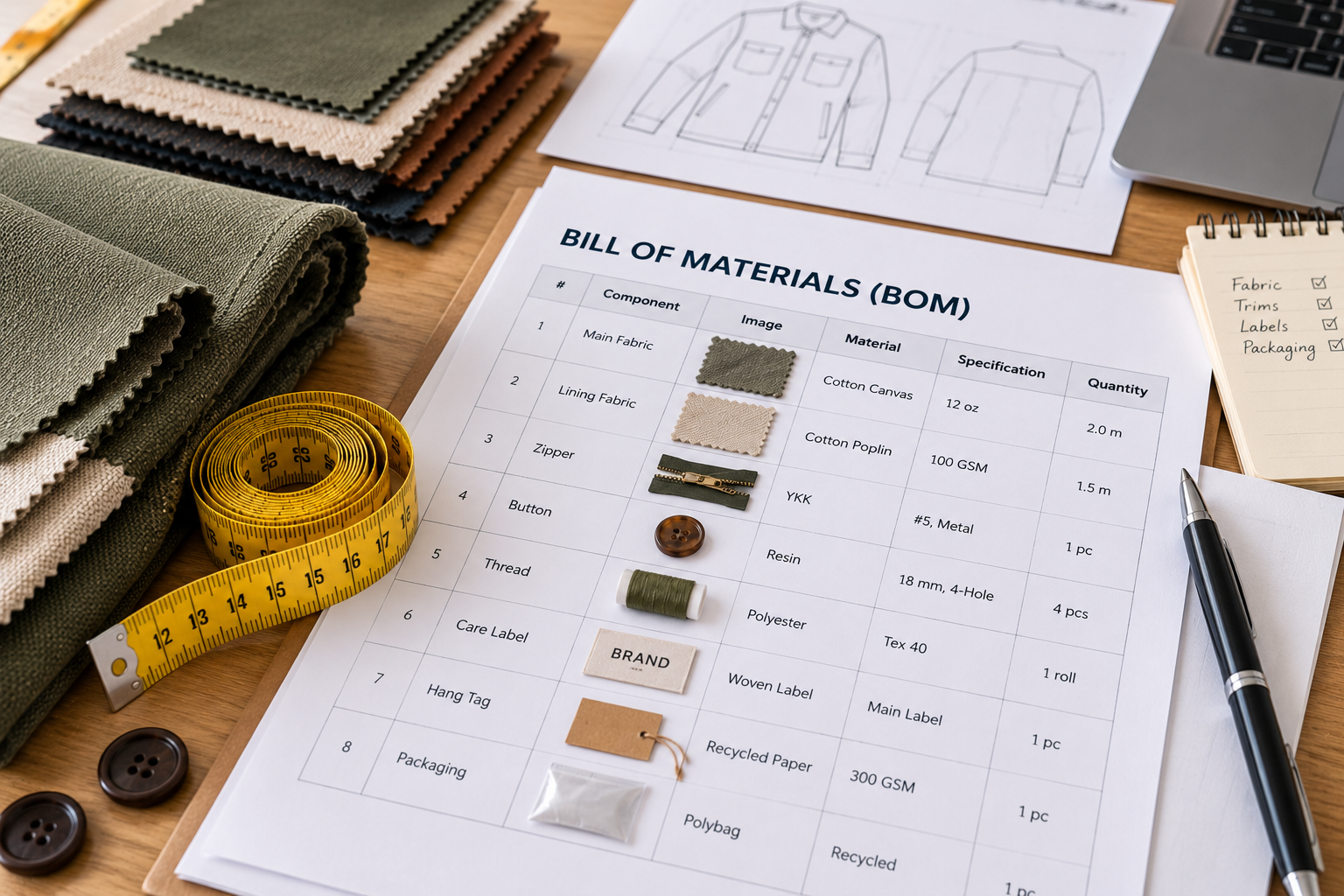
A bill of materials (BOM) is a complete list of every material, component, and packaging item needed to make one unit of a product. Each line adds a specification, a quantity, and a unit of measure.
Let’s talk about where it fits. A bill of materials is one section of your tech pack, the document that gives a factory your full production instructions. The US Bureau of Labor Statistics describes cut and sew apparel manufacturing as purchasing fabric and cutting and sewing it into a garment. That purchasing step starts with your BOM. Our guide to what a tech pack is covers the other sections.
Each BOM line answers the same six questions:
BOM field | What it tells the factory | Example (hoodie) |
Item | Which part of the product | Main fabric |
Specification | Fiber content, weight, width, color, size | Cotton fleece, 320 GSM, 60 in wide (example spec) |
Quantity per unit | How much one finished product uses | 1.60 yd |
Unit of measure | How the item is counted | Yards |
Source | Who buys it: you, the factory, or a named supplier | Factory sources |
Notes | Placement, tolerances, approval status | Match approved swatch |
Two terms appear on nearly every BOM. A trim is any non-fabric component, such as a zipper, button, or drawcord. A wastage allowance is extra material added to cover cutting waste and defects.
A BOM lists materials, not labor. Sewing labor appears separately in your factory quote. For scale, BLS reports a 2025 median wage of $17.37 an hour for sewing machine operators. At that wage, an assumed 25-minute sewing time equals about $7.24 in wages alone, before overhead and profit.
Why Does a Bill of Materials Matter for Your Brand?
A bill of materials matters because it controls three things you care about: price accuracy, legal compliance, and repeatable quality.
- Accurate quotes. Factories price from quantities. When every factory quotes the same list, you compare like with like instead of guessing why one number is higher.
- Fair pricing. SCORE explains that your price must cover purchase, labor, packaging, freight, a share of overhead, and a reasonable profit. Your BOM supplies the purchase and packaging inputs.
- Legal labels. The FTC says textile labels carry fiber content, country of origin, and a company name or RN number. Under the Care Labeling Rule, manufacturers and importers must attach care instructions. Listing each label as its own BOM line keeps them from being forgotten. Read more in our guide to FTC label requirements.
- Chemical compliance. AAFA published RSL 26 in January 2026, a list of restricted chemicals in finished apparel, home textiles, and footwear. Exact material specs on your BOM give suppliers what they need to check against it.
- Easy reorders. A saved BOM lets you repeat the same product later without describing it again.
Real Examples of a BOM at Work
Two worked examples show how a BOM turns one product’s needs into a production order. Both use example inputs for quantities and wastage. They are illustrations, not market prices or client data.
Example 1: A Los Angeles hoodie run of 150 units. The brand lists nine lines plus a wastage allowance for one hoodie, then multiplies by its order size.
Line | Item | Qty per unit | Unit | Total for 150 units |
1 | Main fabric | 1.60 | yd | 240 yd |
2 | Rib trim | 0.25 | yd | 37.5 yd |
3 | Drawcord | 1 | pc | 150 pcs |
4 | Eyelets | 2 | pcs | 300 pcs |
5 | Thread | 1 | set | 150 sets |
6 | Woven neck label | 1 | pc | 150 pcs |
7 | Care and content label | 1 | pc | 150 pcs |
8 | Hangtag | 1 | pc | 150 pcs |
9 | Polybag | 1 | pc | 150 pcs |
10 | Wastage allowance (8% of line 1) | 0.128 | yd | 19.2 yd |
The factory now orders 259.2 yards of main fabric (240 plus 19.2). The brand sends one list instead of nine emails.
Example 2: A Chicago tote bag run of 250 units. Each bag uses 0.9 yards of canvas and 1.5 yards of webbing. That means 225 yards of canvas and 375 yards of webbing. With the same 8% wastage on canvas, the canvas order rises to 243 yards.
The brand sends this list to three factories. Their quotes now compare line by line. The totals also help in minimum conversations, because material suppliers often set their own limits. Our guide to minimum order quantities explains how that works.
How Do You Build a BOM?
You build a bill of materials by listing every part of the product, specifying each part, and multiplying quantities by your order size. Follow these seven steps:
- List every part. Start from your sketch. Walk the product from outside to inside, then add labels and packaging.
- Specify each item. Write fiber content, weight, width, color, and size. “Black thread” is vague. “Polyester thread matched to the approved swatch” is usable.
- Set the quantity per unit. Ask your pattern maker or factory for fabric use. It comes from the apparel marker, the layout of pattern pieces on the fabric.
- Add a wastage allowance. Ask your factory which percentage it uses. The 8% in our examples is an assumed input.
- Assign sourcing. Mark each line as supplied by you or by the factory. A CMT factory typically sews materials you provide, while a full package factory typically sources them. See CMT vs FPP for the difference.
- Add label and compliance lines. Include the content label, care label, and your RN number or company name.
- Multiply by order size. Total need equals quantity per unit times units, plus wastage.
Once the totals are set, the SBA offers a startup costs worksheet that helps you turn them into a budget.
Also Read: How To Make A Professional Tech Pack On Your Own
Bill of Materials on Maker’s Row
Maker’s Row is a marketplace connecting apparel brand owners with verified US manufacturers. A clear bill of materials makes every bid you receive easier to read.
Finding the right apparel manufacturer does not have to mean months of cold emails. On Maker’s Row, post your apparel project for free and verified US manufacturers bid directly. Review bids, check profiles, connect when ready.
Brand owners can post unlimited manufacturing projects at no cost and receive bids from verified US factories with no upfront fee. Replying to factories directly requires a subscription plan. Put your BOM details in your project description, so each factory bids on the same materials.
Frequently Asked Questions
A BOM is a shopping list for one product. It names every fabric, trim, label, and package item, plus how much of each one unit needs. Factories use it to price and order materials.
A tech pack is the full set of production instructions, and a BOM is one section inside it. The tech pack adds measurements, construction details, and artwork. The BOM covers materials and quantities only.
A BOM should include every fabric, trim, label, and packaging item. For each line, add the specification, quantity per unit, unit of measure, and sourcing. Include the care and content labels, because the FTC requires them on most apparel.
The brand usually starts it, and the factory confirms it. Your pattern maker or factory should check fabric quantities against the marker. Your factory may also suggest supplier substitutions, which you should approve in writing.
Multiply the quantity per unit by your order size, then add a wastage allowance. For example, 1.60 yards per hoodie across 150 hoodies equals 240 yards. An assumed 8% wastage adds 19.2 yards, for 259.2 yards in total.
No, a BOM lists materials only. Labor, overhead, and profit appear in your factory quote or cost sheet. SCORE advises that your final price must cover all of them.
Ready to Put a Bill of Materials Into Practice?
Your apparel brand is one manufacturer away from becoming real. The factories are on Maker’s Row, ready to bid. Start with a clear bill of materials, and your first quotes will be easier to compare.