Finding a US mill that will spin wool yarn for a clothing brand should not mean months of dead-end emails. Most founders discover that many spinners sell only to craft shops, then learn their order is too small for the rest. This guide names eight working mills that fit a clothing brand.
The best yarn manufacturers for a clothing brand offer four things. They quote a clear MOQ, sit near your knitwear factory, specialize in your fiber, and sample willingly. MOQ (minimum order quantity) is the smallest amount a mill will spin or sell in one order. For yarn, that number is counted in pounds, not units.
US spinning capacity is small. As of October 2026, the U.S. Bureau of Labor Statistics counts about 77,700 jobs across all textile mills, yarn and fabric combined (preliminary). Confirm that yarn manufacturers still take outside orders before you design a collection around one.
If you already know what you are making, Start Your Free Project, and verified US knitwear manufacturers will respond directly.
What Should You Look for in Yarn Manufacturers?
Look for mills that take commercial orders, quote in pounds you can afford, and spin the fiber your garment needs. Many clothing brands never buy yarn directly, because their knitwear factory buys it for them.
- MOQ range: US wool spinners rarely publish minimums, so request a quote. Mountain Meadow Wool’s custom program shows pricing tiers at 250 to 500 pounds and above 500 pounds of yarn, per a SARE program sheet.
- Location and lead time: Add freight from the mill to your knitwear factory to your cost estimate.
- Fiber speciality: Worsted yarn is spun from combed fibers and feels smooth and strong. Woolen yarn is spun from carded fibers and feels lofty and warm.
- Sample policy: Ask yarn manufacturers for a sample cone in your exact color. A refusal is a warning sign.
- Certification and labeling: The Responsible Wool Standard (RWS) is a voluntary Textile Exchange standard that certifies every site from wool farm to final business-to-business seller. The FTC also says anyone who makes or sells clothing containing any wool must follow the Wool Products Labeling Act.
Best Yarn Manufacturers in the USA (2027)
Eight US mills qualify, and each has a verified address, a documented history, and a named third-party source. Two well-known names are missing on purpose.
Brooklyn Tweed says on its site that it left yarn production in 2025. Handwoven Magazine reported that Jagger Spun of Springvale, Maine ceased yarn production. Confirm current status before you plan around any of these yarn manufacturers.
1. Kentwool
Location: Pickens, SC
MOQ: Contact for quote
Speciality: Combed and dyed worsted wool and wool-blend yarn
Best for: Brands with volume and a knitwear factory ready to run it
Kentwool dates to 1843 and spins at a 135,000-square-foot plant with about 20,000 spindles, per Textile World’s 2018 report. It reported Responsible Wool Standard certification in 2023.
2. Kraemer Textiles
Location: Nazareth, PA
MOQ: Contact for quote
Speciality: Commercial and craft wool yarns, including US merino
Best for: Brands that need a mill with uniform-scale experience
Kraemer says it has spun yarn in Nazareth for more than a century. In 2013, The Express-Times reported that it spun about 6,000 pounds of yarn for US Olympic team uniforms.
3. Harrisville Designs
Location: Harrisville, NH
MOQ: Contact for quote
Speciality: Woolen-spun 100% wool yarn from US-sourced wool
Best for: Heritage-style sweaters with a soft, lofty hand
Woolen yarn has been spun in this village since 1794, and the mill has run since the early 1970s. Brooklyn Tweed’s impact report listed it as a spinning partner. Its machines recently moved to Mill No. 6, so ask whether outside orders are open.
4. Mountain Meadow Wool
Location: Buffalo, WY
MOQ: Tiered program pricing, confirm current terms
Speciality: Full-process mill from scouring to knitting and dyeing
Best for: Small brands that want custom yarn and prototypes
Founded in 2007, this mill handles every step from raw wool to knit goods, per the American Sheep Industry Association’s processor list. The Associated Press reported in 2017 that larger companies usually use it for prototypes first.
5. S&D Spinning Mill
Location: Millbury, MA
MOQ: Contact for quote
Speciality: Custom-blended yarn for outside brands
Best for: Brands that want a niche fiber blend spun in New England
The Dearnley family has run S&D Spinning since the 1800s, per Buffalo Wool Co. That brand has its bison down and merino blend made at S&D, so the mill spins to a customer’s recipe.
6. Green Mountain Spinnery
Location: Putney, VT
MOQ: Contact for quote
Speciality: Small-batch custom spinning of wool, alpaca, mohair, cotton, and Tencel blends
Best for: Brands with their own fleece or an organic story
Vogue Knitting Live lists it as a worker-owned cooperative founded in 1981. Textile World reported in September 2026 that customers ship or drop off raw wool. It has offered certified organic processing, so confirm that certificate is current.
7. Bartlettyarns
Location: Harmony, ME
MOQ: Contact for quote
Speciality: Mule-spun woolen yarn, including Fisherman yarns
Best for: Heritage mittens, hats, and sweaters in small lots
Bartlettyarns has spun wool in Harmony since 1821. The Portland Press Herald reported that its 1948 spinning mule is the last of its kind in the country. Its owners said in a 2013 interview that wholesale accounts are mainly yarn shops, so ask about commercial lots.
8. Brown Sheep Company
Location: Mitchell, NE
MOQ: Contact for quote
Speciality: Wool and natural-fiber yarns spun and dyed in-house
Best for: Brands that want a deep stock palette over custom spinning
Founded in 1980, the mill sources raw wool from Wyoming and Colorado producers, per radio station WYLR. The Long Thread podcast says it does its own dyeing. Among these yarn manufacturers, it leans most toward yarn shops, per Nebraska Passport. Ask about cone pricing and commercial volumes.
Yarn Manufacturers Comparison Table
This table compares all eight mills by location, MOQ, and speciality.
Manufacturer | Location | MOQ | Speciality | Best For |
Kentwool | Pickens, SC | Contact for quote | Worsted wool and blends | Volume orders |
Kraemer Textiles | Nazareth, PA | Contact for quote | Commercial and craft wool | Uniform-scale projects |
Harrisville Designs | Harrisville, NH | Contact for quote | Woolen-spun 100% wool | Heritage sweaters |
Mountain Meadow Wool | Buffalo, WY | Tiered, confirm terms | Full-process, custom yarn | Prototypes, small brands |
S&D Spinning Mill | Millbury, MA | Contact for quote | Custom fiber blends | Niche blends |
Green Mountain Spinnery | Putney, VT | Contact for quote | Small-batch custom spinning | Own fleece, organic |
Bartlettyarns | Harmony, ME | Contact for quote | Mule-spun woolen yarn | Small heritage lots |
Brown Sheep Company | Mitchell, NE | Contact for quote | Stock wool, in-house dyeing | Stock color range |
Calling eight mills means eight conversations, and most will not quote a pound until they see your spec. The faster path is posting your finished garment and letting knitwear factories come to you. Our guide to US knitted fabric manufacturers covers the next step.
Find Wool Knitwear Manufacturers on Maker’s Row
Finding the right knitwear manufacturer does not have to mean months of cold emails. On Maker’s Row, post your wool knitwear project for free and verified US manufacturers bid directly. Review bids, check profiles, connect when ready.
Maker’s Row is a marketplace connecting apparel brand owners with verified US manufacturers. Factories on Maker’s Row are active and responsive. Many reply within 24 to 48 hours of a new project being posted.
Even the best yarn manufacturers supply only one input. When you post a sweater, hat, or sock project, ask each bidder whether they buy yarn or knit yarn you supply.
Brand owners post unlimited projects for free and collect bids with nothing due upfront. Connecting directly with factories takes a paid subscription plan. For other categories, browse our clothing manufacturers directory.
How Do You Choose Between Yarn Manufacturers?
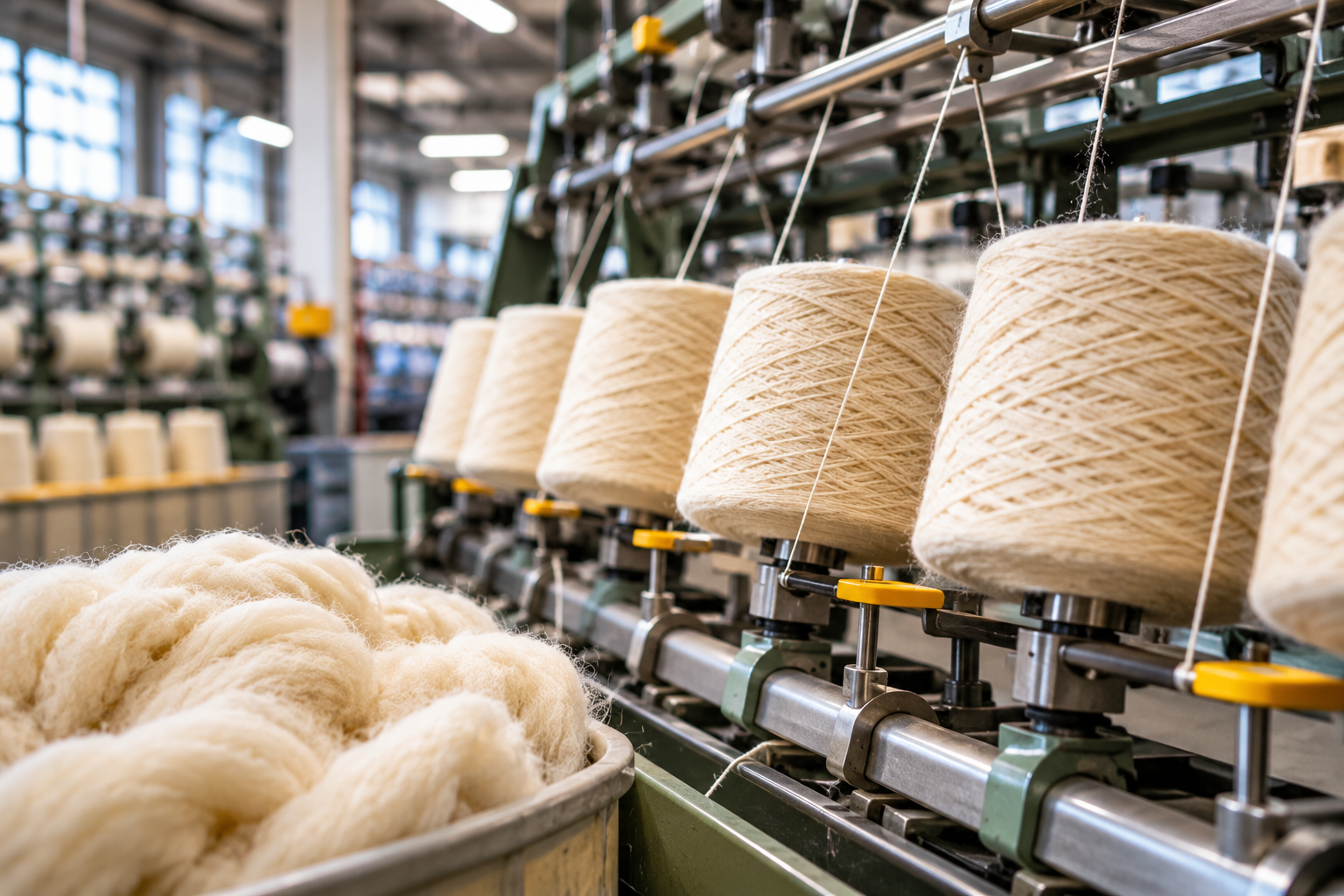
Compare mills by matching minimum, fiber, and lead time to your first run, then test with a small order.
- Define MOQ and budget before reaching out. Ask your knitwear factory how many pounds one style uses, then multiply by your run. VTDigger reported in 2023 that Muriel’s of Vermont, a sweater brand, sends four or five crates of fleece to a processor. Each crate holds about 200 pounds. Read our MOQ guide before you request quotes.
- Request samples before committing to full production. Ask for one sample cone per colorway and knit a swatch.
- Ask for sampling lead time separately from production.
- Verify certifications relevant to wool. Ask whether the mill holds RWS, and ask a US supplier for a written guaranty of compliance with the Wool Products Labeling Act.
- Start with a small test order before scaling. One style in one colorway tells you more about quality control than any sales call.
FAQs About Yarn Manufacturing in the USA
No published average exists, because most US mills quote minimums by the pound after reviewing your spec. Mountain Meadow Wool’s custom program shows tiers at 250 to 500 pounds of yarn and above 500 pounds. Brown Sheep and Bartlettyarns sell mainly through yarn shops, so ask for commercial cone lots.
Sampling timelines are not published, so get a written lead time from each mill before you pay. A mill often blends and dyes a small lot before spinning a sample, and that step is separate from bulk production.
Cost depends on fiber, yarn count, dyeing, and volume, so no single price applies across US mills. Mills quote by the pound, so ask for per-pound pricing with dyeing and freight itemized. Compare at least two quotes for the same spec.
Yes, but look past mills built for large orders. Mountain Meadow Wool and Green Mountain Spinnery advertise custom or small-batch processing, and Bartlettyarns offers custom processing alongside wholesale. A second route is a knitwear factory that buys yarn for you, which you can find by posting your project on Maker’s Row.
Custom spinning means a mill makes yarn to your fiber, blend, and color specification, while stock yarn is an existing line you buy as is. Custom yarn is unique but usually needs higher minimums and a longer timeline.
Confirm a physical mill address, a named third-party listing, and a current certificate for any claim you will repeat to customers. The American Sheep Industry Association’s commercial processor list includes yarn manufacturers such as Kentwool, Mountain Meadow Wool, and S&D Spinning Mill. Textile Exchange runs a directory to check RWS status, and the FTC says you can ask a US wool supplier for a written guaranty of compliance.
Yes, because a knitwear factory can choose and buy yarn for you. Describe the garment, the feel you want, and your target price, then ask bidders which yarn they recommend. You need relationships with yarn manufacturers only when you want a custom blend, and SCORE offers free mentoring for first-time founders.
Ready to Find Your Knitwear Manufacturer?
Your knitwear brand is one manufacturer away from becoming real. The factories are on Maker’s Row, ready to bid.