Your handkerchief design is ready, but a factory just asked which fabric, weave, and weight you want. Every wrong guess costs you sample rounds, weeks, and cash. This guide shows you how to pick handkerchief fabric a US factory can quote, even if this is your first soft goods product.
A handkerchief looks simple, yet the fabric decides almost everything. It sets your cost per unit, your minimum order, and whether customers keep using the product. MOQ (minimum order quantity) is the smallest number of units a factory will produce in one run.
If you are launching your first line, you probably fear paying for a fabric that frays, shrinks, or feels scratchy. Choosing handkerchief fabric comes down to four decisions: the job, the fiber, the weave, and the label. You will leave with a one-page fabric spec and a clear path to bids from US factories.
How Do You Choose Handkerchief Fabric for the Job It Has to Do?
Start with what your customer does with the handkerchief, then match the fabric to that job. An everyday handkerchief needs absorbency and softness. A pocket square needs drape and a clean fold. Write one sentence naming your customer and their daily use before you look at a single handkerchief fabric swatch.
- Hanauer shows why one clear job matters. According to the brand’s own story, Randy Hanauer founded it in 1985 in Fort Mill, South Carolina. It began with hand-cut cotton pocket squares and only later added bow ties and cummerbunds.
Use | What the fabric must do | Fabrics to sample |
Everyday carry (nose, hands, face) | Absorb well, soften with washing, survive hot washes | Cotton lawn, cotton batiste, linen |
Pocket square for suits | Fold cleanly, drape well, hold color | Silk, fine cotton, linen |
Gifts, weddings, embroidery | Take thread and dye well, feel premium | Supima cotton, linen, cotton-linen blend |
Printed or promotional hankies | Hold a crisp print at low cost | Cotton poplin, cotton-polyester blend |
Pick one row for your first run. Sample at least three fabrics from that row so you can compare them side by side.
Which Handkerchief Fabric Is Best: Cotton, Linen, or Silk?
Cotton is the best all-round choice, linen is the best upgrade, and silk belongs on pocket squares only. Judge handkerchief fabric by absorbency first, because a handkerchief that does not absorb fails its main job. A fiber is the raw strand a fabric is spun from, such as cotton from the cotton plant or linen from the flax plant.
Fabric | Absorbency | Feel | Cost level | Best for |
Cotton (lawn or batiste) | High | Soft and light | Low to mid | Everyday carry |
Supima cotton | High | Smooth, rich color | Mid to high | Gifts and embroidery |
Linen | High, dries fast | Crisp, softens with washing | Mid to high | Premium everyday use |
Cotton-linen blend | High | Soft with light texture | Mid | A value upgrade |
Silk | Low | Smooth and luxurious | High | Pocket squares only |
Polyester | Low | Slick | Low | Printed novelty items |
Maker’s Row’s 2026 linen guide says linen fibers are stronger than cotton and that the fabric absorbs moisture and dries quickly. The same guide says quality linen generally runs about $10 to $30 per yard. Read the full linen fabric guide before you shortlist linen as your handkerchief fabric.
Maker’s Row’s 2024 guide to Supima cotton says its fibers measure about 1.5 inches, roughly half again as long as standard cotton. It also says the fabric takes dye well. Choose Supima if you plan rich colors or embroidery.
Silk looks beautiful but absorbs poorly compared with cotton. Reserve it for pocket squares that customers will wear, not use.
What Weave and Weight Should Your Handkerchief Fabric Have?
Pick a lightweight, tightly woven fabric, because a handkerchief folds small and gets washed often. A weave is the pattern in which lengthwise and crosswise yarns cross to form a fabric. The weave changes how the cloth feels, folds, and takes a print.
Weave | Look and feel | Best use |
Lawn | Fine, smooth, and light | Everyday cotton handkerchiefs |
Batiste | Fine, soft, slightly sheer | Classic dress handkerchiefs |
Poplin | Crisp with a fine rib | Printed designs |
Twill | Diagonal line, drapey | Silk pocket squares |
GSM (grams per square meter) is the standard measure of fabric weight. Ask every supplier for the GSM of each handkerchief fabric swatch so you compare like with like. Heavier cloth feels sturdier but bulks up in a pocket.
Ask for the finished size in inches too. A 12 to 13 inch square is a common starting point for pocket squares, and everyday handkerchiefs often run larger. These are working ranges, not a standard, so confirm each one with a sample.
Does Your Handkerchief Fabric Choice Change Your Cost and MOQ?
Yes. Fabric is your biggest cost lever, and fabric roll minimums often set your order size. Maker’s Row’s 2026 MOQ guide reports minimums of 50 to 500 units per style and 100 to 500 yards per roll of custom fabric.
Here is the math, using your own numbers. A 14.5 inch cut square on 45 inch wide fabric yields about 6 handkerchiefs per yard, before waste. At the low end of the $10 to $30 linen range, fabric costs about $1.67 per handkerchief. At the high end, it costs about $5.00.
Order size | Yards needed (about) | Linen fabric cost at $10 to $30 per yard |
50 handkerchiefs | 9 yards | $90 to $270 |
300 handkerchiefs | 50 yards | $500 to $1,500 |
600 handkerchiefs | 100 yards | $1,000 to $3,000 |
Illustrative math, not a quote. It excludes waste, hemming, labels, and labor.
A 100-yard roll minimum therefore locks you into roughly 600 handkerchiefs. If you can, pick a handkerchief fabric the factory already stocks, because that can lower your minimum. Get every minimum in writing.
How Do You Test Handkerchief Fabric Before You Order?
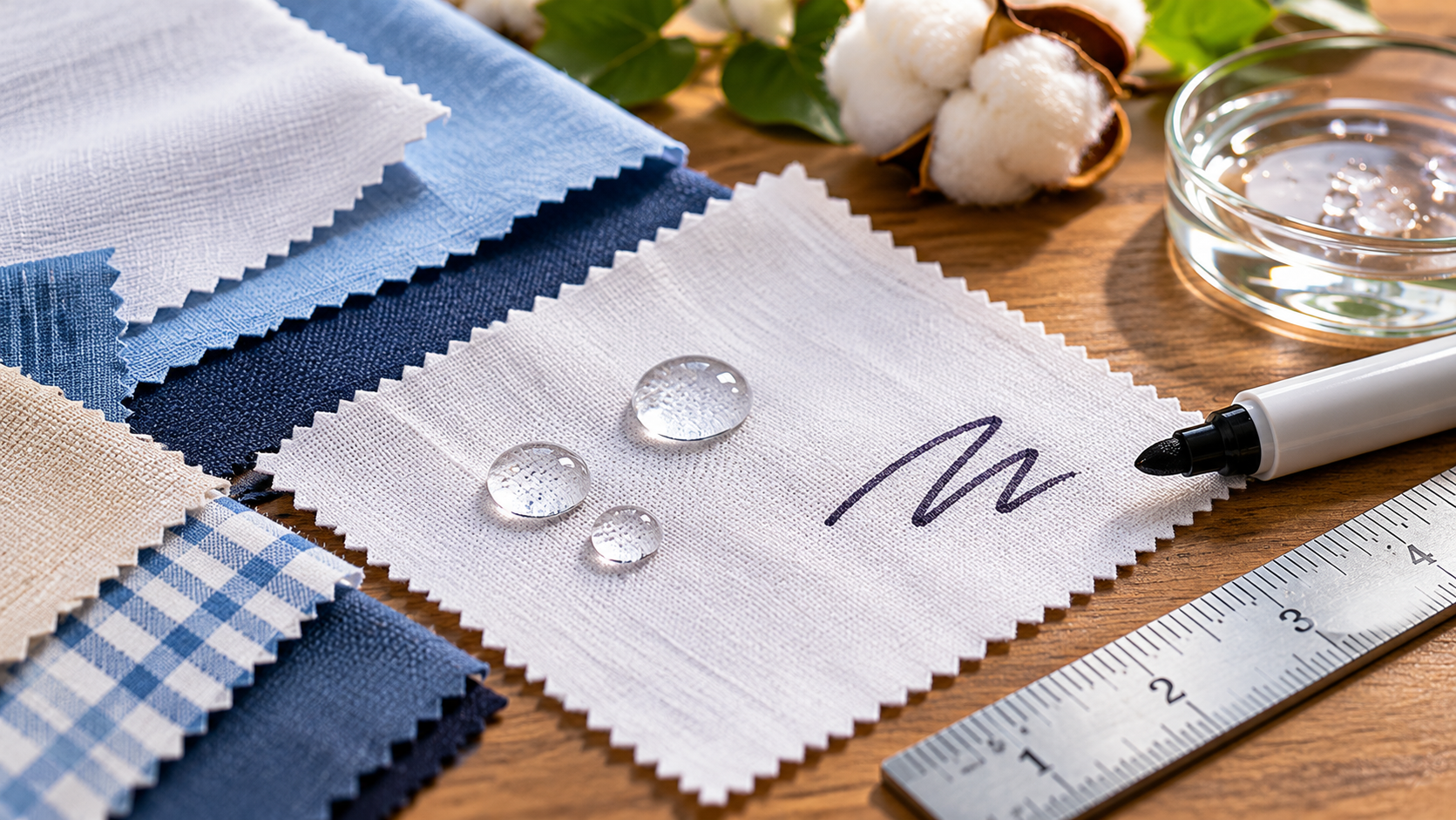
Test swatches for absorbency, shrinkage, fraying, color bleed, and skin feel before you approve a run. Five quick tests at your desk can save you a failed production order.
- Absorbency: Drop a teaspoon of water on each swatch. A fabric that beads up instead of soaking in fails.
- Shrinkage: Mark a 10 inch square in permanent ink. Wash and dry it three times, then remeasure.
- Fraying: Hem a sample and rub the edge after three washes. Loose threads signal a weak hem.
- Color bleed: Wash a dark swatch with a white one. Any tint on the white fails.
- Skin feel: Press each swatch against your cheek and the bridge of your nose.
A tech pack is the document that tells a factory how to build your product. Record your winning handkerchief fabric in a tech pack so the factory builds exactly what you tested. Maker’s Row’s guide to common fabric selection mistakes shows what skipping these tests costs.
What Does the FTC Require on a Handkerchief Label?
Plan for a fiber content label, a country of origin, and your company name or FTC Registered Identification Number (RN). The FTC’s Textile Act guidance does not list handkerchiefs among its exclusions. Confirm your exact wording with a qualified attorney.
The label must list each fiber by its generic name and its percentage by weight, in descending order. Your label might read “100% Cotton” or “55% Linen, 45% Cotton.” Fibers under 5% generally go under “other fiber(s).”
For origin, the FTC says a product made in the United States from imported materials must say so. R. Hanauer’s products, for example, are made in the USA from imported fabrics, according to a Joseph’s Clothier brand page. A plain “Made in USA” on that kind of product would mislead buyers.
The FTC’s Care Labeling Rule guide lists handkerchiefs among the items excluded from that rule. You can still print wash instructions, and they cut returns.
If you plan to say your handkerchief fabric is organic, ask your supplier for certification. Textile Exchange’s Organic Content Standard tracks organic materials through the supply chain and uses independent third-party audits.
How Maker’s Row Helps You Find Handkerchief Manufacturers
Maker’s Row is a marketplace connecting brand owners with verified US manufacturers across apparel, accessories, and soft goods. Choosing handkerchief fabric is half the job, and finding the right sewing partner is the other half.
Finding the right handkerchief manufacturer does not have to mean months of cold emails. On Maker’s Row, brand owners post unlimited manufacturing projects for free and receive bids from verified US factories at no upfront cost. To connect directly, subscription plans give full access.
Attach your handkerchief fabric spec, finished size, and target quantity to your project. If you want to compare factories first, browse Maker’s Row’s verified US clothing manufacturers.
FAQs About Handkerchief Fabric
Cotton is the best all-round fabric for handkerchiefs because it absorbs well, feels soft, and survives hot washes. Linen is a stronger, pricier upgrade, and silk suits pocket squares. Sample three fabrics before you commit.
Cotton is better for softness and price, and linen is better for strength and fast drying. Maker’s Row’s 2026 linen guide puts quality linen at about $10 to $30 per yard. Choose linen only if your customer will pay for the upgrade.
Silk is the classic choice for a pocket square, with fine cotton and linen as alternatives. Silk drapes well but absorbs poorly, so do not market it for everyday use. Test how each swatch folds before you order.
A lightweight, tightly woven fabric is best because it folds small and washes well. No single weight of handkerchief fabric fits every product. Ask suppliers for the GSM of each swatch and compare them against your samples.
Minimums vary by factory. Maker’s Row’s 2026 MOQ guide reports 50 to 500 units per style and 100 to 500 yards per roll of custom fabric. Ask each factory for its minimum in writing.
No. The FTC’s Care Labeling Rule guide lists handkerchiefs among excluded items. Fiber content, country of origin, and company identity labeling can still apply under the Textile Act, so confirm your label with an attorney.
Start Applying These Handkerchief Fabric Choices Today
Your handkerchief brand is one manufacturer away from becoming real. The factories are on Maker’s Row, ready to bid.