Men’s clothing in the USA is no longer just about basics. It is a $155 billion market shaped by heritage labels, direct-to-consumer disruptors, and brands built on a single great product. This guide covers the best men’s clothing brands right now, with lessons every aspiring brand owner can apply.
Men’s fashion in the United States has shifted. Consumers are buying less and buying better. They want provenance, quality, and a story they can stand behind. According to IMARC Group, the US menswear market is anticipated to reach USD 155 billion in 2025, driven by rising demand for sustainable materials, athleisure, and personalised clothing choices.
What separates the best men’s clothing brands from the rest is not advertising budget. It is product clarity, manufacturing integrity, and the ability to build a community before a catalogue.
If you are building a brand in this space, this guide shows you what the best men’s clothing brands are doing right.
Have a clothing idea you’re ready to manufacture? Tell us what you need and connect with top U.S. clothing manufacturers through Maker’s Row. Post your project for free and find the right manufacturing partner for your brand.
What Makes a Great Men’s Clothing Brand?
The best men’s clothing brands in the USA share a few non-negotiable qualities. They start with a point of view, a reason to exist beyond filling a price bracket. They make sourcing and manufacturing decisions that reflect that point of view. And they build audiences who feel like insiders, not just customers.
Specifically, the strongest brands in this space consistently demonstrate:
- Design philosophy: A consistent aesthetic that is recognisable across a full range, not a mix of trend-chasing styles
- Quality of materials: Fabrics and construction that justify the price and hold up over time
- Manufacturing ethics: Transparency about where and how garments are made, increasingly expected by US consumers
- Brand identity: A name, visual language, and tone of voice that communicate clearly who the brand is for
- Community: Loyal customers who refer other customers, built through content, storytelling, and genuine product quality
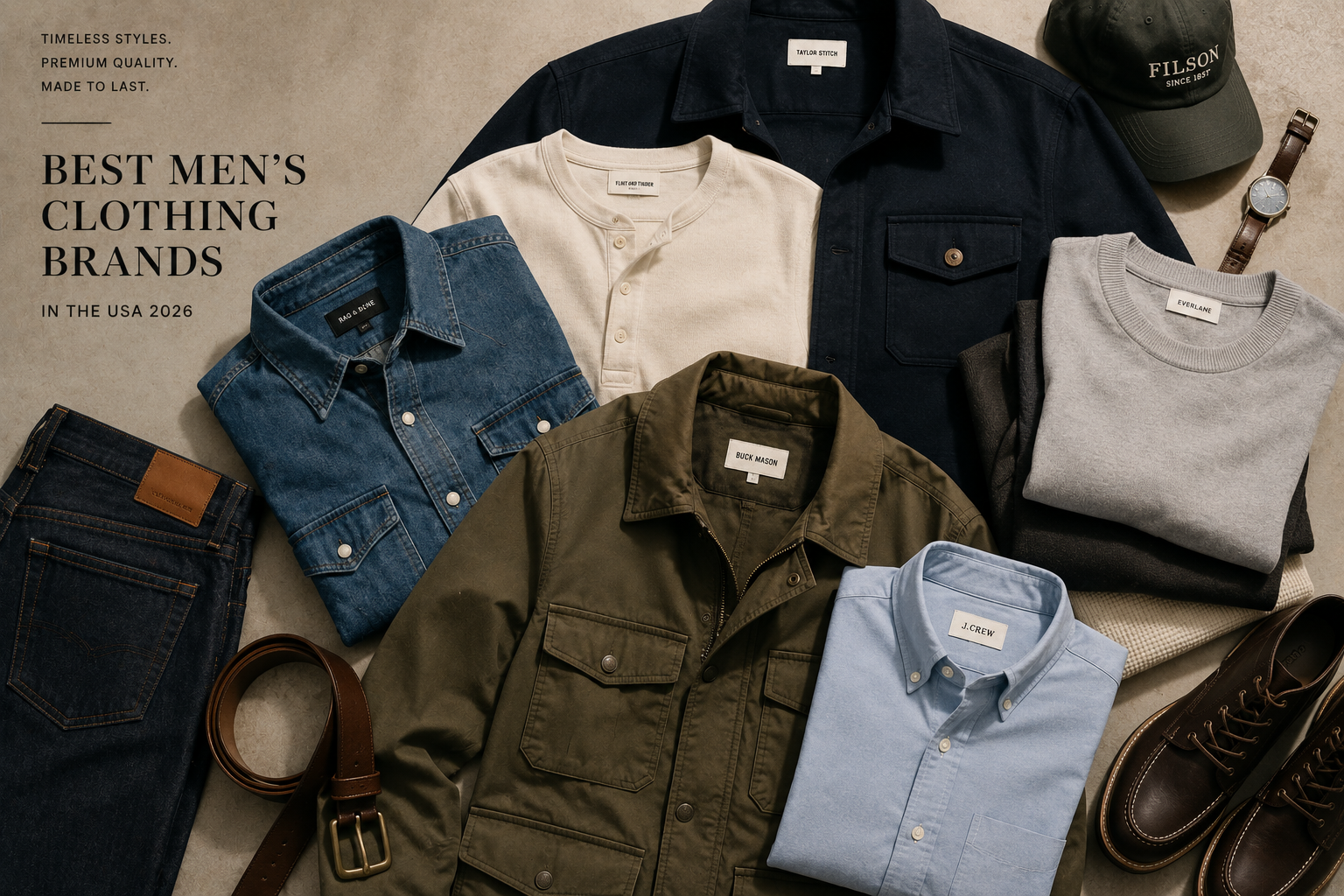
Best Men’s Clothing Brands in the USA 2026
1. Patagonia
Patagonia built its reputation in outdoor gear and extended it directly into everyday menswear. Every product decision runs through an environmental lens.
- Founded: 1973
- Known for: Fleece jackets, technical outerwear, and the Worn Wear repair programme
- Price range: $$$
- What sets them apart: Patagonia’s supply chain transparency is genuinely unusual in the industry. They publish their environmental footprint annually, and their repair programme keeps garments out of landfill. For a new brand, the lesson is that a strong operational value is a brand value.
2. Carhartt WIP
The workwear original crossed into streetwear through European reinterpretation, then came back to the US with significant cultural currency.
- Founded: 1889 (WIP line, 1994)
- Known for: Canvas work jackets, duck chore coats, and relaxed-fit work pants
- Price range: $$
- What sets them apart: Carhartt did not change its product to chase a new audience. The product was already right and the audience found it. That is a manufacturing-first brand story worth studying.
3. Todd Snyder
New York designer Todd Snyder sits at the intersection of American sportswear and tailoring with a clear luxury sensibility.
- Founded: 2011
- Known for: Slim-cut chinos, Japanese selvedge denim, and capsule collaborations
- Price range: $$$
- What sets them apart: Snyder built his brand through small, considered collections and strong retail partnerships before scaling. His approach to MOQ and slow production is a useful model for emerging brand owners.
4. Engineered Garments
Daiki Suzuki’s New York brand produces garments in its own Manhattan studio, making it one of the few remaining made-in-USA menswear labels operating at significant volume.
- Founded: 1999
- Known for: Military-inspired utility clothing, unusual fabric combinations, and intricate detailing
- Price range: $$$
- What sets them apart: Engineered Garments manufactures in-house in New York City, giving them full quality control. The brand proves that domestic production at scale is both possible and marketable in 2026.
5. Everlane
Everlane built its audience on radical price transparency, showing customers exactly what each garment costs to produce and why.
- Founded: 2010
- Known for: Slim Oxford shirts, Japanese denim, and clean essentials
- Price range: $$
- What sets them apart: Every product page shows the factory cost versus retail price. That transparency changed customer expectations across the industry and demonstrated that manufacturing honesty is a competitive asset.
6. Buck Mason
Buck Mason makes one thing: the essential American wardrobe. T-shirts, jeans, chinos, and shirts, nothing else.
- Founded: 2013
- Known for: Curved hem tees, American-made denim, and slub cotton shirts
- Price range: $$
- What sets them apart: Buck Mason started with 50 units of one T-shirt and sold them out in 24 hours. They scaled by making the same things better, not by making more things. That single-product-first strategy is directly applicable to any brand owner starting out today.
7. Rag & Bone
Rag & Bone occupies the upper-middle space between accessible and luxury, with serious manufacturing credentials and a strong wholesale presence.
- Founded: 2002
- Known for: Slim-cut jeans, leather boots, technical outerwear
- Price range: $$$
- What sets them apart: The brand produces core styles in the US and UK, positioning manufacturing origin as a premium signal. Their growth from a two-person operation to major department store accounts shows how strong product opens doors.
8. Taylor Stitch
Taylor Stitch is a San Francisco brand that crowdfunds new designs before manufacturing them, eliminating overproduction and managing MOQ from the demand side.
- Founded: 2008
- Known for: Quilted jackets, selvedge chinos, and the Workshop pre-order model
- Price range: –$
- What sets them apart: Their Workshop model lets customers pre-order new styles at a discount. The brand manufactures only what is already sold. For anyone thinking about MOQ and cash flow management, Taylor Stitch is required reading.
9. Rhone
Rhone built its brand around premium men’s performance apparel, specifically targeting men who wanted workout gear that did not look like workout gear.
- Founded: 2014
- Known for: Commuter pants, Goldenfleece T-shirts, and athletic shorts
- Price range: –$
- What sets them apart: Rhone identified a white space, men who wanted performance fabric in office-appropriate silhouettes, and built directly to that customer. Targeting a specific underserved customer is still the fastest path to a defensible niche.
10. Outerknown
Founded by professional surfer Kelly Slater, Outerknown focuses on fair trade certified, recycled-material menswear with a California coastal aesthetic.
- Founded: 2015
- Known for: The Blanket Shirt, S.E.A. Jeans made from recycled ocean plastic, and boardshorts
- Price range: –$
- What sets them apart: Outerknown built its supply chain before its marketing. Every manufacturer and material is publicly listed on their site. That supply chain discipline made brand credibility straightforward to communicate to customers.
11. Alex Mill
Alex Mill was relaunched by Mickey Drexler’s son as a focused essentials brand with strong retail storytelling and a restrained product line.
- Founded: 2012 (relaunched 2018)
- Known for: The Adventure Shirt, adventure chinos, and easy-fit trousers
- Price range: $$
- What sets them apart: The relaunch showed that a focused edit with sharp creative direction can rebuild a brand name from near-zero. Product restraint is a strategic choice, not a limitation.
12. DUER
A Canadian-born brand with strong US retail presence, DUER makes performance denim and pants for men who refuse to choose between comfort and appearance.
- Founded: 2015
- Known for: Performance Denim, Live Free pants, and No Sweat Shorts
- Price range: $$
- What sets them apart: DUER patented its stretch denim technology and built the brand on that single innovation. Owning a genuine product difference makes copying much harder. For emerging brand owners, unique construction or material is a real competitive moat.
13. Flint and Tinder
Flint and Tinder manufactures entirely in the USA and has built a loyal customer base around their 10-Year Hoodie, a product they guarantee to repair for a decade.
- Founded: 2012
- Known for: 10-Year Hoodie, waxed trucker jackets, and American-made selvedge denim
- Price range: –$
- What sets them apart: The 10-Year Hoodie is a product guarantee turned into a brand story. It also demonstrates deep confidence in US manufacturing quality. If you are considering a clothing manufacturer in the USA, this brand shows what domestic production at scale can deliver in terms of long-term reputation.
14. Faherty Brand
Faherty is a family-owned brand built around American beach culture, four-season natural materials, and a commitment to responsible sourcing.
- Founded: 2013
- Known for: Pacific Poncho, Mission Zero collection, and reversible fleeces
- Price range: –$
- What sets them apart: Faherty built its community through family storytelling. Their use of natural materials like organic cotton and merino reflects a sourcing-first approach that builds authentic credibility with customers who care about how their clothes are made.
15. American Giant
American Giant manufactures exclusively in the United States and has built its brand on the idea that the best-quality basics should be made domestically.
- Founded: 2012
- Known for: Classic Full-Zip Hoodie, American-made T-shirts, and heavyweight sweatshirts
- Price range: $$
- What sets them apart: Their 2012 hoodie went viral after a journalist called it the greatest hoodie ever made. The brand is built on a single product promise, which is exactly how the best men’s clothing brands start. To understand how to find a clothing manufacturer to build that kind of quality into your own first product, Maker’s Row connects you directly with verified US factories.
What These Brands Have in Common
Look across all 15 of the best men’s clothing brands above and the pattern is consistent. Every one started with a single strong product. Every one found a manufacturer before scaling, not after. Every one tested small quantities before committing to large production runs. Every one built a community around their product through transparency, storytelling, or both before building inventory depth.
The brands that lasted longest are the ones who knew what they stood for before they went to market. They made that clarity visible in their materials, their manufacturing choices, and their communication with customers.
“Every brand on this list started exactly where you might be right now, with a strong idea and a need to find the right manufacturer to bring it to life.”
Also Read: Best American Made Shirts for Men →
How to Start Your Own Men’s Clothing Brand
Starting your own men’s clothing brand in 2026 is genuinely viable. The US men’s clothing stores industry has 18,634 businesses according to IBISWorld, with online men’s clothing sales reaching $36.3 billion, a channel that rewards focused brands with strong creative direction.
Here is what actually works for first-time brand owners in menswear.
Step 1 — Define your hero product. Do not launch a full collection. Launch one great piece: a hoodie, a chino, a work jacket. Make it so good it does not need context. Buck Mason launched with one T-shirt. American Giant launched with one hoodie.
Step 2 — Build your brand identity. Name, aesthetic, target customer, and price point. Write a one-page brand brief that answers: who is this for, what do they already own, and why would they choose your brand instead. Reviewing the best high quality clothing brands that got this right shows consistent patterns worth studying.
Step 3 — Find your manufacturer. This is where most brand owners get stuck. The brands above all found the right factory partner before scaling. The manufacturer you choose shapes your product quality, your MOQ, your lead time, and your customer promise. SBA resources and SCORE mentorship can help you plan your initial budget and business structure before you reach out to factories.
Find Men’s Clothing Manufacturers on Maker’s Row
Finding the right menswear manufacturer does not have to mean months of cold emails. On Maker’s Row, post your men’s clothing project for free and verified US manufacturers bid directly. Review bids, check profiles, connect when ready.
Describe your product, including fabric weight, construction type, MOQ range, and preferred location, in your project brief. Manufacturers who specialise in menswear respond directly. Many reply within 24–48 hours of a new project being posted.
FAQs About Men's Clothing Brands
The most widely recognised men’s clothing brands in the USA include Ralph Lauren, Levi’s, and Carhartt, depending on the category. In the premium and direct-to-consumer space, Patagonia, Buck Mason, and Rhone consistently lead in customer loyalty and editorial recognition.
Several of the best men’s clothing brands on this list manufacture domestically, including American Giant, Engineered Garments, Flint and Tinder, and Faherty Brand for select collections. Made-in-USA manufacturing is a meaningful differentiator in 2026, particularly among customers aged 25–40 who prioritise quality and supply chain transparency.
Most of the best men’s clothing brands listed above sourced their initial manufacturing partner through industry introductions, trade shows, or platforms that connect brands with verified factories. For new brands today, Maker’s Row is a direct path: post your project, receive bids from vetted US factories, and connect when you have found the right fit.
Starting a men’s clothing brand typically requires $5,000–$50,000 for an initial production run, depending on MOQ, fabrication, and product complexity. The most efficient brands start with a single product in small quantities, validate demand, then scale.
MOQ varies by manufacturer and product type. US-based manufacturers working with small brands typically offer MOQs between 50 and 300 units per style. Some cut-and-sew manufacturers work with MOQs as low as 24–50 pieces for simple garments. State your target MOQ in your Maker’s Row project brief and manufacturers within that range respond directly.
The best men’s clothing brands build loyalty through product consistency, transparency about manufacturing, and storytelling. Brands like Everlane and Outerknown make their factories and supply chain part of the brand story. Customers who understand how something is made are more loyal to it. According to Business of Fashion, supply chain transparency is increasingly a brand differentiator rather than a compliance exercise.
Your Men’s Clothing Brand Starts With One Decision
Your men’s clothing brand is one manufacturer away from becoming real. The factories are on Maker’s Row, ready to bid.
Post your project, describe your hero product, and let verified US menswear manufacturers come to you. No cold emails. No guesswork. Just direct bids from factories that work with brands at exactly your stage.