Most new clothing brands treat merchandising as an afterthought, something a bigger company worries about once it has a buying team. That gap is exactly why so many first collections sell through 20% of units and sit on 80% of inventory. Apparel merchandising is the discipline that connects what you design to what actually sells, and it works just as well for a five-style startup as it does for a department store. This guide gives you the exact steps to apply it to your own brand, from your first production run through your first reorder.
Building a clothing brand around great design alone is a common and expensive mistake. Plenty of founders can sketch a strong collection, find a manufacturer, and get a sample made, only to watch half their inventory sit unsold at the end of the season. The missing piece is usually apparel merchandising: the planning and analysis work that decides which styles get made, in what quantities, at what price, and how those decisions get corrected once real sales data comes in.
New brand owners face three specific obstacles here. First, they do not know how to size a production run against realistic demand. Second, they price by instinct instead of margin math. Third, they have no system for feeding sales results back into their next order, so the same mistakes repeat every season.
This guide solves all three. You will learn how to audit your assortment, build a buying plan, price for margin, and use sell-through data to make smarter decisions with your manufacturer on every future order.
Step 1: Audit Your Current Assortment and Sales Data
Apparel merchandising starts with an honest look at what you already have, not a blank page. If this is your first collection, this step means researching comparable brands’ assortment breadth instead of your own sales history.
Pull every style you have sold or plan to sell into one list. For an existing brand, mark each style’s units sold, units remaining, and current sell-through rate, calculated as units sold divided by units received. A style sitting at 30% sell-through three months after launch is a signal to markdown or discontinue it, not reorder it.
If you are pre-launch, build the same list using planned styles instead of sold ones, and note which ones are true hero pieces versus filler. A hero product is the one style built to drive the majority of your revenue, usually 30-40% of unit sales from a single SKU in an early collection.
SKU (stock keeping unit) is the unique code assigned to each individual product variation, such as a specific style, color, and size combination. Tracking performance at the SKU level, not just the style level, tells you whether a shirt is underperforming overall or only in one colorway.
Step 2: Build an Apparel Merchandising Plan Before You Design
A merchandising plan is a document that maps out what styles you will produce, in what quantities, at what price points, and on what timeline, before any fabric gets cut.
Start with your open-to-buy, the dollar amount you have available to spend on inventory for a given period after accounting for what you already have committed. For a first production run, this is simply your production budget divided across your planned styles.
Set a target style count and a quantity range per style based on your budget, not your creative ambition. A common early-stage split is 60% of units in 2-3 hero styles and 40% spread across 5-8 supporting styles, which limits your exposure if any single design underperforms.
Assortment Element | What to Decide | Why It Matters |
Style count | Total number of distinct designs | Fewer styles concentrate your MOQ risk into proven winners |
Hero product allocation | % of budget on 2-3 lead styles | Protects margin if supporting styles sell slowly |
Color/size breadth | Variations per style | Wider breadth raises MOQ and cash tied up in inventory |
Price tiers | Entry, core, premium price points | Gives customers multiple ways to buy without diluting brand |
MOQ (minimum order quantity) is the smallest number of units a manufacturer will produce per style, per color, or per order, depending on the factory. Your merchandising plan and your manufacturer’s MOQ need to match, or you will either overcommit cash or get turned away by factories that only work at higher volumes.
The SCORE network offers free mentorship to new brand owners building a first merchandising plan, particularly around sizing style count and quantities against a realistic budget.
Step 3: Connect Merchandising to Your Tech Pack and Product Development
Merchandising decisions only become real production once they are documented in a way a factory can quote against.
Every style in your merchandising plan needs a corresponding tech pack, the specification document that tells a manufacturer the measurements, materials, and construction details for that product. Merchandising sets what to make and how many; the tech pack sets exactly how it gets built.
Also Read: What is a Tech Pack? →
Loop your merchandising decisions back into pattern development early. If your plan calls for a hero style in four colorways, your patternmaker needs to know that before cutting begins, since fabric yield calculations change with color and print placement.
Also Read: What Is Garment Construction? A Complete Guide for Clothing Brand Owners →
Step 4: How Do You Bring Manufacturers Into Your Merchandising Plan?
You bring manufacturers into your merchandising plan by matching your assortment, quantities, and budget to a manufacturer whose MOQ, speciality, and lead time fit those numbers, before you start sampling.
Chasing cold-emailed factories one at a time is slow, and it often means adjusting your merchandising plan to fit whatever manufacturer eventually responds, instead of the reverse. This is where most first-time brand owners get stuck.
Maker’s Row is a marketplace connecting apparel brand owners with verified US manufacturers. On Maker’s Row, you describe your merchandising plan directly in a project brief, including style count, quantities per style, and target price points, and manufacturers whose MOQ and speciality fit those numbers respond directly.
Manufacturer Criteria | What to Confirm Before Committing |
MOQ | Per style, per color, or per total order |
Speciality | Cut-and-sew, private label, knitwear, denim, etc. |
Sample policy | Cost and turnaround for a paid sample |
Communication speed | Response time to your first inquiry |
You can browse full US manufacturer profiles and vetted directories through Maker’s Row’s platform, which brand owners use to shortlist factories that already work at their planned volume before contacting anyone.
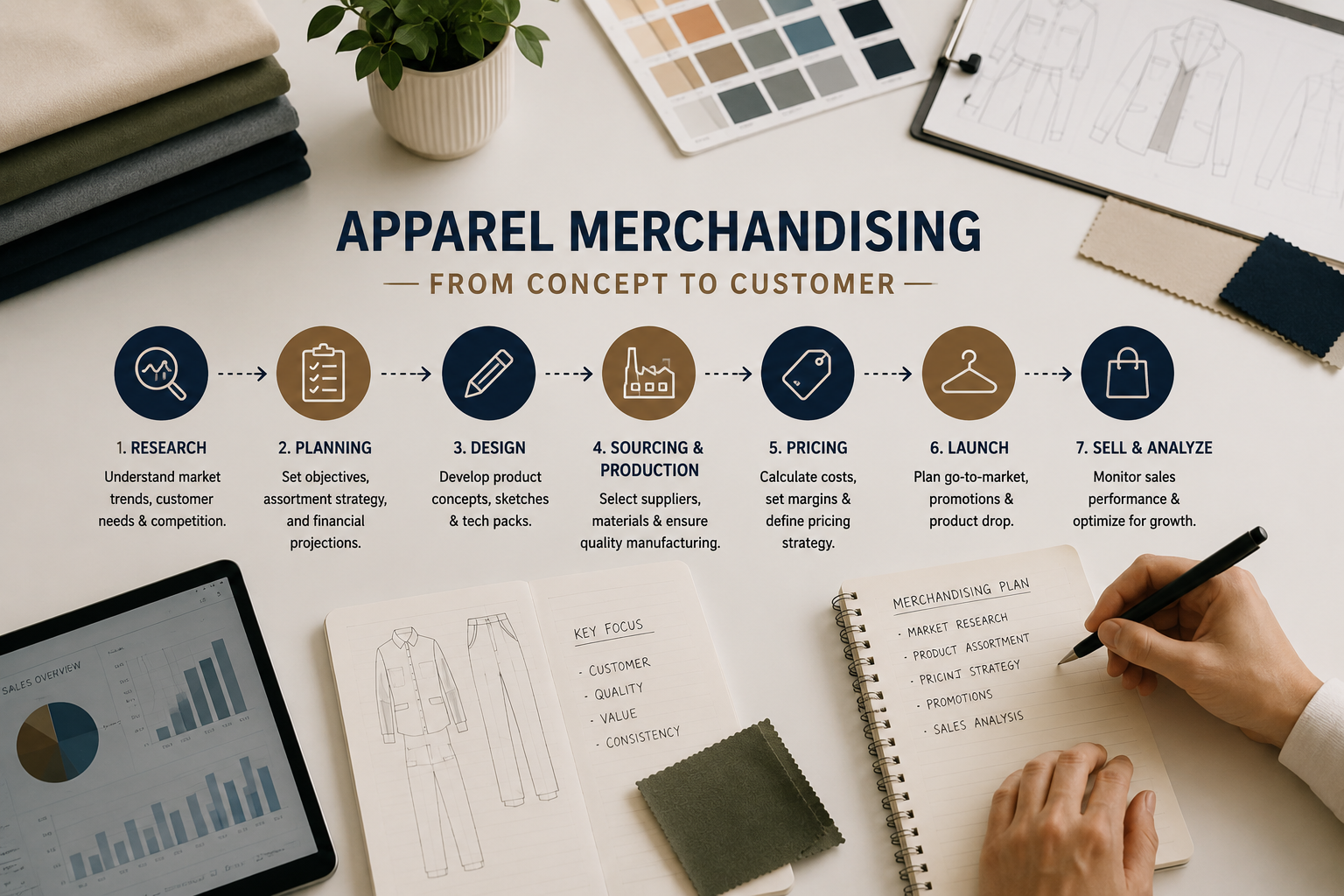
Step 5: Price Your Collection Using Merchandising Math
Pricing is one of the three core merchandising disciplines, alongside assortment planning and sell-through analysis.
Start from your landed cost per unit, meaning production cost plus shipping and any duties, then apply a markup multiplier. A common wholesale-to-retail apparel markup is 2.0-2.5x from wholesale cost to retail price, though your specific multiplier depends on your channel mix and margin targets.
Check your price against two things before finalizing it: your direct competitors’ price points for comparable products, and your customer’s stated or observed price sensitivity from any pre-launch surveys or early sales. A style priced 30% above the closest comparable product needs a clear, visible reason, such as domestic production or a distinct material.
The SBA recommends new business owners build pricing models around full landed cost plus a sustainable margin target rather than competitor price-matching alone, since matching a competitor’s price without matching their cost structure erodes margin fast.
Step 6: What Happens to Inventory Once Production Begins?
Once production begins, merchandising shifts into active inventory management for the rest of the selling season, tracking sell-through and setting markdown triggers before demand tells you it is too late.
Track sell-through weekly, not monthly, for at least the first 8-10 weeks after a new style launches. Early sell-through is the strongest predictor of full-season performance, and a style moving at 10% sell-through in week two rarely recovers to a healthy full-price sell-through by season end.
Set a markdown trigger in advance, for example: any style below 25% sell-through by week six moves to a first markdown. Deciding this before launch removes the emotional difficulty of marking down a style you personally love.
The AAFA lists supply chain and sourcing among its core industry priorities, reflecting how closely production planning and inventory decisions are tied together for apparel brands operating in the current environment.
Step 7: Turn Sell-Through Data Into Your Next Buy
The final step in apparel merchandising closes the loop: every season’s sales data becomes the input for your next merchandising plan.
Rank every style from your last production run by sell-through rate and gross margin dollars, not units sold alone. A style that sold fewer units but at full price and higher margin may deserve more budget next season than a high-volume style that only sold through at a deep discount.
Example: Assortment Correction in Denver
A Denver-based knitwear brand produced 400 units across 10 styles for its first season. Two hero sweaters accounted for 65% of total sell-through by week six, while three supporting styles sat below 20% sell-through in the same window. The brand cut those three weak styles from its next production order and doubled quantities on the two hero sweaters, increasing projected season margin by an estimated 18% on the reorder.
Carry forward your top 20-30% of styles by this ranking as “core” items that get reordered with minimal changes, and treat everything else as a fresh design opportunity. This is the mechanism that separates brands that improve every season from brands that reinvent their entire assortment from scratch every time, often repeating the same pricing and quantity mistakes.
Also Read: 5 Ways to Get Noticed by Retail Buyers →
As of 2026, BLS data shows the US apparel manufacturing sector included more than 6,300 private industry establishments as of the fourth quarter of 2025, employing roughly 72,800 workers nationwide as of May 2026, giving brand owners a wide domestic base of factories to match against a merchandising plan of almost any size.
FAQs: Apparel Merchandising for Brand Owners
It is the process of planning which clothing styles to produce, in what quantities, at what prices, and then analyzing sales results to guide future production decisions. It connects design and production to actual customer demand rather than guesswork.
No, most early-stage brand owners handle merchandising themselves using a simple spreadsheet tracking styles, quantities, cost, and sell-through. Formal merchandising training helps at scale, but the core discipline of tracking sell-through and adjusting your next order is learnable without a degree.
Most first collections perform best with 5-10 styles built around 2-3 hero products rather than a wide, unfocused assortment. A smaller, focused assortment limits your MOQ exposure and makes sell-through data easier to interpret.
A healthy sell-through rate for apparel is generally 70-80% at full price within the planned selling season, though this varies by category and price point. Sell-through below 50% signals a pricing, assortment, or demand-forecasting problem worth addressing before your next production run.
It gives you specific, defensible numbers, meaning style count, quantities, and reorder cadence, to bring to a manufacturer instead of vague requests. Factories respond faster and quote more accurately when a brand owner arrives with a clear merchandising plan already in hand.
Yes, a merchandising plan built around realistic open-to-buy and conservative hero-style allocation is the primary defense against overproduction. Weekly sell-through tracking after launch lets you catch a slow-moving style early enough to adjust before it becomes excess inventory.
Most small brands use a shared spreadsheet tracking SKU-level sales, inventory on hand, and sell-through percentage by week. Purpose-built merchandising software exists but is rarely necessary until a brand carries more than a few dozen active SKUs.
Your Merchandising Plan Is One Manufacturer Away From Reality
Your apparel merchandising plan only works once it is matched to a manufacturer who can actually produce it at your quantities, price point, and timeline. The factories are on Maker’s Row, ready to bid.