Working with a factory in New York’s Garment District means faster sampling, in-person fittings, and direct access to the trim houses and specialty ateliers that have supported American fashion for over a century. Finding the right one inside those few dense blocks, the ones that actually take on small and growing brands, is harder than the neighborhood’s reputation suggests. This guide lists five verified Garment District manufacturers for 2026, what each one specializes in, and what to check before you reach out.
Updated July 2026. The Garment District, also called the Garment Center or Fashion District, sits in Midtown Manhattan between Fifth and Ninth Avenues, roughly 34th to 41st Streets. It has been the physical center of American apparel production for more than a hundred years, and despite decades of decline in citywide manufacturing employment, it remains the densest concentration of cut and sew factories, pattern makers, and trim specialists in the country.
For a brand owner, sourcing inside this neighborhood means your factory, your fabric supplier, and your sample room can all be a subway stop apart. If your search extends beyond Manhattan, our broader guide to clothing manufacturers near you across the USA covers other regional hubs worth comparing. That proximity shortens the feedback loop on fit corrections and lets you walk a swatch from a trim house to a sewing floor in the same afternoon, something no amount of email can replicate with an overseas supplier. As of February 2026, BLS data shows U.S. apparel manufacturing employed roughly 74,300 workers nationally, a small and specialized workforce concentrated in pockets like this one.
If you already know what you need, Start Your Free Project and specify the Garment District in your brief. Verified manufacturers who work in that neighborhood will respond directly.
Why Does the Garment District Still Matter for Your Brand?
This neighborhood survives today because it still solves a real production problem: it puts every stage of small-batch clothing manufacturing inside walking distance, including the factories that will quote your MOQ (minimum order quantity, the smallest number of units a manufacturer will produce per style). A factory here can hand-carry a first sample to a trim house on West 38th Street and have a corrected pattern back the same day, a turnaround that a factory three states away cannot match.
Real estate pressure has shrunk the district for decades, and citywide garment manufacturing employment is a fraction of its mid-century peak. But the businesses still operating here tend to be long-tenured for a reason: family-run shops that survived multiple real estate cycles usually have the production discipline to survive yours too. The historic Fashion Manufacturing Initiative, a partnership between the New York City Economic Development Corporation and the Council of Fashion Designers of America, has granted more than 125 garment manufacturers funding to modernize equipment, a sign local production is still worth investing in.
Best Garment District Manufacturers in NYC (2026)
The list below mixes full-package cut and sew houses with two specialty ateliers that give this neighborhood its character. Need general apparel production? Start with the first two. Working in leather, custom trims, or accessories? The specialists round out the list.
Apparel Production Inc.
- Location: 270 West 39th Street, New York, NY 10018
- MOQ: 200 units per style domestic, 300 overseas
- Speciality: Full private-label production, Men’s, women’s, and children’s apparel
- Best for: Established brands ready to move past small-batch sampling into repeat production
Family-owned by the Sadaka family since 1947, Apparel Production has operated continuously in the Garment District for more than 75 years and has produced for brands including Calvin Klein, Ralph Lauren, and Kenneth Cole. Patterns, first samples, and fittings happen in-house at their NYC facility, with production available domestically or through their nearshore and overseas network depending on a brand’s timeline and budget.
Grace Apparel Production
- Location: 270 West 39th Street, Suite 1401, New York, NY 10018
- MOQ: 20 to 1,500 units per style
- Speciality: Full-package production across knits, denim, silk, leather, and bridal
- Best for: Brands that need real flexibility between sample runs and mid-size production
Grace Apparel Production is listed in the CFDA’s official production directory and has produced for Prabal Gurung, DKNY Sportswear, and Billy Reid, among others. Its 20-unit minimum sits well below what most full-package NYC factories will take on, which makes it one of the more accessible entry points for a brand still testing a first collection.
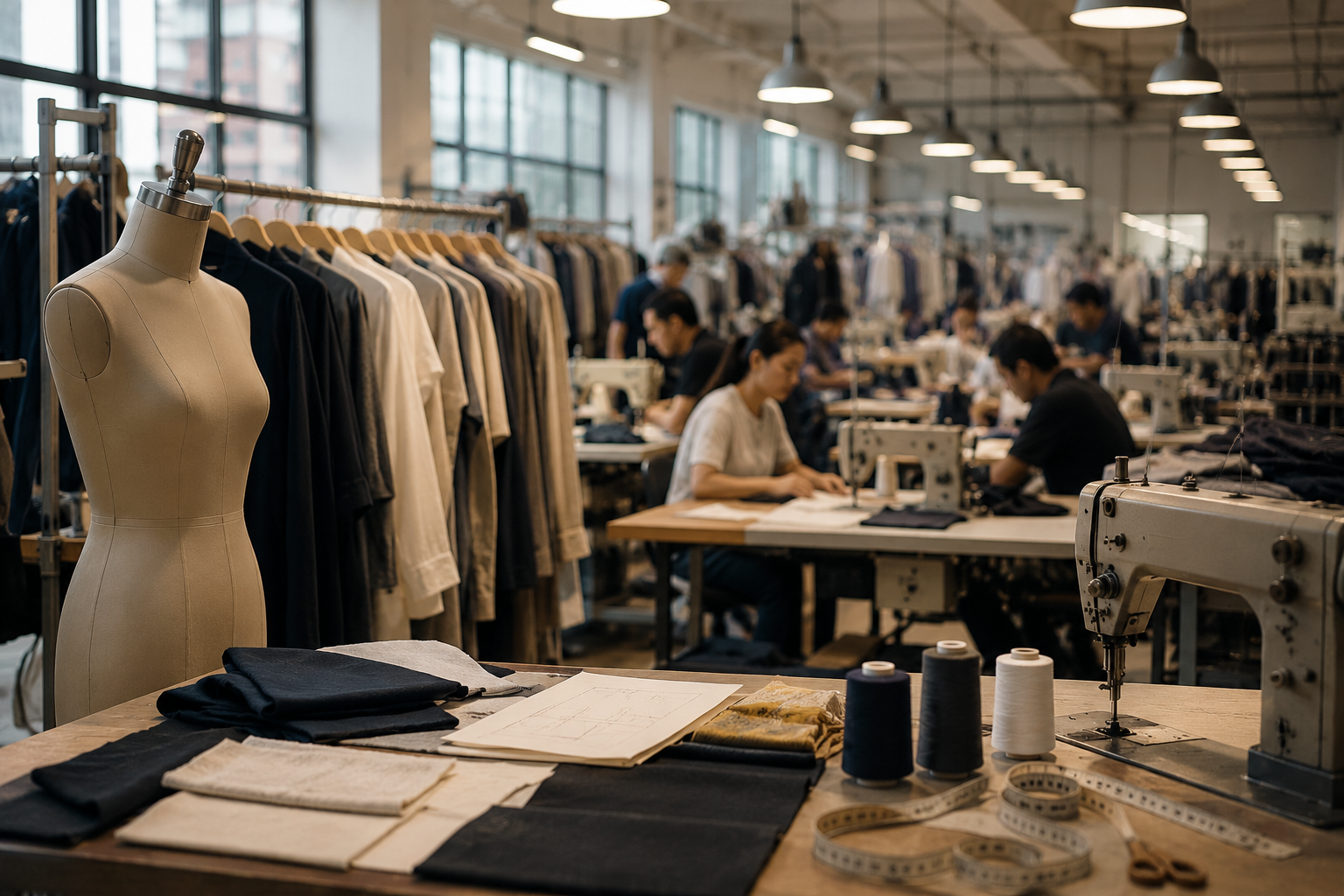
[IMAGE: pattern maker working on a garment inside a Garment District factory | ALT: Garment District manufacturer pattern making NYC]
Carina New York
- Location: NYC Garment District
- MOQ: 50 units per style
- Speciality: Leather and shearling cut and sew, denim, and specialty materials
- Best for: Brands building outerwear, leather goods, or shearling pieces
Carina has run as a family business since 1996, when founder Alfred Sabetay branched off from his earlier leather production partnership. His daughter, Paula Stvan, joined the business the following year and the pair built a private-label client list working across leather, shearling, denim, and cashmere. A 50-unit minimum makes this one of the lower-MOQ options on this list for brands working in technical or specialty materials.
Wing & Weft Gloves
- Location: 265 West 37th Street, Suite 11E, New York, NY 10018
- MOQ: Custom orders, no published minimum
- Speciality: Hand-cut leather and fabric gloves
- Best for: Brands that need a glove or hand-accessory component made domestically
Wing & Weft, formerly Lacrasia Gloves, has hand-cut gloves in the Garment District since 1973 and is the last remaining glove maker in Manhattan. The woman-owned shop has produced gloves for multiple presidential inaugurations and for stage and film costume work, and it accepts custom orders by appointment.
M&S Schmalberg
- Location: 242 West 36th Street, 7th Floor, New York, NY 10018
- MOQ: Custom orders, no published minimum
- Speciality: Handmade fabric flowers and trim
- Best for: Brands that need custom fabric embellishments or floral trim
Founded in 1916, M&S Schmalberg is the last handmade fabric flower manufacturer operating in the United States and has supplied trim for Vera Wang, Ralph Lauren, and Oscar de la Renta, among others. The fourth-generation, family-run shop still uses molds that date back to its founding and welcomes visitors to its seventh-floor factory.
Manufacturer Comparison Table
Manufacturer | Location | MOQ | Speciality | Factory Visits | Best For |
Apparel Production Inc. | 270 W 39th St | 200 domestic / 300 overseas | Full private-label apparel | Contact to confirm | Scaling repeat production |
Grace Apparel Production | 270 W 39th St, Ste 1401 | 20 to 1,500 units | Full-package, multiple materials | Contact to confirm | First collections needing flexibility |
Carina New York | NYC Garment District | 50 units | Leather, shearling, denim | Contact to confirm | Outerwear and leather goods |
Wing & Weft Gloves | 265 W 37th St, Ste 11E | Custom, no minimum | Hand-cut gloves | By appointment | Glove and hand-accessory components |
M&S Schmalberg | 242 W 36th St, Fl 7 | Custom, no minimum | Fabric flowers and trim | Visitors welcome | Custom embellishments and floral trim |
Choosing between five factories still means five calls, five emails, five response times. The faster path is letting manufacturers who already work here come to you.
Find Garment District Manufacturers on Maker’s Row
Maker’s Row is a marketplace connecting apparel brand owners with verified manufacturers in the USA, including Garment District factories with little web presence that are actively taking on new brand projects. Many run lean, family-owned operations, so the ones with the strongest reputations aren’t always the ones ranking on page one of a search.
On Maker’s Row, browse verified US manufacturers or post your project for free and describe your product, your target MOQ, and your material requirements. The U.S. Small Business Administration recommends vetting any new supplier with a smaller test order before committing to a full production run, a principle that applies directly to your first Garment District relationship. Factories on Maker’s Row are active and responsive, and many reply within 24 to 48 hours of a new project being posted. You review bids, check profiles, and connect when you are ready, without the months of cold outreach that sourcing a factory here the old way usually takes.
What Should You Ask Before Choosing a Garment District Manufacturer?
These five questions reveal which factories will actually work with your order size before you waste a sample round. Every factory here looks credible from its website; the questions below are what separate the ones worth pursuing.
- What is your minimum order quantity, and does it apply per style or per order? A 200-unit minimum “per style” is very different from 200 units total across a collection.
- What is your sample lead time, separate from production? Domestic sampling in this neighborhood typically runs two to four weeks; a factory that cannot give you a number is telling you something about how it manages timelines.
- Do you produce entirely in-house, or do you subcontract cutting, sewing, or finishing? Cut and sew manufacturing builds a garment from fabric according to your specifications, unlike private label manufacturer, where you brand an existing style. Subcontracting isn’t automatically a problem, but you should know before you commit. Our guide to cut and sew manufacturers in the USA breaks down the model further.
- Can I visit the factory floor, and is that by appointment or open walk-in? Several specialists in this neighborhood, including trim houses, welcome visitors; general production factories are more often appointment-only.
- What certifications or compliance documentation do you carry for my product category? Children’s apparel, activewear compression garments, and leather goods each carry different compliance requirements worth confirming upfront.
Also Read: Best Clothing Manufacturers in NYC for Small Batch and Custom Production →
FAQs About Manufacturing in the Garment District
The main benefit is proximity: your factory, fabric suppliers, and trim houses can all sit within a few blocks, which shortens sampling turnaround and makes in-person quality checks possible without a flight. Made in USA production also carries brand value for customers who prioritize domestic manufacturing, and it removes the international shipping delays that come with overseas sourcing.
Minimums here generally run from 20 to 500 units per style depending on the factory and product type, with several specialty ateliers accepting fully custom orders with no published minimum. According to AAFA industry data, domestic apparel manufacturers typically set MOQs between 50 and 500 units per style, which lines up with what most cut and sew factories here quote.
The most reliable options are posting a project on a marketplace like Maker’s Row and specifying the neighborhood in your brief, checking the CFDA’s production directory for vetted NYC factories, or working through the NYCEDC’s Fashion Manufacturing Initiative production database. Cold outreach to individual factory websites works but typically takes longer to get a response.
Yes, per-unit costs here generally run higher than overseas manufacturing, but domestic production removes freight lead times, import duties, and the risk of not seeing your product until it lands. For brands prioritizing fast iteration or a Made in USA label, the higher unit cost is often offset by lower sampling costs and fewer wasted runs.
Many can accommodate a visit, though policy varies. Full-package factories are more often appointment-only due to active production floors, while specialty trim and accessory ateliers, including several in this guide, welcome walk-in visitors during business hours.
Cut and sew manufacturers build a garment from fabric you supply or source separately, giving you more control over material choice. Full-package manufacturers, like several factories on this list, handle fabric sourcing, patterns, cutting, sewing, and finishing under one roof, which is faster to launch but leaves less room to swap suppliers mid-project.
Your Manufacturing Partner Is Already on Maker’s Row
Your brand is one manufacturer away from becoming real, and several of them are working the same blocks that have defined American fashion production for a century. The factories are on Maker’s Row, ready to bid.