Most clothing brands that fail do not fail because of bad design. They fail because no one wrote anything down. A clothing brand business plan is the document that turns a strong idea into a fundable, manufacturable, launchable business. This guide shows you exactly how to build one, section by section.
A clothing brand business plan is the document that separates founders who launch from founders who plan to launch forever. If you are applying for a small business loan, bringing in a co-founder, or simply trying to make your own decisions in the right order, a written plan is not optional. It is the framework that keeps every decision connected.
This guide breaks down every section of a clothing brand business plan with specific instructions for apparel founders. It is not a generic business template. Every section is written for the realities of starting a clothing brand in the USA, including the one section most business plan guides skip entirely: manufacturing.
What Is a Clothing Brand Business Plan and Why Do You Need One?
A clothing brand business plan is a written document that defines your brand, your customer, your product, your finances, and your path to market. For apparel founders specifically, it also defines your manufacturing strategy: which factory type you need, what MOQ you can afford, and what your production timeline looks like before your first sale.
You need one for three practical reasons:
- Funding. Banks, investors, and even some US manufacturers ask to see a business plan before committing. According to SBA small business planning guidance, businesses that write a formal plan are significantly more likely to secure funding than those that do not.
- Decision-making. A plan forces you to answer the hard questions before they become expensive problems: Can you afford the MOQ your target manufacturer requires? Does your retail price cover your production cost? Who exactly is buying this?
- Manufacturer conversations. A founder who arrives at a factory conversation with a written plan, covering product specs, target units, price point, and timeline, gets taken more seriously than one who is still figuring it out in the meeting.
Section 1: Executive Summary
The executive summary is a one-page overview of the entire clothing brand business plan. Write it last, even though it appears first. It should cover: what your brand is, what you sell, who buys it, what the market opportunity is, and what you need to make it happen.
Keep it to 250–350 words. The executive summary is the section a lender or manufacturer reads first. If it is vague, they stop reading.
What to include:
- Brand name and one-sentence description
- Hero product and category
- Target customer (one sentence)
- Market size or opportunity (use a named source: AAFA publishes annual US apparel industry data)
- Funding needed, if any
- Your goal for Year 1
Section 2: Brand Identity and Product Concept
This section answers: what are you building and why does it need to exist? It is the creative foundation that every other section draws from.
Brand identity: Write 150–200 words covering your brand name, visual aesthetic, brand values, and price positioning. Be specific. “Sustainable streetwear for urban women” is better than “stylish clothing for everyone.” Specificity is not limiting. It is targeting.
Hero product: Define the single product you are launching first. Name the garment, describe the construction, specify the fabric weight and material, and state your target retail price. A Los Angeles-based womenswear brand launching with one premium heavyweight tee at a $65 retail price point has a clearer path to a profitable first run than a brand trying to launch a full ten-piece collection with no manufacturing experience.
Why this product: One paragraph on the gap in the market your product fills. What is missing from what competitors offer, and how does your product solve it?
Section 3: Market Research and Target Customer
This is the section most first-time brand owners skip. It is also the section that answers every question a manufacturer, investor, or retail buyer will ask you.
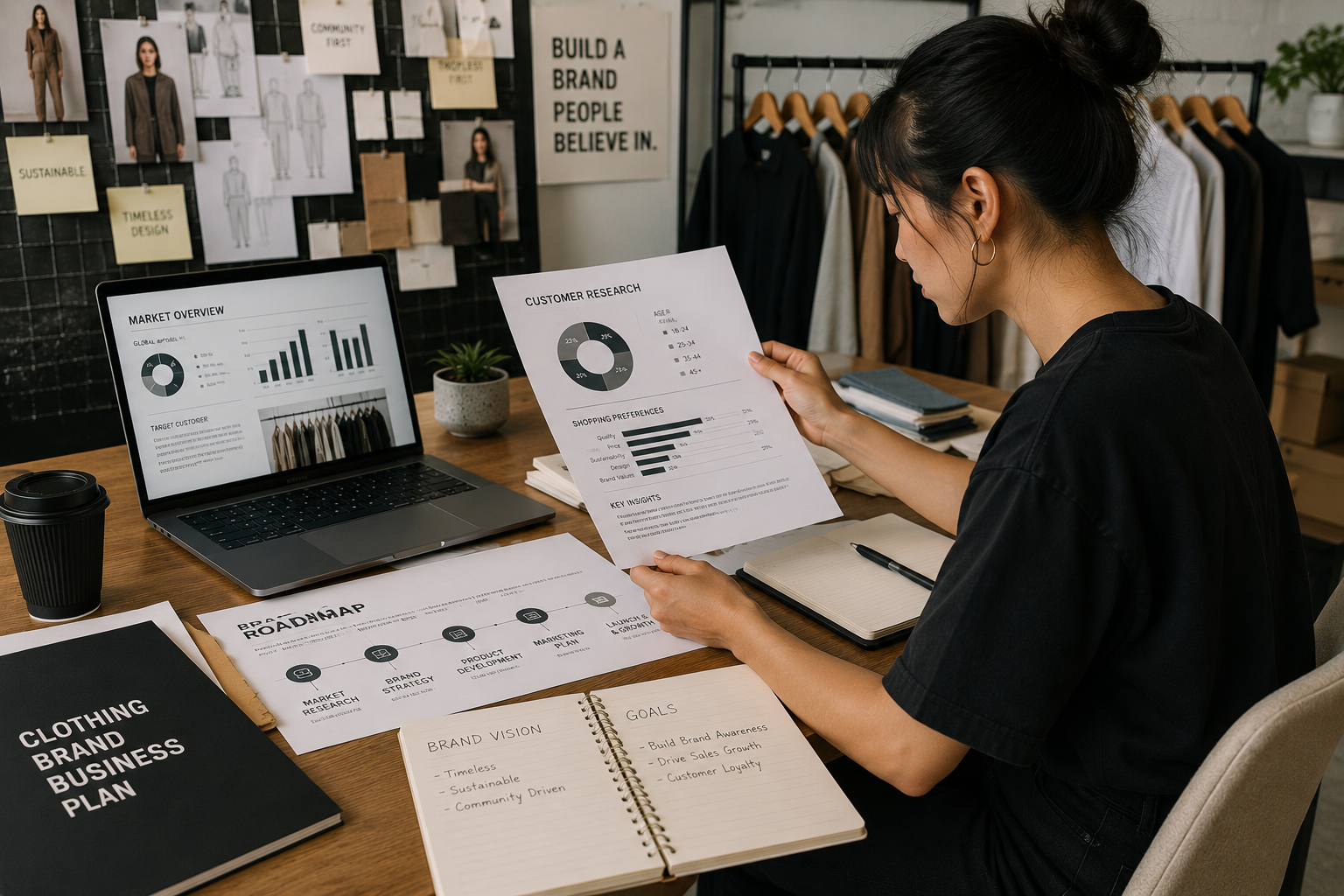
Market size: The US apparel market generates over $350 billion annually, according to AAFA’s US Fashion Industry Benchmarking Study. Your clothing brand business plan does not need to capture a fraction of that. It needs to identify the specific segment you are entering, whether activewear, premium basics, workwear, or sustainable casualwear, and size that segment with a named source.
Target customer profile: Write a one-page customer profile covering:
- Age range, income bracket, location
- Where they currently shop and what they currently spend per item
- What they value: price, sustainability, fit, Made in USA status, brand story
- Where they discover new brands: Instagram, TikTok, editorial, word of mouth
Why this matters for manufacturing: Your target customer determines your price point. Your price point determines your production budget. Your production budget determines your MOQ. These four numbers must be consistent with each other before you approach a single factory. A brand targeting a $40 retail price cannot sustain a $22 unit production cost, because the margin does not work at standard retail markup. Work backwards from your retail price before you write your manufacturing plan.
Section 4: Competitive Analysis
Name five brands your target customer currently buys from. For each one, document:
- Retail price range
- Manufacturing approach (domestic, overseas, private label, cut and sew)
- Their apparent MOQ and production scale
- What they do well
- What gap they leave open
This section tells manufacturers and investors you understand the market you are entering. It also tells you whether your price point and product positioning are realistic before you spend a dollar on production.
End this section with a one-paragraph positioning statement: where your brand sits relative to competitors and why a customer would choose you.
Section 5: Manufacturing and Production Plan
This is the section that most generic business plan templates leave blank. It is also the one that determines whether your clothing brand actually launches.
What to cover:
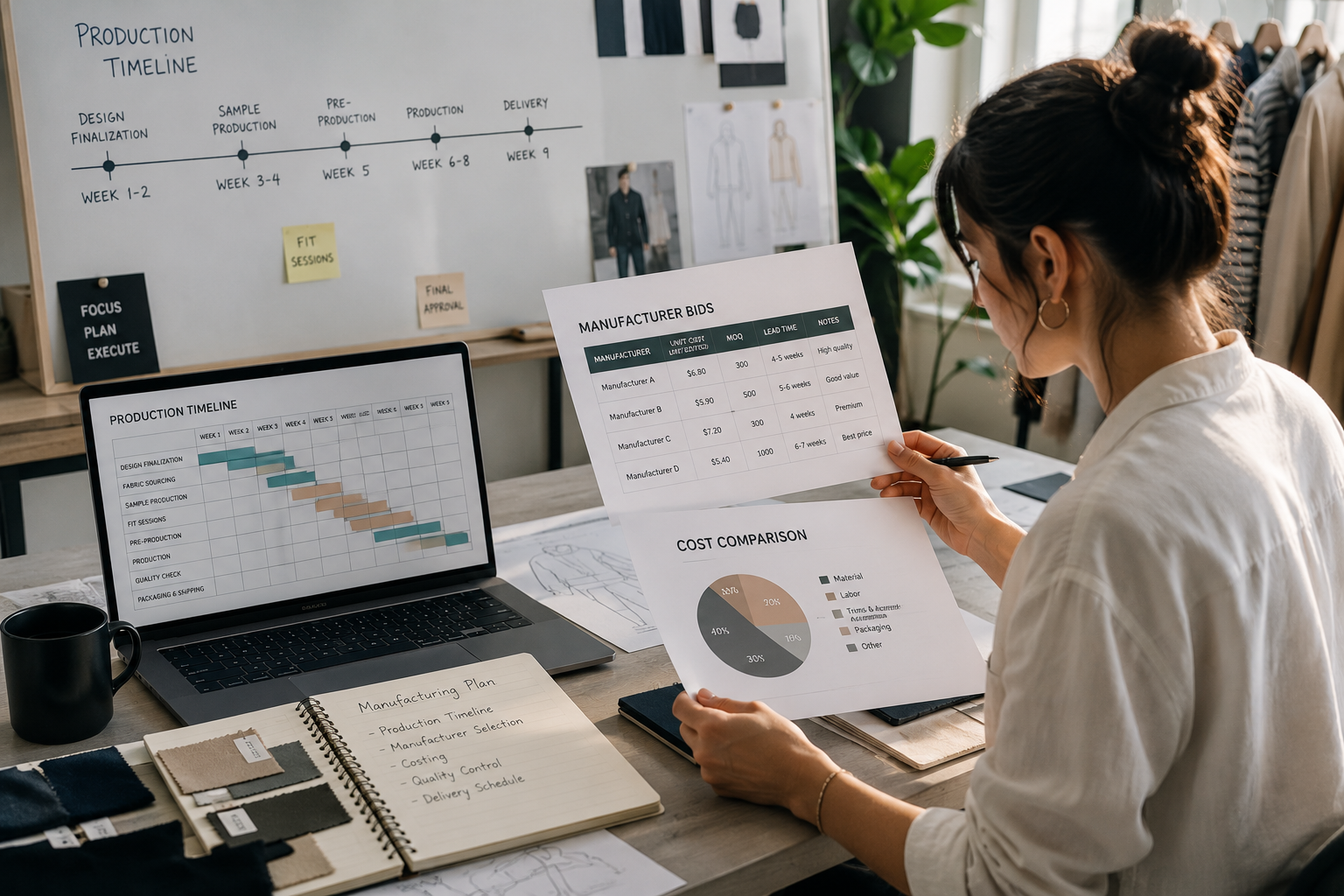
Production method: Are you using cut and sew or private label? Cut and sew means your design, your fabric, and your construction specs. It gives you a unique product but requires a tech pack and costs more per unit. Private label uses a manufacturer’s existing blank customised with your branding. It is faster and cheaper but produces a garment other brands may also carry. Be specific about which approach you are using and why.
Tech pack status: Manufacturers need a tech pack to quote your garment accurately. If you do not have one, your clothing brand business plan should include a line item for tech pack development, typically $300–$800 for a freelance technical designer. For a full breakdown of what a tech pack includes and how to create one, read the Maker’s Row tech pack guide.
MOQ planning: State your target production quantity for your first run and confirm it is achievable within your budget. US clothing manufacturers typically work with MOQs between 50 and 500 units per style. For a full explanation of how MOQ affects your startup budget, read the Maker’s Row MOQ guide.
Location: Domestic or overseas? Both have trade-offs. US manufacturers offer shorter lead times, in-person quality control, Made in USA brand value, and simpler communication. Factor this into your timeline and cost projections.
Timeline: Write out a production timeline covering: tech pack completion, manufacturer selection, sample production, sample approval, production run, and delivery to your fulfilment location. A realistic first-run timeline from zero to finished product in hand runs 16–24 weeks.
Also Read: How to Start a Clothing Brand in the USA: Step-by-Step Guide 2026 →
Section 6: Financial Projections
This is the section that determines whether your brand is a business or a hobby. It does not need to be a spreadsheet with 47 tabs. It needs to answer four questions clearly.
- What does it cost to launch? List every startup cost with a real number:
- Tech pack development: $300–$800
- First production run (units x unit cost): varies by MOQ and garment
- Branding (logo, labels, packaging): $500–$2,000
- E-commerce setup (Shopify + domain): $300–$500 first year
- Photography: $500–$1,500
- Shipping and fulfillment setup: variable
A focused first-run launch, one hero product at 100 units, typically costs $5,000–$15,000 all-in for a US-manufactured garment.
- What is your unit economics? For every unit you sell, what is left after cost of goods?
Item | Example |
Retail price | $85 |
Production cost per unit | $28 |
Gross margin per unit | $57 (67%) |
Less: packaging, labels, shipping | $8 |
Net margin per unit | $49 |
If your unit economics do not work at your target MOQ, your clothing brand business plan needs to change before your bank account does.
- What is your break-even point? How many units do you need to sell to cover your launch costs? If you spend $10,000 to launch and your net margin is $49 per unit, your break-even is 205 units. Does your first production run cover that? Can your target customer base realistically buy 205 units in your first season?
- Year 1 revenue projection: State a conservative, realistic, and optimistic scenario. Base your numbers on your actual unit count and price point, not on aspirational market size percentages.
According to SCORE’s startup financial planning resources, founders who build three-scenario projections are better prepared for investor conversations and better equipped to make decisions when actual revenue diverges from plan.
Section 7: Marketing and Sales Strategy
Your marketing plan does not need to cover every channel. It needs to cover the two or three channels where your target customer actually discovers new brands, and commit to a realistic content and spend plan for each.
Channel selection:
- Instagram and TikTok are standard for apparel. Commit to a post frequency and content format: product, behind-the-scenes, founder story, and UGC.
- Email list: build this before you launch. A pre-launch landing page capturing email addresses from day one gives you a launch audience that costs nothing to reach.
- Influencer seeding: identify five to ten micro-influencers in your category with audiences that match your target customer. Budget for product seeding, not paid posts, in your first season.
Sales channels: State where you will sell: direct-to-consumer via your own website, wholesale to retail buyers, pop-ups, or a combination. Your sales channel determines your margin requirements, your order minimums, and your fulfilment model. Wholesale to retailers typically requires 50% margin. Direct-to-consumer gives you full margin but requires you to drive all traffic yourself.
Launch plan: Write a brief timeline from brand announcement to first sale. A 6–8 week pre-launch period, building your email list, posting content, and warming your audience, consistently outperforms a cold-launch approach for first-time brands.
Section 8: Operations Plan
The operations plan covers the practical logistics of running the business day to day. For a startup clothing brand, this section is usually short, but it should be specific.
Business structure: Are you operating as a sole proprietor, LLC, or S-Corp? An LLC is the standard starting structure for independent clothing brands. It separates your personal liability from your business. If you are unsure which structure fits your situation, SBA’s business structure guide is a clear, practical starting point.
Design protection: If your designs are original, document them before sharing with any manufacturer. Registration with the US Patent and Trademark Office provides formal protection for logos and brand marks. Confidentiality agreements are standard practice when sharing unreleased designs with factories.
Fulfilment: How are you getting product to customers? Self-fulfilment from home works for the first 50–100 orders. Beyond that, a third-party logistics partner handles storage, picking, and shipping at scale.
Team: List who is doing what. If it is just you, say so, but be honest about which functions — tech pack creation, photography, bookkeeping — you are outsourcing.
Find Clothing Manufacturers on Maker’s Row
Your clothing brand business plan is only as strong as the manufacturing strategy inside it. Finding the right factory, one that matches your MOQ, your garment type, your timeline, and your budget, is the step that turns the plan into a product.
Finding the right manufacturer does not have to mean months of cold emails. On Maker’s Row, post your clothing project for free and verified US manufacturers bid directly. Review bids, check profiles, connect when ready.
Factories on Maker’s Row are active and responsive. Many reply within 24–48 hours of a new project being posted. State your garment type, target MOQ, and timeline in your brief and manufacturers who match those requirements come to you.
FAQs About Clothing Brand Business Plans
You do not legally need one, but you practically do. A clothing brand business plan forces you to confirm your unit economics, MOQ, and production timeline before spending money on samples or stock. Brands that launch without one are more likely to discover their retail price does not cover their production cost after they have already manufactured inventory.
A working clothing brand business plan for a startup runs 8–15 pages. It does not need to be a 40-page investment deck. It needs to clearly answer: what you sell, who buys it, how much it costs to make, how you will sell it, and what the numbers look like. Every section in this guide maps to one of those five questions.
A focused first production run, one hero product, 100 units, US manufacturer, typically costs $5,000–$15,000 all-in, covering production, tech pack, branding, e-commerce setup, and photography. That range moves significantly based on your MOQ, garment complexity, and whether you use domestic or overseas manufacturing.
Standard apparel gross margin for direct-to-consumer brands runs 55–70%. If you are planning to sell wholesale to retailers, you need a minimum 50% margin after cost of goods to leave room for the retailer’s markup. Run your margin calculation before committing to any production quantity.
Yes. Most lenders require a formal business plan as part of any loan application. According to SBA guidance on business plan requirements, your plan should include financial projections for at least three years, a market analysis, and a clear description of the business and its ownership structure.
Register your logo and brand name with the US Patent and Trademark Office before sharing designs externally. Use a non-disclosure agreement with any factory you share unreleased designs with. Reputable US manufacturers are familiar with NDAs and will sign them without issue.
From a completed clothing brand business plan to first product in hand typically runs 6–9 months. That covers: manufacturer selection (2–4 weeks on Maker’s Row), tech pack finalisation (3–6 weeks), sampling (4–8 weeks), production (4–8 weeks), and pre-launch setup (6–8 weeks, running parallel to production).
Your Clothing Brand Is One Manufacturer Away From Becoming Real
Your clothing brand business plan is the foundation. The manufacturer is the next step. The factories are on Maker’s Row, ready to bid.
On Maker’s Row, brand owners post unlimited manufacturing projects for free and receive bids from verified US factories at no upfront cost. To connect directly, subscription plans give full access.