Starting a kids clothing brand is one of the most rewarding paths a creative entrepreneur can take. It is also one of the most demanding, because every garment you sell touches a child, and that raises the safety bar above any other apparel category. This guide is different. It gives you the exact steps from idea to first production run, including how to find a US manufacturer who understands CPSIA compliance, even if you have never done this before.
According to the American Apparel and Footwear Association (AAFA), domestic apparel manufacturing continues to draw new brand entrants who want shorter lead times and closer quality control than overseas production offers, and children’s categories are no exception. New brand owners face three real obstacles before they can act on that opportunity: manufacturing a garment that meets federal safety standards, financing a first production run, and knowing which step actually comes first. This guide solves all three, and shows you how to start a clothing brand for kids without the months of trial and error that stall most first-time founders.
How to Start a Clothing Brand for Kids: The 7-Step Process
Learning how to start a clothing brand for kids means moving through seven sequential stages: defining your product, understanding your customer, building your tech pack, finding a compliant manufacturer, sampling, budgeting for production, and launching. Skipping a stage, especially the safety and compliance work in Steps 3 and 4, is the single biggest reason first kids clothing collections stall before they ever reach a customer. The sections below walk through each stage with the specific numbers, tools, and decisions a new brand owner needs.
Step 1: Define Your Kids Clothing Brand Identity and Hero Product
Pick one hero product before you design a full line. A hero product is the single item that best represents your brand and gives customers a reason to remember you.
Write a one to two page brand brief covering your target age range (infant, toddler, or 4 to 12 years), your price point, and your top three competitor brands with reference images. Decide early whether you are designing for one age band or multiple, since sizing standards, fabric weight, and safety testing requirements all shift by age group under CPSIA.
CPSIA (Consumer Product Safety Improvement Act) is the federal law that sets safety requirements for products made for children under 12, including clothing. For clothing brands, this means your fabric, dyes, trims, and closures all fall under specific lead content and flammability limits before you can legally sell in the US. Building this into your hero product decision now saves a redesign later.
A Denver-based founder launched with a single organic cotton romper style in three colorways rather than a five-piece layette set. That focus let her hit her first manufacturer’s 100-unit MOQ per style within a $6,000 budget, instead of needing $30,000 to cover a full collection. This is the first real decision in how to start a clothing brand for kids, and getting it wrong here is far more expensive to fix later than it is to get right now.
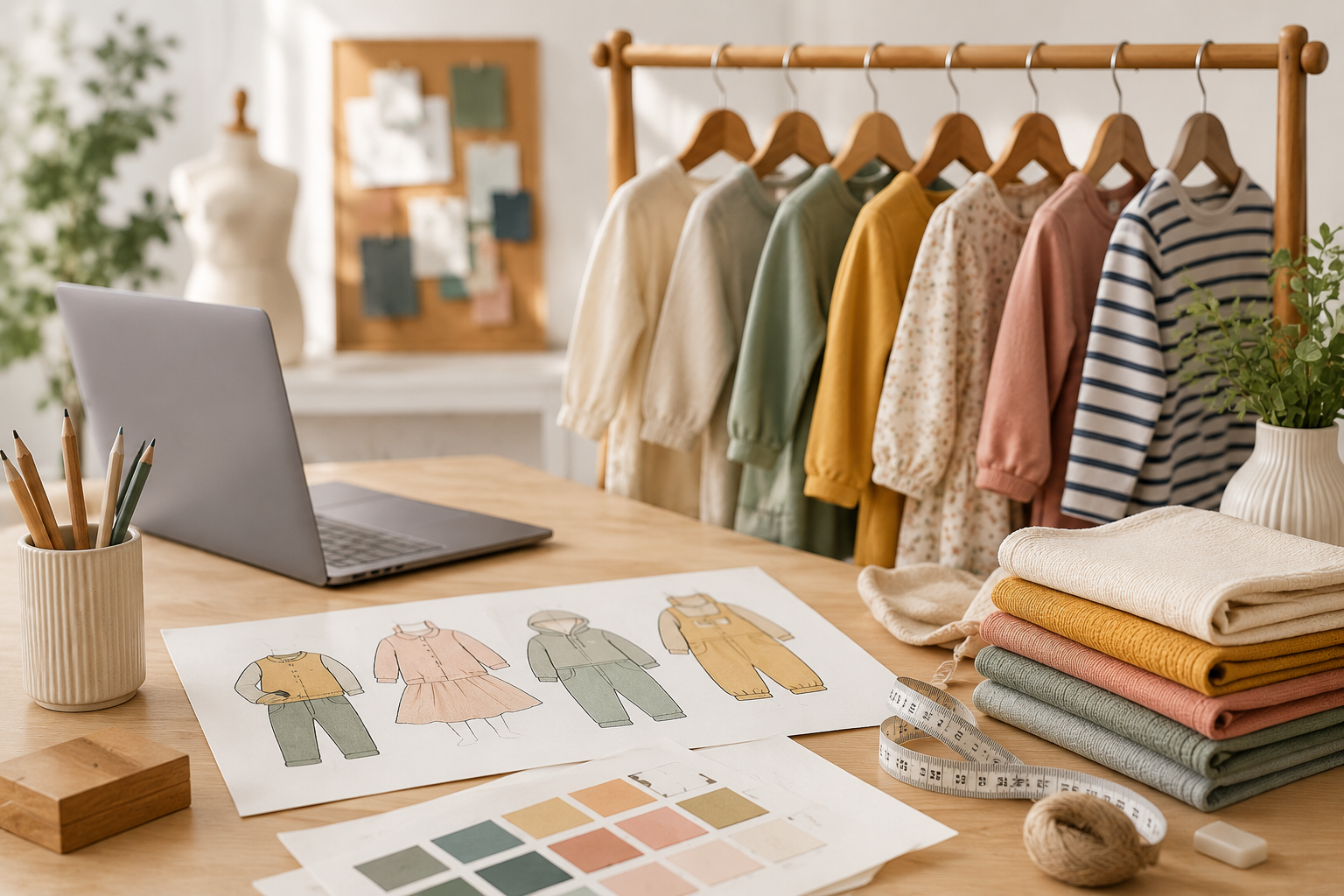
Step 2: Know Your Target Customer (Parents and Kids)
Kids clothing brands sell to two audiences at once. Parents make the purchase decision and control the budget. Kids influence it through comfort, character, and color preference, especially from around age 4 upward.
Define your buyer specifically: their child’s age range, their household income bracket, and what they currently buy instead of your brand. A brief that says “parents of toddlers who want organic, non-toxic clothing and currently shop at boutique baby stores” gives a manufacturer and a marketer far more to work with than “parents who care about quality.”
Durability matters more in kids clothing than almost any other apparel category, since garments face repeated washing, stretching, and rough play. Reinforced knees, flat-lock seams, and pre-shrunk fabric are not optional extras for this audience. They are baseline expectations that reduce your return rate.
Step 3: Build Your Product Concept and Tech Pack
A tech pack is a detailed document that tells a manufacturer everything they need to produce your garment correctly, including measurements, materials, construction details, and label placement. For a kids clothing brand, your tech pack also needs to document every safety-relevant detail: fabric weight for flammability exemption, snap and button lead content, and drawstring exclusions on hoods and waists for sizes 2T to 12.
Also Read: What is a Tech Pack? How to Create One for Your Brand →
Before contacting any factory, also understand MOQ. MOQ (minimum order quantity) is the smallest number of units a manufacturer will produce per style in a single order. US kids clothing manufacturers typically set MOQs between 48 and 200 units per style, with blank-focused suppliers sometimes going as low as 24 units for basic bodysuits and tees.
Also Read: What is MOQ in Clothing Manufacturing? →
Include a size grading chart across your intended range in your tech pack from the start. Retrofitting sizes after your first sample round typically adds two to four weeks and a full resample fee.
Step 4: Find Your Kids Clothing Manufacturer
This is where most new brand owners get stuck, and it determines whether your kids clothing brand actually launches. Not every apparel factory works with children’s products. Fewer still are set up for CPSIA compliance, organic or low-chemical dye processes, and the smaller construction tolerances kids garments require.
The old way of cold emailing custom manufacturers and private label manufacturers found through a general search is slow and unreliable for children’s apparel. Many general cut-and-sew manufacturers will decline children’s work outright rather than take on the added compliance liability, which means you can spend weeks contacting factories that were never going to say yes. For the general mechanics of sourcing, see our full guide on how to find a clothing manufacturer in the USA, then layer the compliance criteria below on top.
What Should You Look for in a Kids Clothing Manufacturer?
A kids clothing manufacturer needs to clear a higher bar than a general apparel factory. Use the table below to evaluate any candidate before you send a tech pack.
Criteria | What to Confirm |
CPSIA experience | Prior production for children’s apparel sold in US retail |
Fabric sourcing | Access to organic cotton or low-chemical-dye materials |
MOQ | Typically 48 to 200 units per style for kids categories |
Sample policy | Sew-out sample required before any bulk approval |
Communication speed | Response within 24 to 48 hours to sample queries |
Also Read: Best Infant Clothing Manufacturers in the USA →
Maker’s Row is a marketplace connecting apparel brand owners with verified US manufacturers. On Maker’s Row, post your kids clothing project for free and verified US manufacturers bid directly. Review bids, check profiles, connect when ready. Factories on Maker’s Row are active and responsive, with many replying within 24 to 48 hours of a new project being posted.
State your safety compliance requirements, size range, and target fabric directly in your project brief. Manufacturers who work in children’s categories and understand CPSIA see that detail and respond with quotes that already account for it, instead of you discovering a compliance gap three weeks into a conversation.
For a full breakdown of the flammability, lead content, and drawstring rules specific to children’s apparel, see our guide on product safety tests for children’s clothing designs.
Step 5: Order Samples and Refine
Never approve a production run from photos alone. Order a physical sew-out sample and check it against your tech pack for measurement accuracy, seam construction, and any snap or button placement that could pose a choking hazard for younger sizes.
Budget two to six weeks for your first sample round and expect at least one revision cycle. A Charlotte-based toddlerwear brand went through three sample rounds on a single romper style because their first tech pack did not specify snap placement in millimeters from the seam. The fourth sample matched their design exactly once that detail was added.
Test wash your sample at least twice before approving bulk production. Shrinkage and colorfastness issues show up after washing, not before, and kids clothing gets washed far more often than adult apparel.
Step 6: Plan Your Production Run and Budget
Budgeting correctly is the step most people skip when they research how to start a clothing brand for kids, and it is exactly where CPSIA testing costs and organic-fabric premiums show up as surprises if you have not planned for them.
How Much Does It Cost to Start a Clothing Brand for Kids?
Most new kids clothing brands launch their first production run for between $4,000 and $12,000, covering sampling, a 100 to 200 unit run at $6 to $18 per unit depending on garment complexity, labels, and basic packaging. Organic cotton or GOTS-certified fabric typically adds a 15 to 30 percent premium over standard cotton.
Set your MOQ and total budget before you approach any manufacturer, not after. A brand that says “we need 150 units, our budget is $9,000, and we need delivery within 10 weeks” gets a faster, more accurate quote than one that starts with “what can you make for this price.” The Small Business Administration (SBA) recommends new product businesses build a full landed-cost estimate, including samples, materials, and testing, before committing to a first order.
Factor in a compliance testing line item that adult apparel brands do not carry. If your annual revenue and unit volume exceed the CPSC’s small-batch exemption thresholds, third-party lab testing for lead and flammability adds real cost per style. Budget for this before you set your retail price, not after your first invoice arrives.
Step 7: Launch and Market Your Brand
Launch is often treated as an afterthought once production is finally done, but it is just as much a part of how to start a clothing brand for kids as sourcing your manufacturer, since a strong product with a weak launch still fails to sell through.
Photograph your product on real children in real use, not only on a flat surface or a mannequin. Parents buying kids clothing want to see fit, movement, and durability before they trust a new brand with their child.
Build your launch around one channel first, whether that is a direct-to-consumer store, a farmers market or pop-up circuit, or a small wholesale push to boutique baby stores. Trying to launch across five channels simultaneously with a 150-unit first run spreads inventory too thin to build momentum in any one place.
Collect feedback from your first customers specifically on fit and durability after multiple washes. That feedback becomes the basis for your second production run and, eventually, for expanding into additional sizes or styles. SCORE mentors work with early-stage product brands on exactly this kind of first-launch planning, often at no cost, if you want a second set of eyes before you commit to a channel.
For a first-person account of building a Made in USA kids brand from scratch, read Made in USA: Starting a Children’s Clothing Line, which covers the search for a domestic manufacturer and fabric house from a founder who built her brand through Maker’s Row.
FAQs: Starting a Kids Clothing Brand
Most new kids clothing brands launch their first collection for $4,000 to $12,000, covering samples, a 100 to 200 unit production run, labels, and basic packaging. Organic or certified materials can add 15 to 30 percent to that figure. Costs scale with unit count, fabric choice, and how many styles you launch with at once.
Yes. A clear tech pack, a defined hero product, and a manufacturer experienced in children’s apparel compensate for a lack of industry background. Most manufacturers who work with new brands expect founders to be learning as they go, as long as the brief they receive is specific and complete. For most first-time founders, that trial-and-error process is simply how to start a clothing brand for kids in practice, not a shortcut anyone skips.
Post a project brief on Maker’s Row specifying your product, size range, and CPSIA compliance needs. Verified US manufacturers with children’s apparel experience respond directly to briefs that match their capabilities, which is faster than cold-emailing general apparel factories that may decline children’s work outright.
MOQ, or minimum order quantity, is the smallest number of units a manufacturer will produce per style in one order. For kids clothing, MOQ typically ranges from 48 to 200 units per style. A lower MOQ reduces your upfront capital requirement but often raises your per-unit cost.
Most first-time kids clothing brands take three to six months from initial concept to a finished production run, factoring in tech pack development, two to three sample rounds, and manufacturer lead time. Rushing sampling to save time typically costs more later in reorders and corrections.
Yes. Most professional US manufacturers require a tech pack before quoting, and for kids clothing it also needs to document safety-relevant construction details like drawstring exclusions and lead-free trims. Without one, quotes are rough estimates and sample rounds multiply.
Children’s clothing sold in the US must meet CPSIA limits on lead content in fabric, dye, and hardware, along with flammability standards and drawstring restrictions on hoods and waistbands for sizes 2T to 12. The USPTO offers resources on protecting your designs once you finalize them, and your manufacturer should be able to speak to CPSIA compliance without you having to explain the requirement to them first.
Add a confidentiality notice to your tech pack and flat sketches, and use a one-page NDA for new manufacturer relationships before sharing full design files. The USPTO provides guidance on design protection and intellectual property basics for product-based businesses.
Your Kids Clothing Brand Is Closer Than You Think
Your clothing brand is one manufacturer away from becoming real. The factories are on Maker’s Row, ready to bid.