To design clothes for a clothing manufacturer, you move through five stages: concept research, a flat sketch, fabric and colorway selection, a measurement spec sheet, and a finished tech pack. Most first-time brand owners complete this sequence in 3 to 6 weeks, depending on complexity and revisions. Each stage produces a specific document a factory needs before it can quote or start a sample.
Most people learn how to design clothes the way a hobbyist does: sketch something, pick a fabric that looks nice, and hope a factory figures out the rest. A manufacturer needs dimensions and material specifics before it can quote your project. Skipping a stage is the biggest reason first samples come back wrong.
How to Design Clothes for a Manufacturer: The 5-Stage Process
Designing clothes for a manufacturer means producing five specific outputs in sequence: a defined concept, a flat sketch, confirmed materials, a measurement spec, and a tech pack that bundles all of it together. A factory cannot spec fabric usage without a flat sketch, and it cannot quote sizing without a spec sheet.
As of July 2026, US apparel manufacturing employed roughly 71,800 workers across 6,338 private establishments, according to the U.S. Bureau of Labor Statistics.
Design Stage | What You Produce | Typical Time |
1. Concept research | Mood board, reference notes, target silhouette | 2 to 5 days |
2. Flat sketch | Technical drawing, front and back | 3 to 7 days |
3. Fabric and colorway | Material specs, Pantone or swatch references | 3 to 7 days |
4. Measurement spec sheet | Point-of-measure chart, base size | 2 to 4 days |
5. Tech pack assembly | Combined file ready to send to factories | 2 to 5 days |
Step 1: Research and Define Your Concept
A manufacturer-ready design starts with a defined concept, not a folder of inspiration images. This is where how to design clothes for a manufacturer actually begins: pin down your silhouette, your target customer, and the detail that makes the garment yours.
Write a one-page brief: garment type, fit, price point, and two reference garments.
If your concept includes a genuinely novel construction detail, note it now. The USPTO classifies apparel design patents under Design Class D2, protecting a garment’s ornamental appearance.
Step 2: Create a Production-Ready Flat Sketch
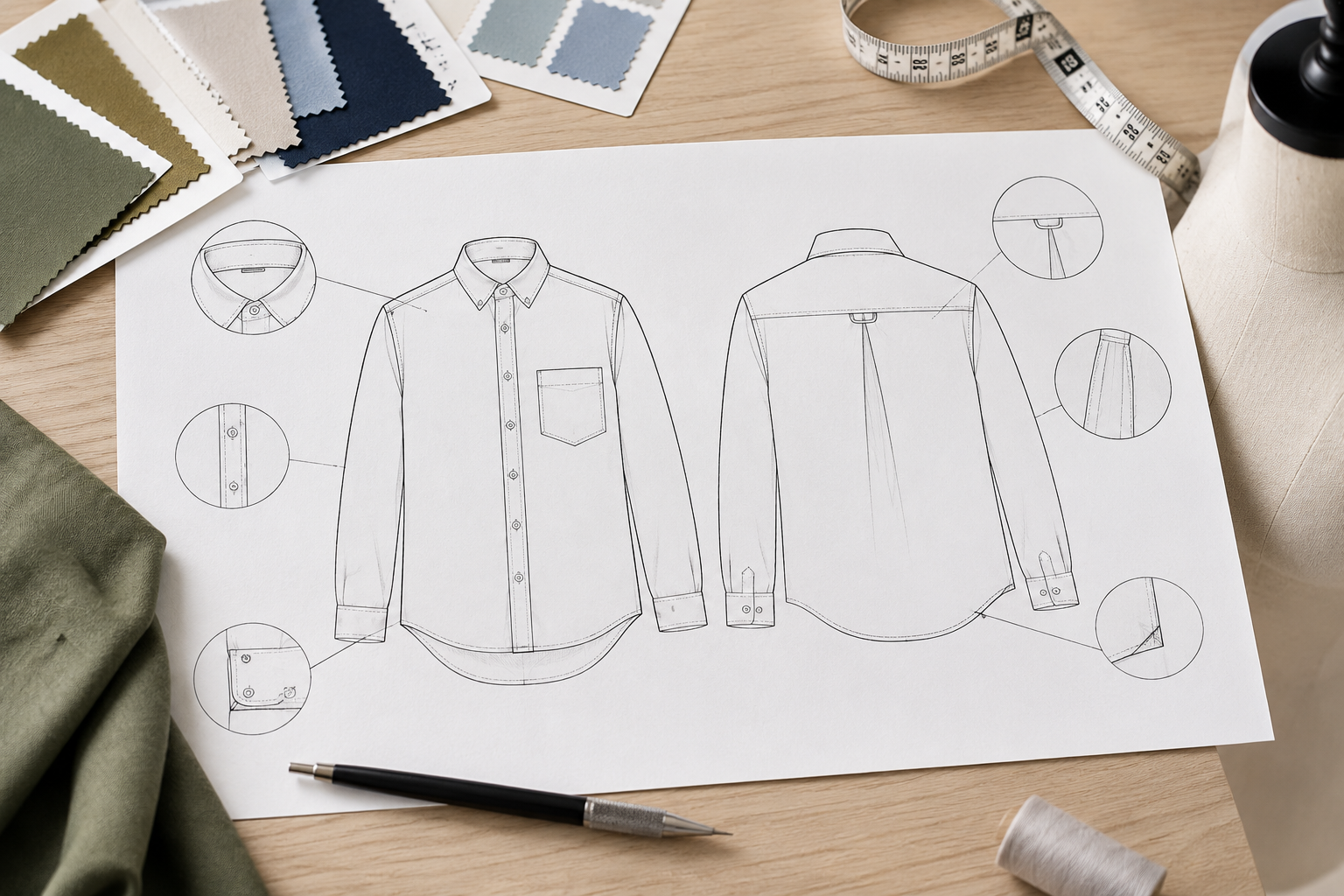
A flat sketch, also called a technical flat, is a clean line drawing of your garment shown from the front and back with no shading or color. It is the first document a factory can work from, and the step most guides on how to design clothes skip entirely.
Mark seam lines, stitch lines, closures, and pocket placement on the sketch. A pattern maker builds your first pattern from this drawing, so ambiguity here becomes a guessing game at the factory. Maker’s Row’s guide to what a flat sketch is covers the marks a factory expects. Adobe Illustrator, CLO3D, and Procreate with a grid overlay all produce usable sketches, no illustration training required.
Step 3: Choose Fabric, Trims, and Colorways
Once you know how to design clothes for a manufacturer up through the sketch stage, fabric and trim decisions come next. They belong before sampling, since a vague fabric note gets substituted with whatever the factory has on hand. Specify fiber content, weight, and finish rather than “soft knit.”
Assign a Pantone TCX or TPG number to every colorway, or a physical swatch for a custom shade. For trims, name the exact component: “brass zipper, 6-inch, YKK #5” is usable, “metal zipper” is not.
Textile Exchange maintains standards such as the Organic Content Standard and Recycled Claim Standard if sustainability claims matter to your brand.
Step 4: Build a Measurement Spec Sheet
A measurement spec sheet lists every point of measure on your garment (chest, sleeve length, hem circumference) at your base size, giving the factory numbers a sketch cannot convey alone.
Pick your base size first, typically S or M, then list every measurement point in inches and centimeters. Note your MOQ range too. MOQ (minimum order quantity) is the smallest number of units a manufacturer will produce per style per order, and most US manufacturers expect this before quoting.
Step 5: Assemble the Complete Tech Pack
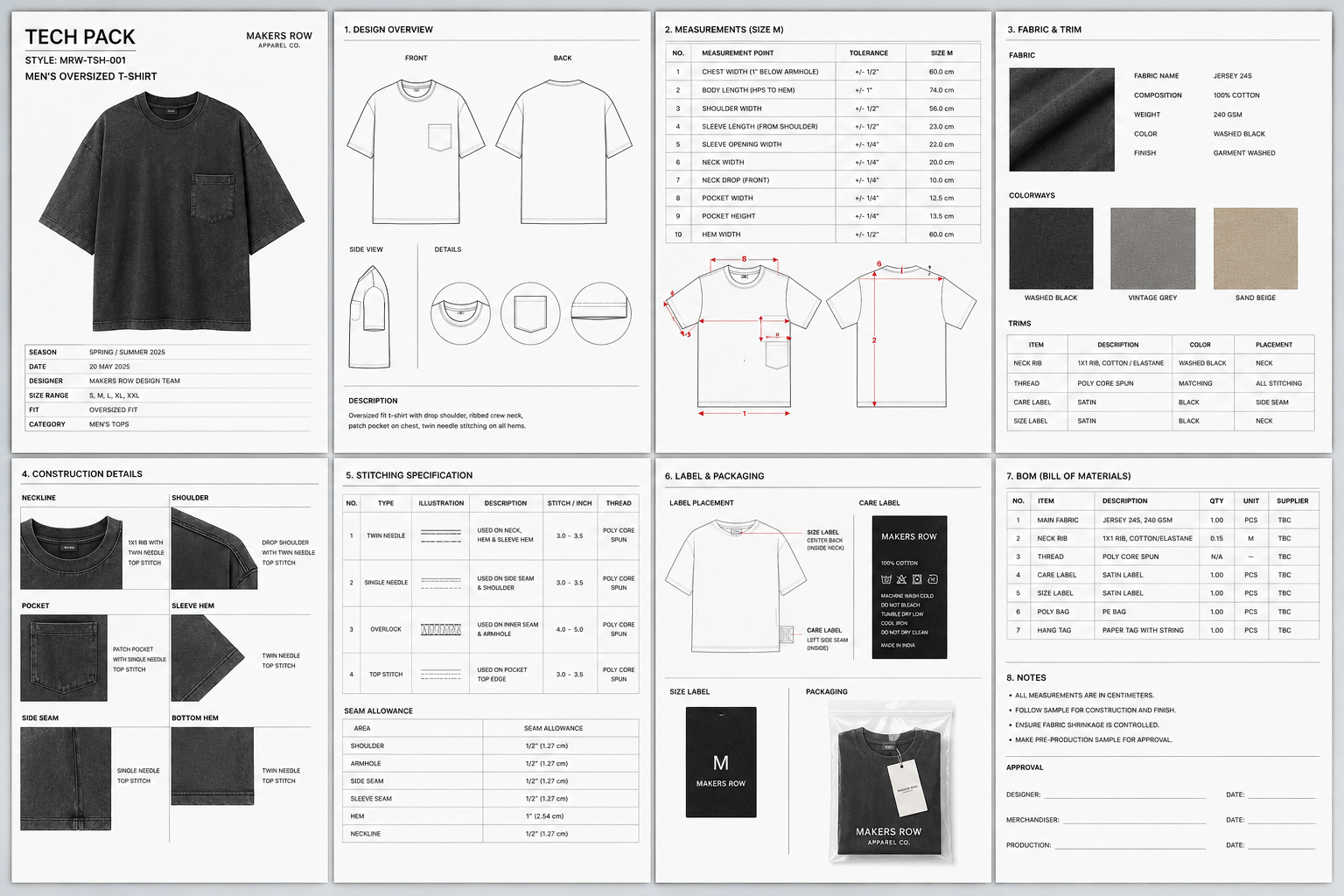
The last stage in how to design clothes for a manufacturer is bundling everything into one file. A tech pack combines your flat sketch, spec sheet, fabric details, and construction notes, the document sent to a factory for quoting or sampling.
Combine everything from Steps 1 through 4 into one PDF, organized by section. Maker’s Row’s guide to tech pack clothing breaks down every page a complete tech pack needs.
Do You Need Formal Design Training to Do This Yourself?
No, you do not need formal design training to design clothes for a manufacturer. What matters more than a design degree is completeness: a factory works with a self-taught tech pack as easily as a trained designer’s, as long as every measurement and material is specified.
Free flat sketch and spec sheet templates are widely available, and several Maker’s Row factories offer pattern development support if you arrive with a concept but no formal tech pack.
Where Can You Find a Manufacturer for Your Design on Maker’s Row?
Once your design reaches the tech pack stage, or even earlier with just a sketch and a concept, Maker’s Row connects you with verified US clothing manufacturers who can quote, sample, and produce it.
On Maker’s Row, brand owners post unlimited manufacturing projects for free and receive bids from verified US factories at no upfront cost. Subscription plans give full access to connect directly.
FAQs About Designing Clothes for a Manufacturer
Start with a one-page concept brief, then follow the same sequence anyone learning how to design clothes for a manufacturer uses: a flat sketch, fabric selection, and a spec sheet. Free templates cover most of the gap for a first-time brand owner.
Adobe Illustrator is the industry standard for flat sketches and tech packs, though CLO3D and Procreate with a grid overlay both work.
Most first-time brand owners take 3 to 6 weeks from concept to a finished tech pack, depending on how many revisions the design needs.
Yes, many US manufacturers, including several on Maker’s Row, offer pattern making and tech pack development as a paid service.
Yes, most experienced US manufacturers ask for a tech pack before quoting, since it lets them price and pattern your garment accurately. Some will quote from a sketch and spec sheet and build the tech pack during sampling.
Ready to Design With a Manufacturer in Mind?
That covers how to design clothes for a manufacturer, concept to tech pack. Once your design is ready, whether that means a full file or just a solid sketch, verified US manufacturers on Maker’s Row can take it from there.