You have a design in your head and almost nothing in your bank account. Most guides skip the hard part, which is that every garment costs real money to make. This guide shows which steps cost $0, which cost under $1,000, and how pre-orders can pay for the rest. It is written for first-time founders with a tight budget and a real product idea.
The US still has a deep factory base. As of Q1 2026, the US Bureau of Labor Statistics counts 6,199 private apparel manufacturing establishments (preliminary data). That is a large pool of factories to approach.
Three obstacles stop most new founders. You do not know the steps, you fear minimums you cannot afford, and you worry about losing a deposit to a stranger.
This guide explains how to start a clothing brand with no money upfront. You will do the planning work for free, pay for samples in small amounts, and fund your first run with pre-orders or a small loan. Every stage below carries a real dollar figure.
Can You Really Start a Clothing Brand With No Money?
You can plan your brand for $0, but you cannot make a physical garment for free. Every sample and production run needs cash from you, your customers, or a lender. Your real goal is simple when you learn how to start a clothing brand with no money. Spend as little as possible, as late as possible, and only after buyers prove demand.
Maker’s Row data points to a clear cost picture. Cut-and-sew pricing typically runs $15 to $45 per unit. Sample fees typically run $50 to $300 per sample, and most designs need 2 to 3 rounds. Small-batch minimums typically start at 50 to 100 units.
Stage | Typical cost | How to cover it |
Steps 1 to 3: brand brief, customer research, tech pack | $0 | Your time and free tools |
Step 4: post a project and collect bids | $0 | Posting is free on Maker’s Row |
Step 5: 2 to 3 sample rounds at $50 to $300 each | $100 to $900 | Savings or side income |
Step 6: first run of 50 to 100 units at $15 to $45 each | $750 to $4,500 | Pre-orders, loan, or savings |
Minimum total | $850 to $5,400 | A mix of the above |
The bare minimum lands near $850 to $5,400. Our full startup guide plans for $5,000 to $15,000 because it also covers branding, photos and a store. Your number falls somewhere between, based on how many pieces you order.
Step 1: Define Your Brand Identity and Hero Product
Your hero product is the one garment you make first, in one fabric and one cut. Choosing a single style keeps your costs low and your story clear.
Here is why. MOQ (minimum order quantity) is the smallest number of units a factory will produce per order, and it usually applies to each style. Three styles at 50 units each means 150 pieces. At $30 per unit, that is $4,500 instead of $1,500 for one style.
Write a one-page brand brief this week. Include your target customer, your target retail price, and your top 3 competitor brands. Then place your retail price next to a unit cost from the $15 to $45 range. If the gap is thin, simplify the garment.
Also Read: What is MOQ in Clothing Manufacturing? →
Next, test whether real people want this product.
Step 2: Know Your Target Customer
You can validate demand for $0 before you pay a factory anything. Free tools give you enough proof to decide whether to order a sample.
Post your sketch or mockup in Instagram Stories with a poll. Message 20 people in your target group and ask what they pay for a similar item. Set up a free landing page to collect email signups. A good target is 50 signups before you spend on a sample.
Then book a free session with a mentor. SCORE offers business mentoring at no cost, and a mentor can pressure-test your brief in one call.
Your research now shapes what you hand to a factory.
Step 3: Build Your Product Concept and Tech Pack
A tech pack is the document that lets a factory build your garment without guessing. A tech pack is a technical blueprint that lists your garment’s measurements, fabric, trims, stitching and colors.
Build yours in a free spreadsheet, one tab per section. Include a flat sketch of the front and back, a size chart with measurements, the fabric type, and every trim, such as zippers and labels. Add stitch details and your color options.
Skipping this step is expensive. A vague tech pack leads to a wrong sample, and a wrong sample costs another $50 to $300 round. A DIY tech pack costs you $0.
Also Read: What is a Tech Pack? How to Create One for Your Brand →
With your tech pack ready, you can approach manufacturers.
Step 4: Find Your Manufacturer
The right manufacturer decides whether your brand launches, and this is where most founders get stuck. You need a factory that accepts small orders, shares clear pricing, and answers fast.
The old way is slow. Cold emails to factories often sit unanswered for weeks, and trade show travel costs money you do not have. Our guide on how to find a clothing manufacturer in the USA covers every route in detail.
Use this table to compare any factory you contact.
What to check | What to look for | Red flag |
MOQ | 50 to 100 units for small batch, 25 to 50 in some categories | Will not state the minimum in writing |
Location | US-based, with a street address you can verify | Only a P.O. box or a messaging handle |
Sample policy | A clear fee of $50 to $300 and a written timeline | Asks for full payment before any sample |
Communication speed | Replies to questions within 2 business days | Goes silent after you share your tech pack |
How Do You Avoid Getting Scammed by a Manufacturer?
Verify the factory, pay in stages, and always pay for a sample before a production deposit. Ask for the business address and registration, then look both up. A typical production deposit runs 30% to 50% upfront, with the balance due before shipping. Pay by traceable methods such as card or bank transfer, never gift cards.
Find Clothing Manufacturers on Maker’s Row
Finding the right clothing manufacturer does not have to mean months of cold emails. On Maker’s Row, post your clothing project for free and verified US manufacturers bid directly. Review bids, check profiles, connect when ready.
Maker’s Row is a marketplace connecting apparel brand owners with verified US manufacturers. Brand owners post unlimited manufacturing projects for free and receive bids from verified US factories at no upfront cost. To connect directly, subscription plans give full access. You can also browse clothing manufacturers to see what is available.
Step 5: Order Samples and Refine
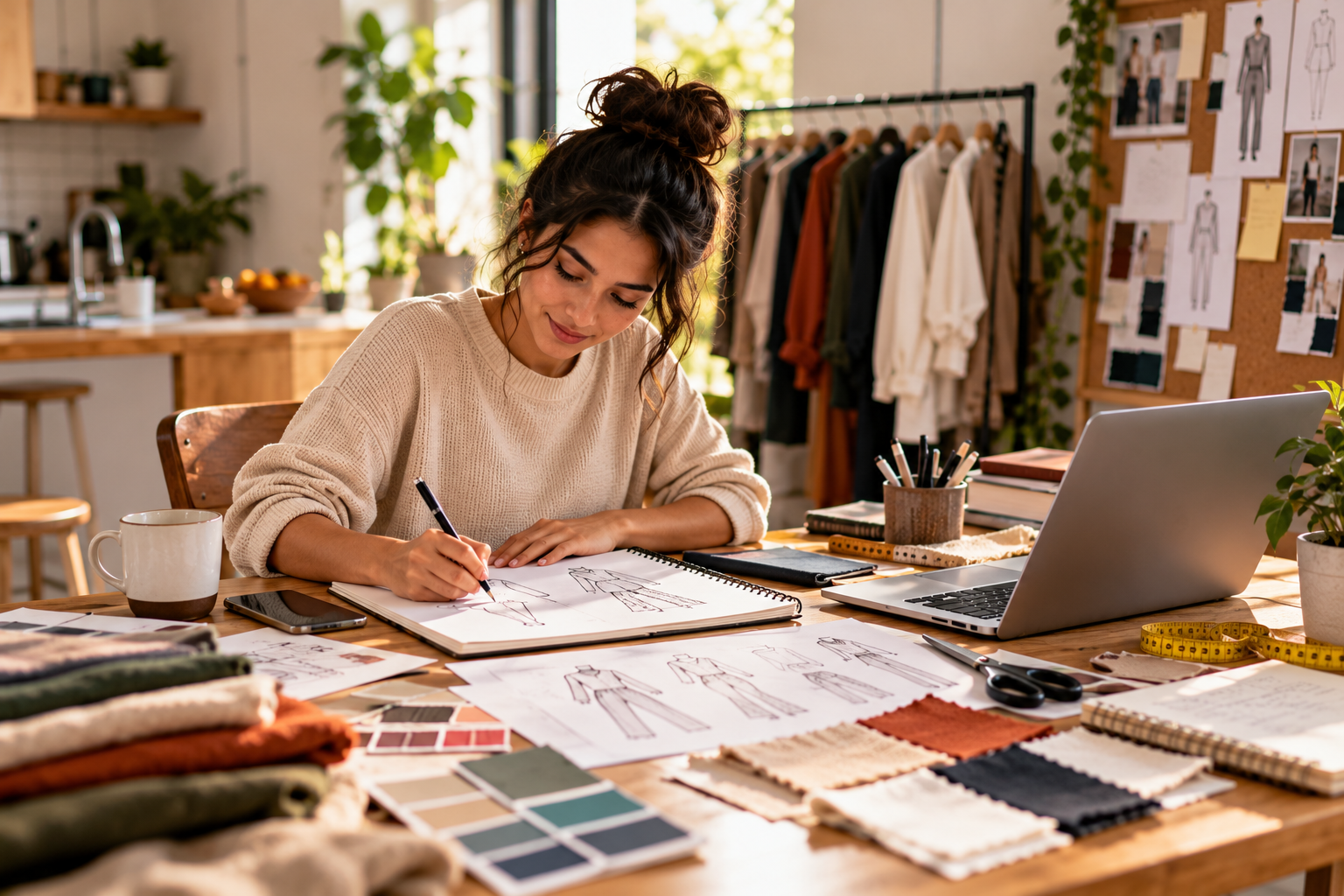
A sample is a physical test garment a factory sews from your tech pack before any production run. Plan for 2 to 3 rounds at $50 to $300 each, so your sampling budget is $100 to $900.
Review every sample against your tech pack. Measure each seam, check the fabric weight, and wash the garment once. Send written feedback with photos after each round. Our guide to the 7 stages of apparel samples shows what to inspect at each stage.
Ask each factory whether the sample fee credits toward your first order. That one question can save you up to $300. Maker’s Row guidance puts the path from idea to a production-ready garment at 4 to 6 months. Budget your time as well as your cash.
Once a sample is right, you need to pay for the run.
Step 6: How Do You Fund Your First Production Run?
You fund your first run with customer pre-orders, an SBA microloan, service income, or your own savings. Most founders who study how to start a clothing brand with no money combine two of these.
First, know what you are paying for. The BLS reports that US sewing machine operators earned a median $17.37 per hour in 2025, about $0.29 per minute. A garment that takes 40 minutes to sew carries about $11.60 in sewing labor before fabric and trims. That math explains why unit prices start near $15.
Funding option | Amount | The catch |
Customer pre-orders | Illustrative: 50 buyers at $65 each = $3,250 | You must ship on time (FTC rule below) |
SBA microloan | Up to $50,000, with an average near $13,000 | Applied for through nonprofit intermediaries, with no guaranteed approval |
Service-first income | Varies by client | Slower, but your clients fund your learning |
Savings or side income | $850 to $5,400 minimum | Your own cash is at risk |
Here is an illustrative example, not a real customer. You order 50 hoodies at $30 each, a $1,500 production bill. A 30% to 50% deposit is $450 to $750. You sell 50 pre-orders at $65 and collect $3,250. After the $1,500 run and $300 in sample fees, you keep $1,450 for shipping, payment fees and your next batch.
Maker’s Row recommends a pre-order campaign of up to 4 weeks, with 2 to 3 weeks as the sweet spot. The FTC Mail, Internet, or Telephone Order Merchandise Rule requires you to ship within your stated time, or within 30 days if you state none. If you will miss the date, you must notify buyers and offer a refund.
The SBA microloan program lends up to $50,000 for working capital, inventory and supplies. The average microloan is about $13,000.
The service-first route is real. Knickerbocker Mfg. Co. had no starting capital for its own line, so it sold private label production to other brands first. In Maker’s Row’s own words, that kept cash flowing and funded its mistakes with other people’s dollars. Read more in our guide on saving money when starting your brand.
Funding secured, it is time to sell.
Step 7: Launch and Market Your Brand
Your launch is a pre-order window, a content plan, and an email list, and all three cost $0 to start. Open pre-orders for 2 to 3 weeks and post a sample photo or short video every day.
Email your signups from Step 2 first, since they already asked to hear from you. Show your sample, your fabric and your price. Give a firm ship date and keep it, because the FTC rule applies the moment you take payment.
Build on what works. Our guide to building a brand with low capital covers the steps after launch. Then reinvest your first sales into a second batch. That is the full path for how to start a clothing brand with no money: plan for free, sample small, and sell before you produce.
FAQs: Starting a Clothing Brand With No Money
You need about $850 to $5,400 to cover samples and a first run of 50 to 100 units. That range assumes $100 to $900 for samples and $750 to $4,500 for production. Branding, photos and a website add to it, which is why our broader guide plans for $5,000 to $15,000.
Yes, you can learn how to start a clothing brand with no money and no experience if you bring a clear tech pack. Factories handle construction, so your job is to define the product and communicate it well. A free SCORE mentor can review your plan before you spend anything.
Post your project on Maker’s Row and let verified US manufacturers bid. Compare each bid on MOQ, sample fee, timeline and communication speed. You can start from the project creation page at no cost.
MOQ is the smallest number of units a factory will make per order. It sets your minimum spend directly. At $30 per unit, a 50-unit MOQ costs $1,500, while a 100-unit MOQ costs $3,000.
Expect 4 to 6 months from idea to a production-ready garment, based on Maker’s Row guidance. Most of that time goes to tech pack work and 2 to 3 sample rounds. Production adds time after sample approval.
Yes, a tech pack is the single most useful document you can bring. It lets factories quote accurately and build the right sample. A DIY version costs $0 and prevents $50 to $300 sample rounds from being wasted.
Start by registering your brand name as a trademark and keeping your files organized. The USPTO charges a base application fee of $350 per class. Many founders file after demand is proven so the fee does not delay their first sample. Read our guide on how to protect clothing designs, and speak with an attorney for legal advice.
Small-batch minimums typically start at 50 to 100 units, and some categories allow 25 to 50. Ask each factory for its minimum in writing before you order a sample. Our list of small batch manufacturers in the USA is a good place to begin.
Your Clothing Brand Is Closer Than You Think
Your clothing brand is one manufacturer away from becoming real. The factories are on Maker’s Row, ready to bid.