Building a fashion brand around fair labor and honest sourcing is one of the most meaningful things a founder can do right now. It is also one of the most confusing parts of starting a clothing line, because “fair trade” gets used loosely, and most guides skip the part where they tell you what the term actually requires. This guide is different. It walks you through the exact steps to build a fair trade clothing brand, including how it is defined, how to source honestly, and how to find a US manufacturer whose practices back up your claims.
Consumer demand for ethically produced apparel has grown steadily, and shoppers increasingly expect brands to show their work rather than just state a value. That shift creates real opportunity for a new fair trade clothing brand built on transparency from day one. Three obstacles trip up most founders trying to enter this space: confusion over what “fair trade” legally and practically means, uncertainty about sourcing without the budget of a large label, and not knowing which of the seven steps below actually moves a brand from idea to first production run. This guide solves all three, in order.
What Does “Fair Trade” Actually Mean for a Clothing Brand?
Fair trade clothing is apparel produced under audited standards that guarantee workers a living wage, safe working conditions, and a share of proceeds through a community development premium. For a brand owner, this means the term is not a marketing adjective you can apply on your own judgment. It is tied to specific certification programs with their own audit requirements.
The best-known certifier for apparel is Fair Trade USA, a nonprofit that audits factories against its Factory Production Standard and licenses the Fair Trade Certified™ seal to brands that source from certified facilities. A second body, Fairtrade International, certifies fair trade cotton and other raw materials rather than finished-garment factories in most cases. Formal Fair Trade Certified apparel factories are concentrated in certain manufacturing hubs, most heavily in South and Southeast Asia, with a smaller number of certified facilities operating in the USA.
This distinction matters for your fair trade clothing brand strategy. If your goal is the specific Fair Trade Certified™ seal, you will need to work with a factory that already holds that certification, or one willing to pursue it, and you should confirm certificate status directly through the certifying body rather than relying on a factory’s own claim. If your goal is a domestically made brand built on fair labor values more broadly, US manufacturing gives you built-in advantages: enforceable federal and state labor law, in-person audit access, and a “Made in USA” story that many customers already associate with fair treatment of workers, even without a specific fair trade seal attached.
Standard | What It Verifies | Typical Scope |
Fair Trade Certified™ (Fair Trade USA) | Wages, safety, worker committees, community premium | Factory-level, mostly overseas Tier 1 facilities |
Fairtrade International | Fair minimum price and premium for raw materials | Primarily cotton and fiber, not finished garments |
Domestic US manufacturing | Federal and state labor law, OSHA safety standards | Any US-based factory, verifiable by visit |
Step 2: Know Your Target Customer
Your fair trade clothing brand needs a customer who will pay for the story behind the garment, not just the garment itself. Write a one-page brief covering three things: who buys from you, what price point they accept, and which three competitor brands they currently consider.
Ethically minded shoppers respond to specificity. A brand that says “we pay our workers fairly” earns less trust than one that says “our production partner in North Carolina pays above the state minimum wage and passed an independent labor audit in June 2026.” Decide now what level of documentation you are prepared to collect and publish, because that decision shapes which manufacturers you approach in Step 4.
Also define your price ceiling honestly for a fair trade clothing line. Fair labor and transparent sourcing add cost. A t-shirt made in a facility with audited wage standards typically costs more per unit than one made without those standards, and your customer needs to be someone willing to pay that difference.
For a sense of how established USA-made brands position themselves on price and story, Maker’s Row’s brand page is worth a look before you finalize your own positioning.
Step 3: Build Your Product Concept and Tech Pack
Lock one hero product before building a full collection. A single well-made, well-documented piece, a shirt, a hoodie, a simple dress, gives you something concrete to source, sample, and market, rather than a vague collection concept that no factory can quote accurately.
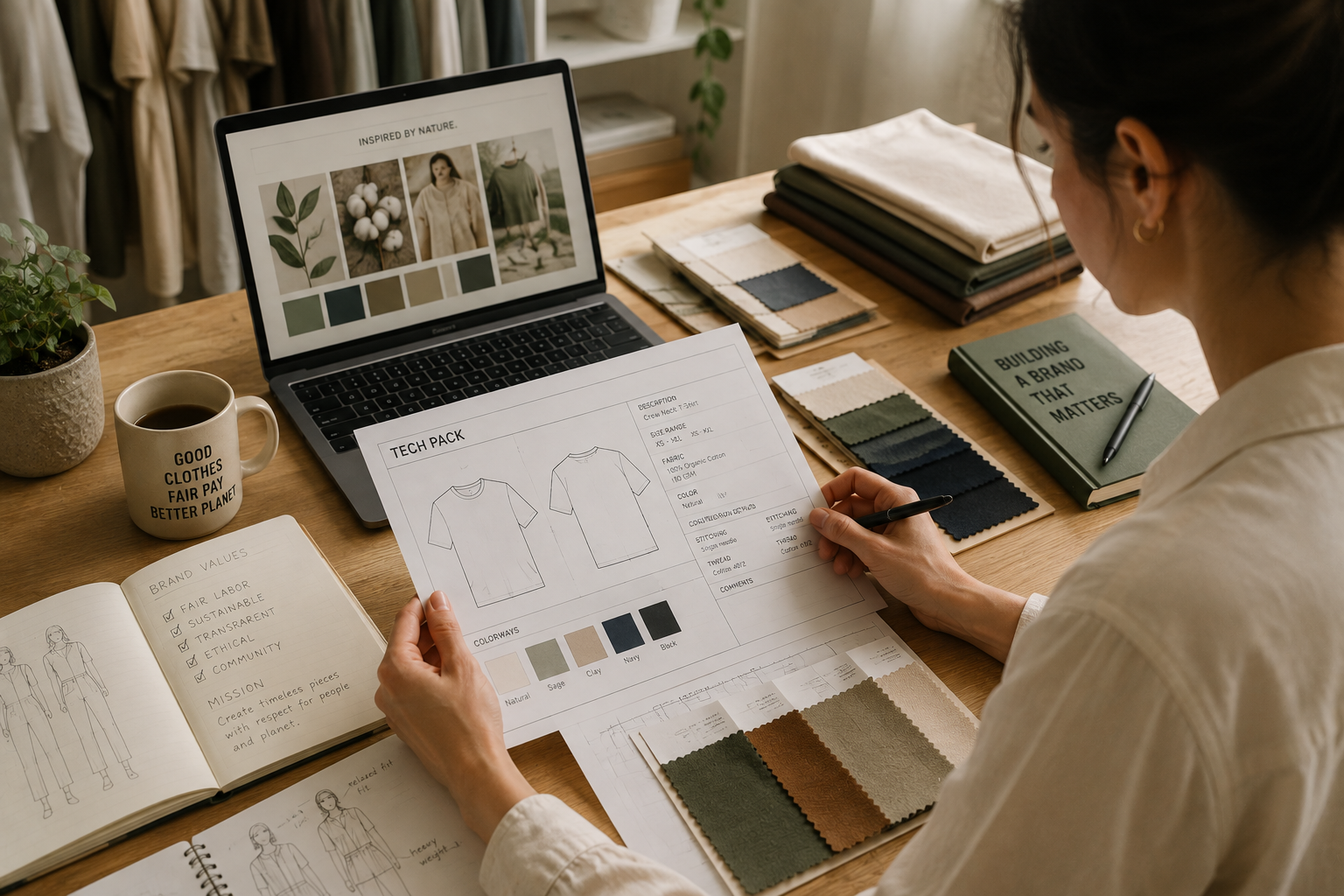
Once your hero product is defined, translate it into a tech pack for your fair trade clothing brand. A tech pack is a detailed specification document that tells a manufacturer exactly what to produce: measurements, fabric, construction details, trims, and finish. For a fair trade clothing brand, add a fabric sourcing page to the standard tech pack noting any preferred-fiber standards you want followed, such as organic cotton or recycled materials, since fiber sourcing is often reviewed separately from factory labor certification.
Also Read: What is a Tech Pack? How to Create One for Your Brand →
Alongside the tech pack, define your MOQ, or minimum order quantity, the smallest number of units a manufacturer will produce per style in a single run. US manufacturers focused on small, ethically documented runs commonly set MOQs between 50 and 300 units per style, lower than the 500 to 1,000-unit minimums common at large overseas facilities.
Step 4: How Do You Find a US Manufacturer That Supports Fair Labor Practices?
A US manufacturer that supports fair labor practices operates under enforceable domestic labor law, allows in-person facility visits, and will discuss wage and working-condition questions directly rather than deflecting to a supply chain it does not control. This is where most fair trade clothing brand owners get stuck, because sourcing information for small factories rarely appears in a Google search.
The old way is cold emails to factories found through directory listings, plus trade shows like the LA Textile Show, hoping someone answers. It is slow, and it puts the burden of vetting entirely on you before a factory has any incentive to respond honestly.
When evaluating any clothing manufacturer for a fair trade clothing brand, compare candidates on the same criteria every time:
Criteria | What to Ask | Why It Matters |
MOQ | Per-style minimum for your product category | Determines your upfront capital risk |
Location | City, state, and whether visits are permitted | US location enables real audit access |
Sample policy | Fee, turnaround, and revision process | Signals how the factory treats small brands |
Communication speed | Response time to first inquiry | A predictor of production-stage reliability |
Labor documentation | Will they share wage or audit records? | Core to any honest fair trade claim |
A factory unwilling to answer the labor documentation question directly is not a factory to build a fair trade clothing brand around, regardless of how strong the samples look.
Maker’s Row is a marketplace connecting apparel brand owners with verified US manufacturers, and it removes most of the guesswork from this step. Rather than cold-emailing dozens of factories, you can find clothing manufacturers in the USA by posting a single project brief describing your product, target MOQ, and the labor or sourcing standards you require, and manufacturers who match respond directly. This does not replace verifying a specific factory’s Fair Trade Certified™ status with Fair Trade USA if that formal seal is your goal, but it does put you in front of active, US-based factories fast enough to ask those questions yourself, factory by factory.
For a broader walkthrough of vetting any US clothing manufacturer, not specific to fair trade sourcing, the guide on how to find a clothing manufacturer in the USA covers the full evaluation process.
Step 5: Order Samples and Verify Labor Practices
Never approve a production run from a sample photo alone, and never accept a fair trade clothing claim from a factory without documentation to support it.
Request a sample against your tech pack first, typically a two-to-four-week turnaround for domestic cut-and-sew production, the manufacturing model where a factory cuts fabric and sews it into a finished garment based on your original design, as opposed to private label manufacturing, where you brand an already-developed style the factory produces for multiple clients.
Alongside the physical sample, ask for whatever labor documentation the factory is willing to share: a Fair Trade Certified™ certificate number you can verify with Fair Trade USA directly, a third-party labor audit summary, or, at minimum, a factory visit where you can see the working floor yourself. A domestic factory that resists an in-person visit is a signal worth taking seriously.
A small Ohio-based basics brand built its first ethical sourcing positioning around exactly this step: it toured three candidate factories in person, requested wage-range documentation from each, and selected the one willing to put its pay scale in writing before placing a 120-unit first order.
Step 6: Plan Your Production Run and Budget
Fair trade clothing sourcing changes your cost structure, so budget for it directly instead of treating it as a rounding error. Domestic cut-and-sew production for a basic garment typically runs $15 to $45 per unit depending on fabric and construction complexity, and factories documenting wage and safety standards often sit toward the higher end of that range because those standards carry real cost.
Multiply your target MOQ by your per-unit landed cost, then add your sampling fees, typically $150 to $400 per sample garment, and any tech pack development costs. A first production run of 150 units at $30 landed cost, for example, represents $4,500 in production capital before packaging, shipping, or marketing spend.
According to the Small Business Administration (SBA), new product-based businesses should calculate total landed cost, production plus shipping plus any duties, before committing to a first order, a step that applies directly to a fair trade clothing brand where a factory switch mid-run can be costly. The SCORE mentorship network also offers free one-on-one guidance for founders building a first cost model, worth using before you finalize a budget.
Step 7: Launch and Market Your Brand Honestly
Market only what you can document. If your factory holds Fair Trade Certified™ status, name it specifically and link to verification where possible. If your factory is US-based with strong labor practices but does not hold a formal fair trade certificate, say exactly that, rather than implying a certification you do not have.
According to the American Apparel and Footwear Association (AAFA), domestic apparel production carries higher per-unit costs than most overseas alternatives, a fact worth stating plainly to customers as part of why a fair trade clothing garment costs more than fast fashion.
Launch with your documentation ready before your first sale: factory location, certification status if applicable, and a plain-language explanation of what your fair trade claim does and does not cover. This single habit prevents the kind of backlash that hits brands making vague ethical claims they cannot support.
FAQs: Starting a Fair Trade Clothing Brand
Most founders need $5,000 to $20,000 for a first production run, covering a tech pack, sampling, and a domestic minimum order of 100 to 300 units at $15 to $45 per unit. Fair trade or ethically documented sourcing tends to sit toward the higher end of that per-unit range because audited labor standards carry real cost.
No, but you do need to be precise about what you claim. If you use the Fair Trade Certified™ seal, your factory must hold that certification through Fair Trade USA. If you have not pursued formal certification, describe your actual practices, such as documented wages or in-person factory audits, instead of using the certified term.
Yes. Start with one hero product, a clear tech pack, and a small first order from a US manufacturer willing to share labor documentation. Most first-time founders learn the vetting process through direct conversations with two or three candidate factories before choosing one.
Post a project brief on a platform like Maker’s Row describing your product, target MOQ, and the labor standards you require, so manufacturers who match respond directly, rather than cold-emailing factories with no context on your sourcing priorities.
MOQ, or minimum order quantity, is the smallest number of units a manufacturer will produce per style. Domestic factories focused on small, ethically documented runs commonly set MOQs between 50 and 300 units, which keeps your upfront capital lower than the 500-plus unit minimums typical at large overseas facilities.
Budget six to twelve weeks from a confirmed tech pack to an approved sample, plus two to six weeks for a first production run, depending on factory capacity. Verifying a factory’s labor documentation or certification status can add one to two weeks if you are confirming a Fair Trade Certified™ claim directly with Fair Trade USA.
Request a signed Non-Disclosure Agreement before sharing your tech pack with any factory. The United States Patent and Trademark Office (USPTO) provides resources on design patents for founders who want formal intellectual property protection on a unique garment design.
Many US cut-and-sew factories that document labor standards accept first orders as low as 50 to 100 units per style, though some full-package facilities require 300 or more. Confirm MOQ on your first factory call, before sending a tech pack.
Your Fair Trade Clothing Brand Is Closer Than You Think
Building a brand around fair labor is not just a marketing position, it is a sourcing discipline you can build correctly from your very first order. The factories are on Maker’s Row, ready to bid.