A single printed silk square can carry your entire art direction, which is exactly why a scarf makes such a good first product. It is also hard to source, because silk is unforgiving and most factories never publish their minimums. This guide gives you seven steps to find, vet, and sample with a custom silk scarf manufacturer, even if you have never produced anything before. It is written for founders launching their first scarf line.
A scarf is light, flat, and cheap to ship, and a strong print photographs beautifully. That makes it one of the easier accessories to launch from a small studio.
New founders still hit the same three walls. First, manufacturing: scarf production often splits across fabric, printing, and hemming, so no single factory is obvious. Second, cost: minimums can apply per design, which multiplies the cash you need. Third, process: nobody tells you what to prepare before you email a factory.
This guide solves all three. You will leave with a one-page spec sheet, a budget formula, and a vetted shortlist for your custom silk scarf manufacturer search.
Step 1: Decide What Kind of Silk Scarf You Are Making
The scarf type you choose decides the fabric, the hem, and the custom silk scarf manufacturer you need. A 36 inch square, a long oblong, and a skinny twilly are not interchangeable products.
Momme is the weight unit for silk fabric, and a higher momme number means a heavier, denser cloth. Lighter weights drape and float. Heavier weights hold a knot and resist snagging. You will pick a momme weight in Step 3, so learn the vocabulary now.
Scarf Type | Common Silk Fabric | What to Ask the Factory |
Square scarf (about 36 inches) | Silk twill | Which momme weight, and is the hem hand-rolled or machine finished? |
Long oblong scarf | Habotai or crepe de chine | How is the print positioned along the full length? |
Twilly (skinny scarf) | Twill or satin | Is the narrow strip hemmed by hand or by machine? |
Sheer wrap or shawl | Chiffon or georgette | How do you prevent fraying and snags on sheer cloth? |
Small bandana or neckerchief | Habotai | Does your minimum change for smaller sizes? |
Twill is a diagonal-rib weave that holds sharp prints, habotai is a plain lightweight weave, and crepe de chine is a twisted-yarn weave with a pebbled surface. Chiffon and georgette are sheer, airy weaves that suit wraps rather than structured squares.
A hand-rolled hem is a narrow edge rolled and stitched by hand, common on premium square scarves. A machine-finished hem costs less and suits promotional or lower-priced lines. Neither is wrong. Your price point decides.
Write a one to two page brand brief covering your scarf type, target customer, price point, and three competitor scarf brands. Every custom silk scarf manufacturer will ask for it. Next, turn that brief into an order size.
Step 2: Set Your Customer, Price Point, and Order Size
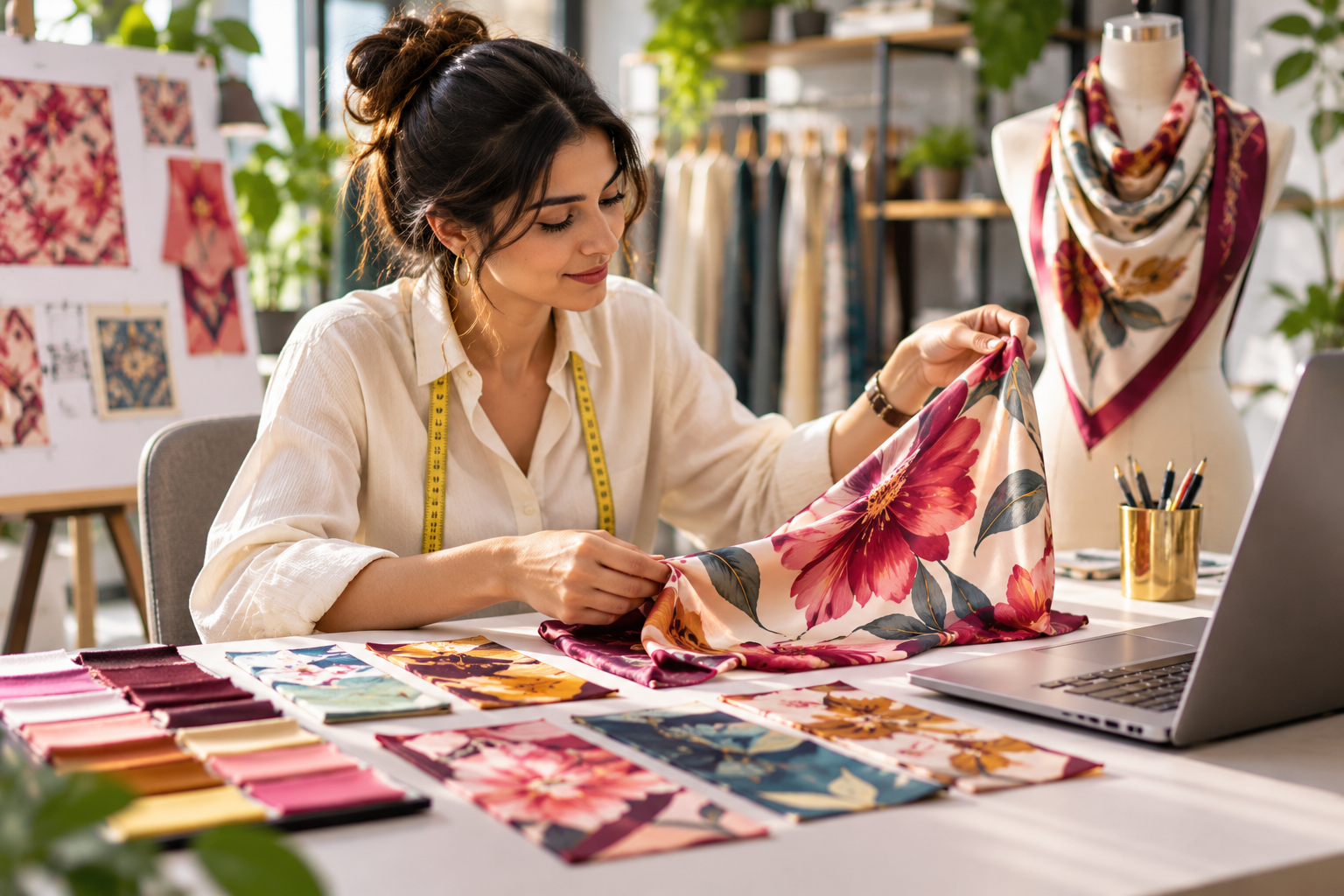
Your order size is the number of scarves per design multiplied by the number of designs, and it decides which custom silk scarf manufacturers will say yes. Set it before you send a single email.
MOQ (minimum order quantity) is the smallest number of units a manufacturer will produce per order. For scarves, ask whether the minimum applies per design or per order. That one word can multiply your cash need.
Here is a planning scenario, not a case study. Picture a founder in Austin who wants three prints. If the factory sets a per-design minimum of 50, her run is 150 scarves, not 50. At a placeholder price of $30 per scarf (replace it with your real quote), that is $4,500 before samples, labels, and shipping.
She learns this before emailing anyone, so she negotiates from a real number. Do the same math with your own prints. Then state your quantity and design count in the first message to every custom silk scarf manufacturer.
Also Read: What is MOQ? Complete Guide for Brand Owners 2026 →
With your numbers set, you can prepare what a factory needs to quote you.
Step 3: Prepare Your Artwork and Spec Sheet
A one-page spec sheet and print-ready artwork let a factory quote accurately. A custom silk scarf manufacturer cannot price what it cannot see, so build both before you make contact.
Your spec sheet should list:
- Finished size and scarf type
- Fabric and momme weight
- Print method and number of colors
- Color references for each design
- Hem type, label placement, and packaging
- Quantity per design
Print method shapes your minimums, so choose it deliberately.
Print Method | Best For | What It Means for Your Order |
Digital printing | Detailed art, gradients, many colors, small runs | No screens to make, so smaller minimums are common |
Screen printing | Bold flat colors and repeat orders at volume | Each color needs its own screen, so setup rises with color count |
Colors shift between a monitor and real silk. A strike-off is a small printed test of your artwork on the actual fabric, used to check color before production. Ask for one before you approve a full sample.
A full apparel tech pack is more than a scarf needs, but the same logic applies: give the factory everything in writing.
Also Read: Tech Pack Clothing: What It Is and How to Create One (2026) →
Your spec sheet is ready, so the search can start.
Step 4: How Do You Find a Custom Silk Scarf Manufacturer?
You find a custom silk scarf manufacturer by matching your scarf type, print method, and order size to factories that already print and hem silk for outside brands. This is the step where most new founders stall. It decides whether your line launches.
The old way is referrals, trade shows, and cold emails. Each route takes weeks, and silk specialists rarely advertise.
Scarf production also passes through several stages: fabric, printing, cutting and hemming, and finishing. Some factories handle every stage. Others handle one, so ask each custom silk scarf manufacturer who does what.
Use this table to compare every candidate on the same terms.
Criteria | What to Ask | Why It Matters for Silk Scarves |
MOQ | Is your minimum per design or per order? | It sets your real cash requirement |
Location | Where is the fabric woven, printed, and hemmed? | It decides your origin label and whether you can say Made in USA |
Print method | Do you print digital, screen, or both? | It must match your art and order size |
Sample policy | Do you offer a paid strike-off before a full sample? | It catches color problems early |
Communication speed | Will you answer written spec questions before quoting? | Slow answers at quoting predict slow answers in production |
If your design adds sewn construction beyond a hem, such as a lining or patchwork, read our guide to cut-and-sew manufacturers in the USA. For the general outreach process, see how to find a clothing manufacturer in the USA.
Find Custom Silk Scarf Manufacturers on Maker’s Row
Maker’s Row is a marketplace connecting brand owners with verified US manufacturers. Instead of cold emailing each custom silk scarf manufacturer one by one, post your silk scarf project for free and verified factories bid directly. Review bids, compare minimums and print methods, and connect when a factory fits.
On Maker’s Row, brand owners post unlimited manufacturing projects and receive bids from verified US factories at no upfront cost. To message factories directly, subscription plans give full access. You can also browse verified US manufacturers before you post.
Step 5: How Do You Vet Factories and Approve Samples?
You vet a custom silk scarf manufacturer by confirming it is a real business, checking references, and requesting a paid sample before you commit to a full run. Do this even when a bid looks perfect.
Confirm a physical address and a working phone number. Ask for two references from outside brands. Then search the company name with the word “scam” or “complaint,” a step the FTC recommends before doing business with any new company. The same FTC guide says to refuse anyone who demands payment by wire transfer, cryptocurrency, or gift card.
SCORE lists five factors for choosing a supplier: stability, quality, customer service, cost, and compatibility. Score each custom silk scarf manufacturer on all five, not on price alone.
Plan for more than one sample round. Check each sample against your approved strike-off for color, print alignment, hem quality, size, and drape. Ask in writing who owns your artwork files and any screens, so you can move production later without losing them.
Once a sample feels right, you can plan the full run.
Step 6: Plan Your Production Run and Budget
A small first run and a calendar built backward from your on-sale date keep both the budget and the schedule intact. Start with the launch date, then subtract production, pre-production approval, sample rounds, and sourcing. Add a buffer for a color correction.
Budget these lines:
- Strike-offs and samples
- Production for each design
- Labels and packaging, since silk is often sold in a gift box
- Shipping and photography
Get payment terms in writing before you pay a deposit. Our guide to what a manufacturing quote contains shows how to read each line.
Labels carry legal weight. Federal textile rules enforced by the FTC require most textile products to show fiber content, country of origin, and the business responsible for the product. The same FTC guidance covers products made in the USA with imported materials.
That matters because an unqualified claim has a high bar. The FTC Made in USA standard requires “all or virtually all” of a product to be made here. A scarf printed and hemmed in the USA on silk woven abroad needs a qualified statement. Confirm your origin label with your custom silk scarf manufacturer before you print it.
Also Read: What is the Cost of Manufacturing Clothes in a Quote? (2026) →
Your budget is set, so the last step is proving the product before you scale.
Step 7: Approve Pre-Production and Launch Your First Run
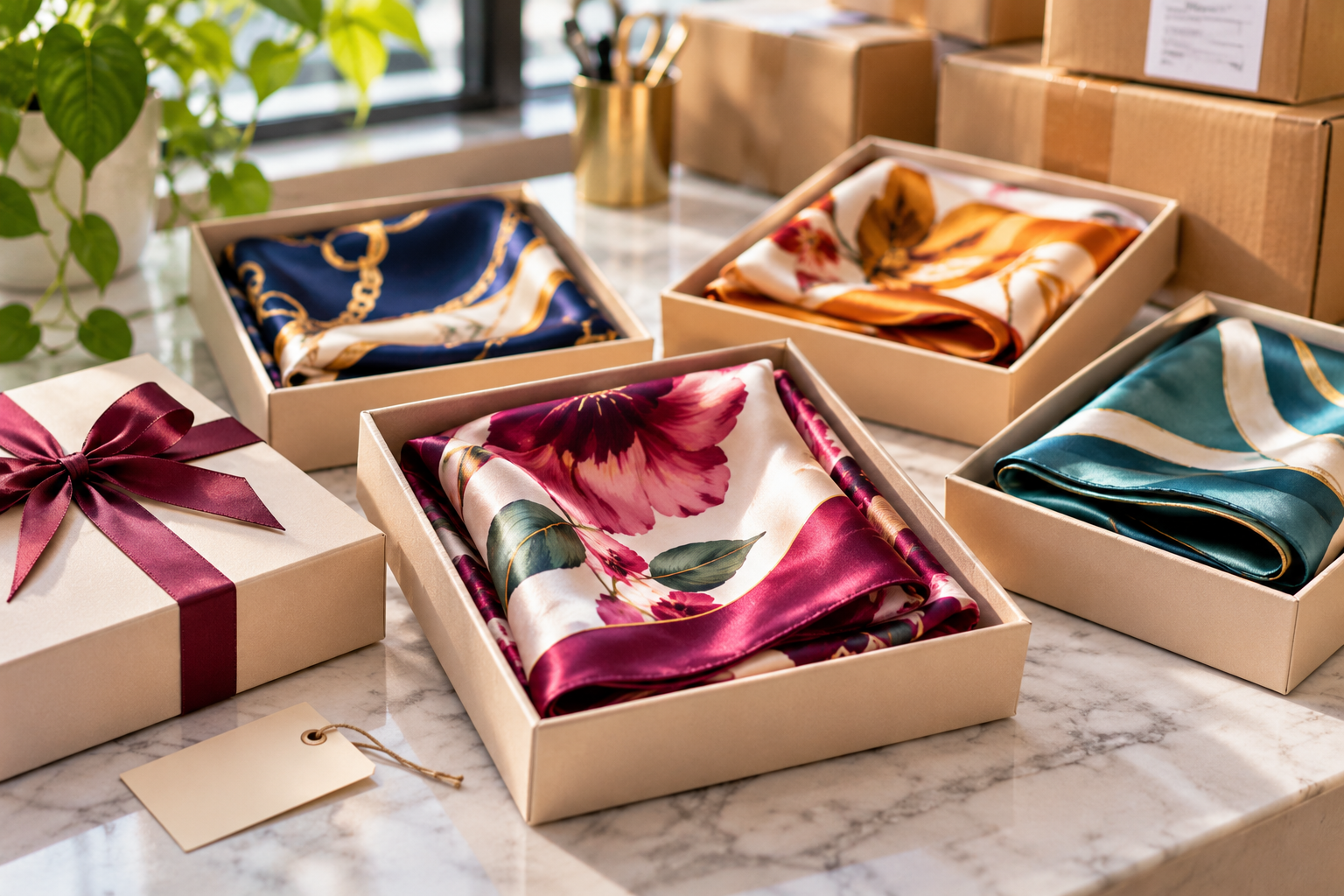
You approve pre-production by signing off in writing with your custom silk scarf manufacturer on a final sample. That sample becomes the standard your delivered scarves are judged against. A pre-production sample is the last sample made with final fabric, print, hem, and label before the full run starts.
When the delivery arrives, inspect units against that sample. Check color in daylight, print alignment, hem edges, finished size, and label placement. Report any defect to the factory in writing within the window you agreed on.
Keep a few units from this run as reference samples. Every reorder can then be matched against the same standard for color and hand feel.
Launch small. Sell the first run, watch which design moves fastest, and reorder that one. Reordering a proven print with the same custom silk scarf manufacturer is faster and safer than sampling a new factory.
FAQs: Starting a Silk Scarf Brand
You need enough to cover samples, one minimum run per design, labels, packaging, and shipping. Multiply units per design by the number of designs and by your quoted unit price, then add sample and label costs. Our manufacturing quote guide explains each line item.
Yes, you can, because a scarf has few components and a clear process. Write a brand brief, prepare a one-page spec sheet, and work with a custom silk scarf manufacturer that answers written questions quickly. The seven steps above cover everything else.
Post your project on Maker’s Row to reach a custom silk scarf manufacturer whose minimums fit your first run, and let verified US factories bid on it. You can also use referrals and cold outreach, which take longer. Our guide to finding a clothing manufacturer in the USA covers every route.
MOQ is the smallest number of units a manufacturer will produce per order. For scarves it may apply per design, so three prints can triple your first order. Always ask which way your custom silk scarf manufacturer counts it. See our full MOQ guide.
It depends on how many sample rounds your design needs and how fast each factory responds. Build your calendar in stages: sourcing, strike-off, sample, pre-production approval, then production. Ask each factory for a written timeline for every stage, and add a buffer.
No, you need a one-page spec sheet and print-ready artwork. A full apparel tech pack is more than a scarf requires. List size, fabric, momme weight, print method, color references, hem, and quantity. Our tech pack guide shows the full format if your design is more complex.
Your original artwork is generally protected by copyright, and your brand name can be protected by trademark. The USPTO explains that a trademark protects brand names and logos, while a copyright protects an original artistic work. Ask each factory in writing who owns your files and screens. This is general information, not legal advice, so consult an attorney for your situation.
It depends on the factory and your print method. Digital printing usually allows smaller minimums than screen printing, but each factory sets its own. Ask each custom silk scarf manufacturer whether the minimum is per design or per order, then compare bids on Maker’s Row.
Your Silk Scarf Brand Is Closer Than You Think
Your silk scarf brand is one manufacturer away from becoming real. The factories are on Maker’s Row, ready to bid.