Starting a capsule collection sounds simple: pick a few great pieces and launch. In practice, most new brand owners get stuck between design and production, unsure how many pieces to make or which manufacturer will even take on a small run. This guide walks you through the entire process, from defining your first pieces to finding a US manufacturer built for capsule-sized orders. It is written for founders launching their very first line, with no manufacturing experience required.
A capsule collection is a small, tightly edited set of clothing pieces designed to work together, usually somewhere between 10 and 25 items. For a new brand, it is also a low-risk way to prove out a concept before committing to a full seasonal range. You spend less on fabric, less on samples, and less on inventory sitting in a warehouse.
New founders trying to start a capsule collection usually get stuck on three things. Deciding exactly which pieces belong in the first drop is one. Keeping every piece cohesive when fabrics and trims come from different sources is another.
The third is finding a manufacturer willing to take on a small first order at all. Most factories are built for volume, and a 15-piece collection does not look like an obvious win to them.
This guide solves all three. By the end, you will have a framework for choosing your core pieces. You will also have a plan for building the documents your manufacturer needs, and a clear path to a US factory that works with capsule-sized production runs.
Step 1: Define Your Capsule Concept and Core Pieces
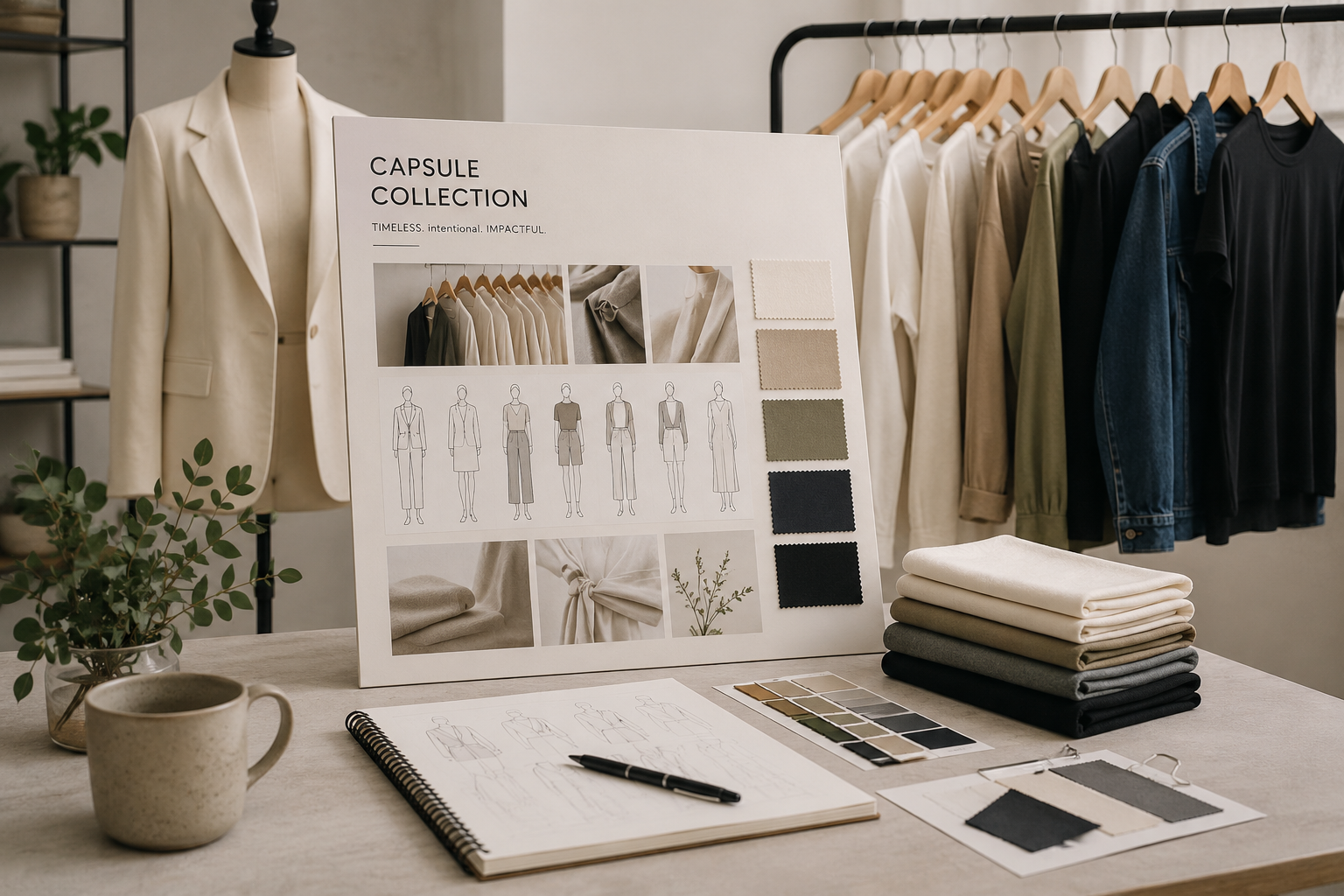
A capsule collection only works if every piece is built to be worn with every other piece. Start by picking one unifying idea, such as a color palette, a fabric story, or a single silhouette theme. Let that idea filter every design decision that follows.
Limit your first run to somewhere between 10 and 20 pieces. Fewer than that and the collection feels thin. More than that and you are back to managing a full seasonal line, with all the sourcing complexity that comes with it. A useful starting exercise: write down five pieces you would wear on repeat, then design your collection around variations of those five.
Good example: “Build your first collection around one trouser, one top, and one layering piece.” Bad example: “Design a versatile collection.” The first gives you something to sketch. The second does not.
Keep a running list of every fabric and trim you plan to use. A capsule wardrobe for women built around three fabrics is far easier to source and cost consistently than one that pulls from eight different mills.
Step 2: Know Your Target Customer
Every design decision in a capsule collection gets easier once you know exactly who you are dressing. Write a one-page brief covering your target customer’s age range, price sensitivity, and the three brands they already buy from instead of yours.
Price point shapes fabric choice, construction method, and manufacturer selection all at once. A collection positioned at $180 per piece needs a different fabric and a different factory than one positioned at $45 per piece. Decide this before you sketch a single style.
Look at how your target customer already shops. If she is buying a men’s clothing capsule from a competitor, study what made that collection feel complete to her. Then identify the gap your version fills.
This is not about copying. It is about understanding what “complete” means to the person you are designing for.
Step 3: Build Your Product Concept and Tech Pack
Once your core pieces and customer are defined, translate every design into a document a factory can actually produce from. This is the step most new founders skip, and it is the one that costs the most money later in bad samples.
A tech pack is the specification sheet a manufacturer uses to build your garment correctly the first time. For each piece, it should include a flat sketch, your bill of materials, exact measurements by size, and construction notes on seams and finishing. Skipping this step means the factory fills in every gap with guesswork, and guesswork rarely matches the sample in your head.
Also Read: Tech Pack Clothing: What It Is and How to Create One →
Before you approach any manufacturer, also decide your target minimum order quantity, or MOQ, for each style. This number determines which factories will even consider your project, so knowing it in advance saves weeks of dead-end conversations.
Step 4: Find Your Manufacturer
This is where most brand owners trying to start a capsule collection get stuck, and it determines whether the collection actually launches.
The old way is cold emails, trade show floors, and industry contacts who may or may not respond. It is slow by design, and most high-volume factories will not prioritize a 15-piece order from an unknown brand.
That does not mean a small collection cannot get made. It means you need a factory built for small-batch, low-MOQ work.
When evaluating a manufacturer for a capsule collection, look for four things. First, an MOQ that matches your order size, since many small-batch US factories accept 25 to 100 units per style. Second, a location that supports the sample turnaround you need.
Third, a clear sample policy with a stated cost and timeline. Fourth, communication speed. A factory that takes two weeks to answer a first email will cost you months once production starts.
Also Read: How to Find a Clothing Manufacturer in the USA →
Finding the right manufacturer for a capsule collection does not have to mean months of cold emails. On Maker’s Row, post your project for free and verified US manufacturers bid directly. Review bids, check profiles, connect when ready.
Step 5: Order Samples and Refine
Never move to full production on the strength of a single sample. Order a full sample of every piece in your collection from your shortlisted factory, and check it against your tech pack point by point.
Look at whether the fabric matches your spec, whether seams and finishing are clean, and whether measurements fall within half an inch of your size chart. A capsule collection lives or dies on cohesion, so also check every sample against the others side by side. Colors and fabric weights that looked fine individually sometimes clash once they are on a rack together.
Budget for two to three sample rounds before final approval. A Nashville-based womenswear founder building her debut capsule wardrobe collection ordered samples from two factories for the same trouser style. She found a noticeable difference in drape at the same fabric weight, and that difference changed which factory she chose for the full run.
Step 6: Plan Your Production Run and Budget
Before you place a production order, build a realistic budget covering fabric, labor, trims, and shipping. According to the American Apparel and Footwear Association, domestic apparel production typically costs more per unit than overseas manufacturing, a tradeoff many founders accept in exchange for faster sampling and easier quality checks.
Because a capsule collection is small by design, per-unit costs run higher than a bulk seasonal order. Offset this by pricing pieces to reflect the quality and limited nature of the collection, not by cutting corners on fabric. The Small Business Administration’s guidance on startup budgeting is a useful framework for building your first production cost sheet, even outside the apparel category. SCORE also pairs new founders with free mentors who have direct apparel startup experience, a useful second opinion before you finalize your budget.
Plan for eight to twelve weeks from approved sample to finished goods, depending on your factory’s queue and your fabric’s lead time. Order slightly more fabric than your unit count requires to cover cutting waste and any quality rejects during production.
Step 7: Launch and Market Your Capsule Collection
A capsule collection has a natural marketing advantage over a full seasonal line: scarcity is built in. Lean into it. Tell customers exactly how many pieces exist and that once they sell out, they are gone until the next drop.
Document your process from sketch to sample to finished piece. Founders who show the collection coming together, not just the final product, build anticipation before launch day and give customers a reason to follow along. This also doubles as proof of a real, working supply chain, which matters to customers who care where their clothes are made.
After launch, watch sell-through by piece, not just total revenue. A collection with 15 pieces will usually have two or three standout sellers. Use that data to shape your next collection instead of guessing.
FAQs: Starting a Capsule Collection
A first capsule collection typically costs between $3,000 and $15,000, depending on piece count, fabric quality, and sample rounds. Smaller collections of 8 to 12 pieces from a domestic small-batch factory sit toward the lower end of that range. Fabric and sampling usually account for the largest share of early costs, ahead of marketing or packaging.
Yes. Many successful founders had no formal design background before their first launch. What matters more is a clear concept, a complete tech pack, and a manufacturer willing to work with a first-time brand. US small-batch factories are often experienced at guiding new founders through their first sample round.
Post a project brief on Maker’s Row specifying your piece count, target MOQ, and fabric requirements. US factories that work with small-batch and capsule-sized orders respond directly to briefs that are specific. Alternatively, search for cut and sew manufacturers in states with strong small-batch apparel infrastructure, such as California and New York.
MOQ, or minimum order quantity, is the smallest number of units a factory will produce per style. For a small collection, a lower MOQ per style, often 25 to 100 units, keeps your total upfront investment manageable across multiple pieces. A higher MOQ reduces your per-unit cost but increases the total capital you need before launch.
Plan for 14 to 22 weeks from concept to finished goods. Tech pack development takes two to four weeks. Sampling and revisions take four to six weeks. Production plus shipping takes eight to twelve weeks, depending on fabric availability and factory queue.
Yes. A complete tech pack for every piece in your collection is strongly recommended before contacting any manufacturer. Without one, factories cannot quote accurately, and your first samples will not match your vision. Even a basic tech pack with flat sketches and a bill of materials is better than approaching a factory with photos alone.
Use a non-disclosure agreement before sharing a detailed tech pack with any manufacturer. For longer-term protection, review the United States Patent and Trademark Office’s guidance on trademarking your brand name and logo before your collection launches publicly.
Most capsule collections run between 10 and 25 pieces, though a debut collection from a new brand often works best closer to 10 to 15. This range is large enough to feel like a real collection but small enough to keep sourcing, sampling, and production manageable for a first-time founder.
Your Capsule Collection Is Closer Than You Think
Your capsule collection is one manufacturer away from becoming real. The factories are on Maker’s Row, ready to bid.