Starting a clothing brand around mesh shirts is one of the smartest moves you can make right now. Mesh is everywhere: streetwear, athletic wear, festival fashion, and everyday casual. But getting from idea to first production run is where most brands get stuck. This guide gives you the exact steps to manufacture mesh shirts in the USA, from building your first concept to receiving your first order.
The mesh shirt market has expanded far beyond the gym. Consumers now wear mesh shirts at concerts, on the street, and as layering pieces in everyday outfits. That shift creates a clear opportunity for brand owners who move fast and source smart.
The three biggest obstacles most founders hit: not knowing which mesh fabric to specify, not understanding how to approach a cut and sew factory, and not having a clear path from sample to production. This guide solves all three.
By the end, you will know exactly what fabric to specify, how to build a tech pack, how to find a US mesh shirt manufacturer, and how to launch your first production run without wasting money on bad samples.
Step 1: Define Your Mesh Shirt Brand Identity and Hero Product
Every strong mesh shirt brand starts with one decision: what is your hero product, and who is it for?
Do not launch five styles at once. Launch one mesh shirt so well-executed that it does not need context. That might be a relaxed open-weave tank for festival season, a performance mesh shirt for training, or a fitted jersey-style top for streetwear. Each of these serves a different customer and requires a different mesh fabric, so picking one focus first saves you significant time and money later.
Write a one-page brand brief before you contact a single manufacturer. It should answer: Who is my target customer? What is my price point? Who are my three closest competitors, and what am I doing differently? This brief becomes the foundation of every conversation you have with factories, fabric suppliers, and buyers.
Take a look at how other brands have positioned themselves in the good quality clothing brands USA space. The brands that cut through are those that started with a clear product story, not a broad catalogue.
Step 2: Know Your Target Customer
Once you have your hero product concept, narrow your target customer to a specific person, not a demographic range.
A good customer profile answers: Where do they shop now? What do they already own? What would make them buy your mesh shirt instead of a brand they already trust? The more specific your answers, the easier your product brief becomes.
For mesh shirts, customer profiles typically fall into three buckets. Athletic buyers care about breathability, moisture management, and fit during movement. Streetwear buyers care about silhouette, exclusivity, and how the shirt looks with the rest of their wardrobe. Fashion-forward buyers care about texture, layering potential, and visual uniqueness. Your mesh fabric choice changes completely depending on which of these you are serving.
Knowing your customer also determines your price point, and your price point determines your acceptable cost of goods. A general rule from the Small Business Administration is that product cost of goods should not exceed 30 to 40 percent of your retail price to leave margin for marketing, operations, and growth. Fix this number before you approach any factory.
Step 3: Build Your Product Concept and Tech Pack
A tech pack is the single most important document you will create before manufacturing your mesh shirt. It tells the factory exactly what to make, in language they understand.
For a mesh shirt, your tech pack must include: a flat sketch (front, back, and detail views), fabric specification (mesh type, weight in GSM, fiber content), colorway options, all measurements by size, construction details (seam type, stitch count per inch, finishing), label placement, and care instruction requirements.
Mesh fabrics require specific callouts. A 100% polyester athletic mesh behaves differently from a nylon power mesh or an open-weave cotton mesh. If you leave the fabric choice undefined, the factory will substitute whatever they have available, and your sample will not match your vision. Specify the exact mesh type, weight, and any stretch requirement (two-way or four-way stretch for athletic applications).
Also Read: How to Create a Professional Tech Pack for Your Brand →
You do not need to create a tech pack yourself. Many freelance tech pack designers work in this category for $150 to $400 per style. That investment protects you from costly sample revisions later.
Colorways: start with two to three. More colorways at sampling stage multiplies your sample cost and slows your timeline with no clear benefit until you have validated market demand.
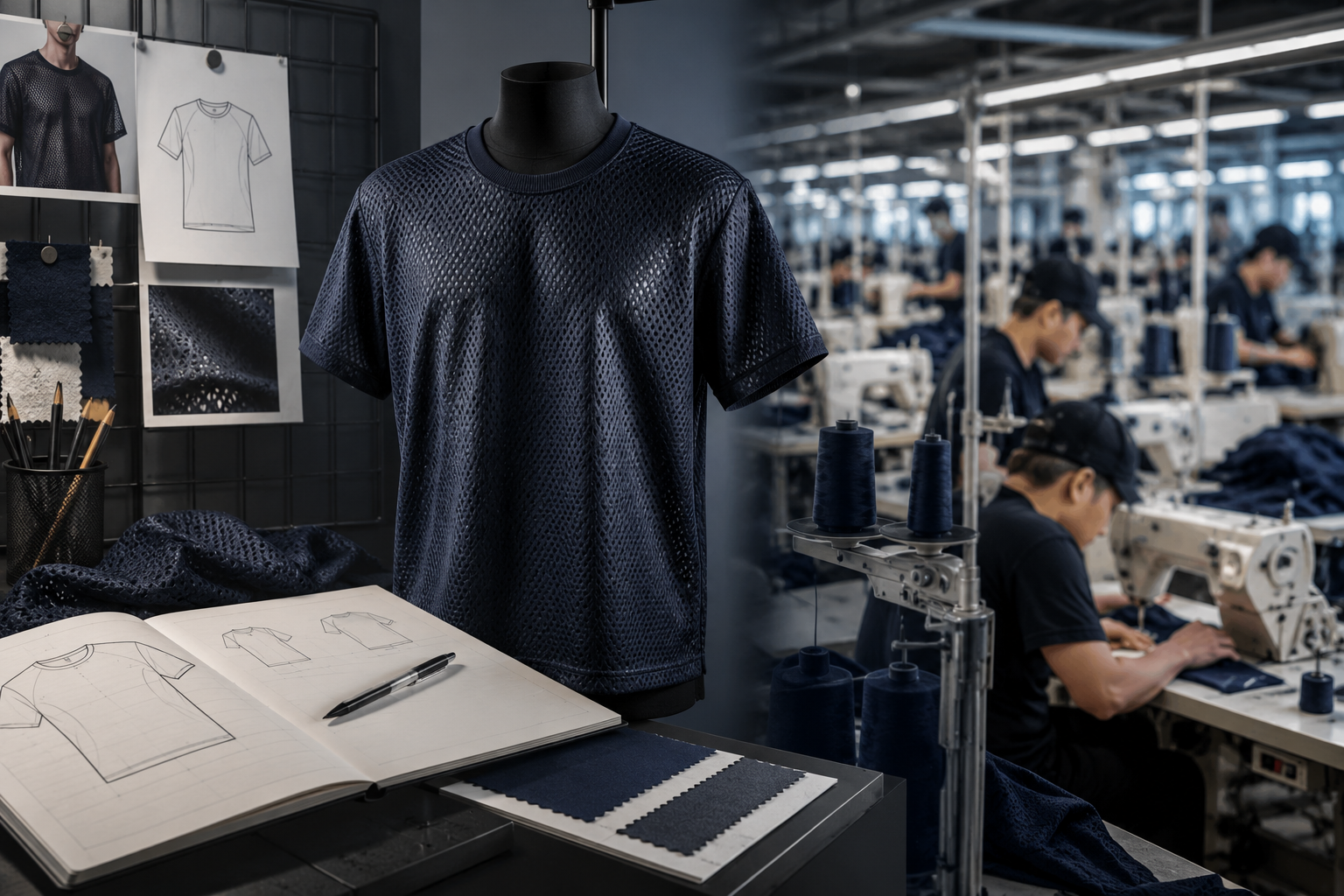
Step 4: Find Your Mesh Shirt Manufacturer
This is where most brand owners get stuck, and it determines whether your mesh shirt brand actually launches.
Finding a factory the old way means cold emailing factories listed on directories, waiting days for responses, getting MOQs you cannot afford, and repeating the process twenty times. Most brands spend months on this step and still end up with a bad fit.
Here is what to look for in a mesh shirt manufacturer:
MOQ: For a first run, target factories that accept 50 to 150 units per style. Many US cut and sew factories work with emerging brands at these volumes. Avoid committing to a factory with 500-unit minimums on your first order.
Mesh fabric capability: Not every cut and sew factory has experience with mesh fabrics. Mesh is a technical material. It can shift on the cutting table, fray at edges, and require specific needle types to prevent skipped stitches. Ask specifically: do you have experience cutting and sewing mesh or technical knits?
Sample policy: The best factories are transparent about their sample process, including a sample fee (typically $75 to $300 depending on complexity), a clear turnaround (usually two to three weeks), and a defined revision process before bulk.
Communication speed: A factory that takes five days to respond to an initial inquiry will take longer when you have a production problem. Response time is a quality signal.
For an overview of what the US cut and sew landscape looks like before you start outreach, the cut and sew manufacturers guide covers exactly what to compare.
Find Your Mesh Shirt Manufacturer on Maker’s Row
Finding the right mesh shirt manufacturer does not have to mean months of cold emails. On Maker’s Row, post your mesh shirt project for free and verified US manufacturers bid directly. Review bids, check profiles, connect when ready.
Describe your mesh fabric type, MOQ range, and target delivery window in your project brief. Manufacturers who have experience with technical knits and mesh production respond to briefs that are specific. Vague briefs attract vague responses.
Factories on Maker’s Row are active and responsive. Many reply within 24 to 48 hours of a new project being posted.
Step 5: Order Samples and Refine
Never commit to a production run without approving at least one sample. For mesh shirts, sample approval is especially important because mesh drape and fit behave differently from woven fabrics.
When your first sample arrives, evaluate it against your tech pack point by point. Check: Does the mesh type match your spec? Is the construction clean at the seams, with no skipped stitches or exposed raw edges? Do the measurements match your size spec within half an inch? Does the garment hold its shape when pulled and released?
Order samples from at least two factories before choosing a production partner. An Atlanta-based activewear brand launching a mesh training shirt ordered samples from three US factories and found that the same fabric specification produced noticeably different results depending on the factory’s cutting technique and machine settings. The quality difference at the same price point was significant enough to change their manufacturer decision entirely.
Do not accept a sample that is 80 percent right. Request a second sample addressing specific revision notes from your tech pack. Most US factories include one revision round in their sample process.
Also Read: Best Clothing Manufacturers in the USA →
Step 6: Plan Your Production Run and Budget
Once your sample is approved, plan your first production run before placing the order. This step catches budget problems before they become production problems.
Units: For a first run, 100 to 200 units per style is a practical starting point. It gives you enough inventory to test the market and generate real sales data, without the financial exposure of a 500-unit order.
Cost breakdown: For a US-manufactured mesh shirt, typical cost of goods at 100 to 200-unit runs range from roughly $12 to $28 per unit depending on fabric weight, construction complexity, and finishing details. Add pattern making (usually a one-time cost of $100 to $300 per style), labeling, hangtags, and packaging.
Timeline: Allow six to ten weeks from purchase order to delivery for a first production run with a new US manufacturer. This accounts for fabric sourcing, cutting, sewing, finishing, and quality control.
Payment terms: Most US factories require 50 percent upfront and 50 percent on completion. Build this into your cash flow plan before you place the order.
For brands building out a broader apparel line alongside mesh shirts, understanding the broader landscape of activewear manufacturing in the USA gives you context on how factories structure production for technical fabrics.
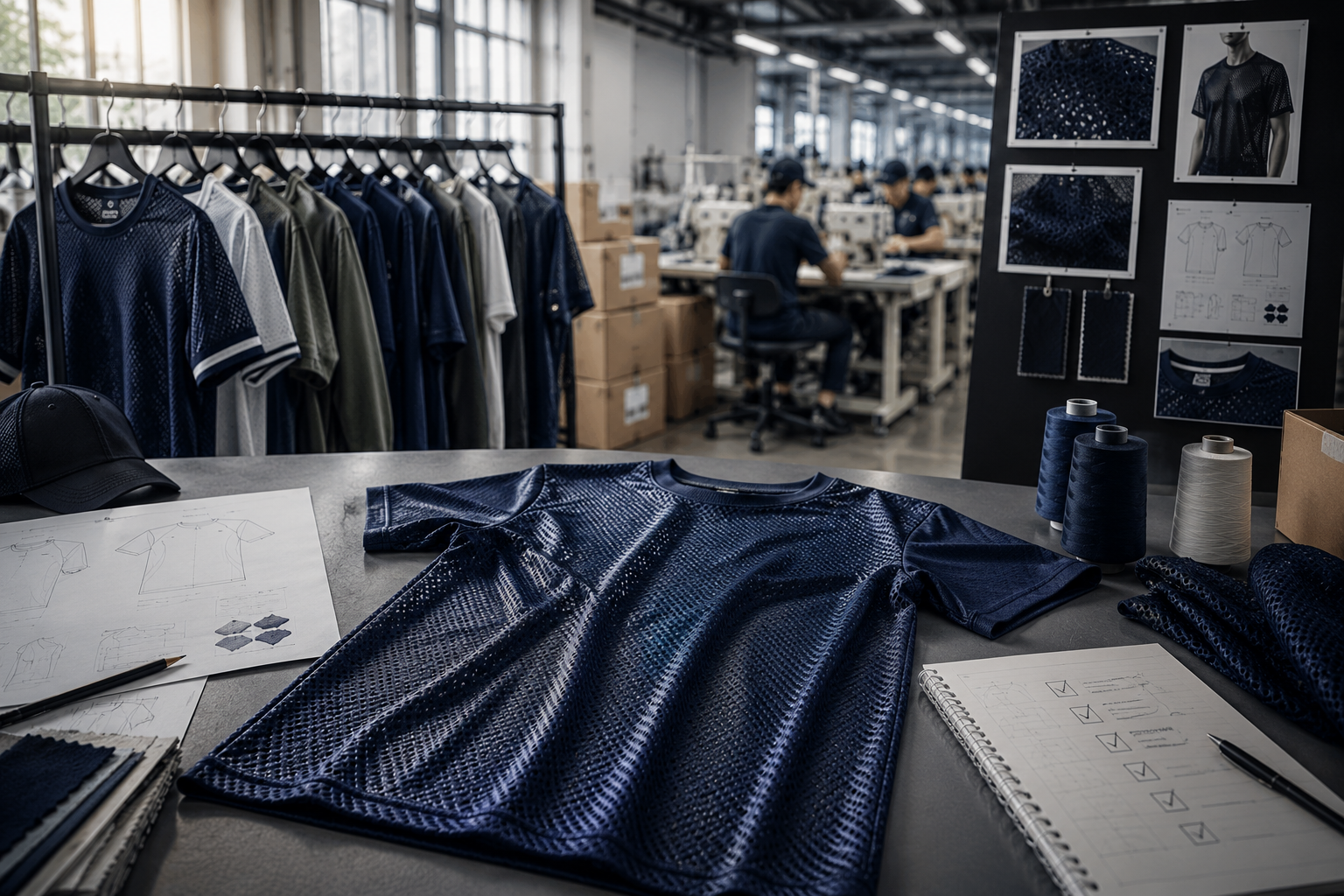
Step 7: Launch and Market Your Mesh Shirt Brand
With production confirmed and inventory on the way, your launch strategy determines how fast your first run sells.
Pre-launch: Build anticipation before inventory arrives. Post behind-the-scenes content from sampling. Share the story of why you chose US manufacturing. A pre-launch email list of 200 to 500 people is worth more than 10,000 social media followers you do not own.
Photography: Invest in product photography before launch. For mesh shirts specifically, photography needs to capture texture, drape, and fit. Flat lay shots alone do not show the product well. On-body shots in the context your customer actually wears the shirt are essential.
Pricing: Work backward from your cost of goods. If your mesh shirt costs $18 to produce and ship, a $54 to $65 retail price gives you a sustainable 3 to 3.6x markup. According to the American Apparel and Footwear Association, US-manufactured products carry a premium pricing signal with consumers that supports higher retail price points.
Channels: For a first launch, own two channels: your own website and one social platform where your target customer already spends time. Do not spread across five channels before you have validated that your product sells.
FAQs: Starting a Mesh Shirt Brand
You can start a mesh shirt brand for $3,000 to $8,000 for a first run of 100 to 200 units, including tech pack creation, sampling, production, labels, and photography. This estimate varies based on fabric complexity and whether you are producing in the USA or overseas. US production carries higher per-unit costs but lower minimums and shorter lead times, which reduces your initial capital risk. According to SCORE, most apparel startup founders underestimate launch costs by 30 to 40 percent, so build a buffer into your budget from the start.
Yes. The majority of brand owners who launch through Maker’s Row have no prior manufacturing experience. What you need is a clear product spec (tech pack), a realistic MOQ budget, and a factory that works with emerging brands. US factories that specialize in small-batch production are experienced at guiding first-time brand owners through the sampling and production process.
Post a project brief on Maker’s Row specifying your mesh type, MOQ, and target timeline. US factories with mesh and technical knit experience respond directly to your listing. Alternatively, search for cut and sew factories in California, New York, and North Carolina, which have the highest concentration of technical apparel manufacturers in the country.
MOQ stands for minimum order quantity. It is the smallest number of units a factory will produce in a single order. For mesh shirts, US factory MOQs typically range from 50 to 300 units per style. A higher MOQ reduces your per-unit cost but increases your upfront capital requirement and inventory risk. For a first run, targeting a factory with a 50 to 100-unit MOQ lets you test market demand before committing to a larger investment.
Plan for 12 to 20 weeks from initial concept to receiving finished inventory. Tech pack creation takes two to four weeks. Sampling takes two to four weeks. Sample revision and approval takes one to two weeks. Full production takes four to eight weeks. Shipping from factory to your location adds one to two weeks depending on distance.
Yes. A tech pack is not optional for mesh shirts. Without one, factories cannot quote you accurately, cannot produce a sample that matches your vision, and cannot catch specification errors before they become production problems. A clear tech pack with mesh fabric specifications, measurements, and construction details is the minimum required to have a productive factory conversation.
For design protection before factory conversations, the USPTO recommends considering copyright for graphic elements and trade dress protection for distinctive garment features. A non-disclosure agreement with any factory before sharing your tech pack adds an additional layer of protection. Most reputable US factories will sign an NDA on request.
US cut and sew factories with small-batch capability typically accept starting orders of 50 to 100 units per style. Some studios go lower, to 25 or even 10 units per style, though cost per unit increases significantly at those volumes. On Maker’s Row, you can specify your target MOQ in your project brief so that only factories aligned with your production volume respond.
Your Mesh Shirt Brand Is Closer Than You Think
You have the concept. You know your customer. You know your product. What you need now is the right manufacturing partner to bring it to production.
Your mesh shirt brand is one manufacturer away from becoming real. The factories are on Maker’s Row, ready to bid.