Starting a clothing line built on merino is exciting. Finding a merino wool clothing manufacturer in the USA is where most founders stall, because merino needs specialized knitting and small-batch factories. This guide gives you the exact steps from idea to first production run, even if you have never worked with a factory. It is written for you if you are launching a first line on a small budget.
Merino wool is a fine, soft wool fiber from Merino sheep that manages moisture and resists odor. That is why it keeps showing up in base layers, tees, socks, and sweaters.
Domestic capacity is the catch. As of August 2026, the U.S. Bureau of Labor Statistics reports about 72,000 workers in US apparel manufacturing. In 2025, it counted only 1,500 knitting and weaving machine operators inside that group, and stand-alone knitting mills are classified separately.
Three obstacles stop most first-time founders: finding a factory that works with merino wool, affording the minimum order, and not knowing the steps. This guide solves all three.
Step 1: Define Your Brand Identity and Hero Product
You define your merino wool brand identity by choosing one hero product, one customer, and one price point before you contact a single factory.
Write a one to two page brand brief covering your target customer, your price point, and your top three competitor brands. Then pick one hero product. A base layer, a tee, a sock, and a sweater each need a different kind of factory.
Cut and sew is a method where knit or woven fabric is cut into pattern pieces and stitched into a garment. Base layers and tees usually follow that route. Sweaters often go to flat knitters, and socks go to sock mills.
A tight story helps too. Duckworth in Montana built its brand around wool from its founder’s ranch and certified Rocky Mountain growers. You do not need a ranch, but you do need a clear reason a customer picks you over a big-box base layer.
Once your hero product is locked, you can decide exactly who you are selling it to.
Step 2: Know Your Target Customer
Your target customer decides your merino wool fabric weight, fit, price, and order size, so define that person before you design anything.
Pick one buyer, such as a trail runner, a ski commuter, or a frequent flyer. Interview 10 people in that group and ask what they wear now, what they pay, and what annoys them. Then record the retail price, fiber blend, and fabric weight of three competing products.
Fabric weight is measured in grams per square meter (gsm), and a higher number means a thicker, warmer fabric. Your customer’s climate and activity set the gsm you request from a factory. A summer hiker needs a different fabric than a winter skier.
Write your target retail price at the top of your brief. Every later cost decision has to fit under it. Next, you turn all of this into a spec a factory can quote.
Step 3: Build Your Product Concept and Tech Pack
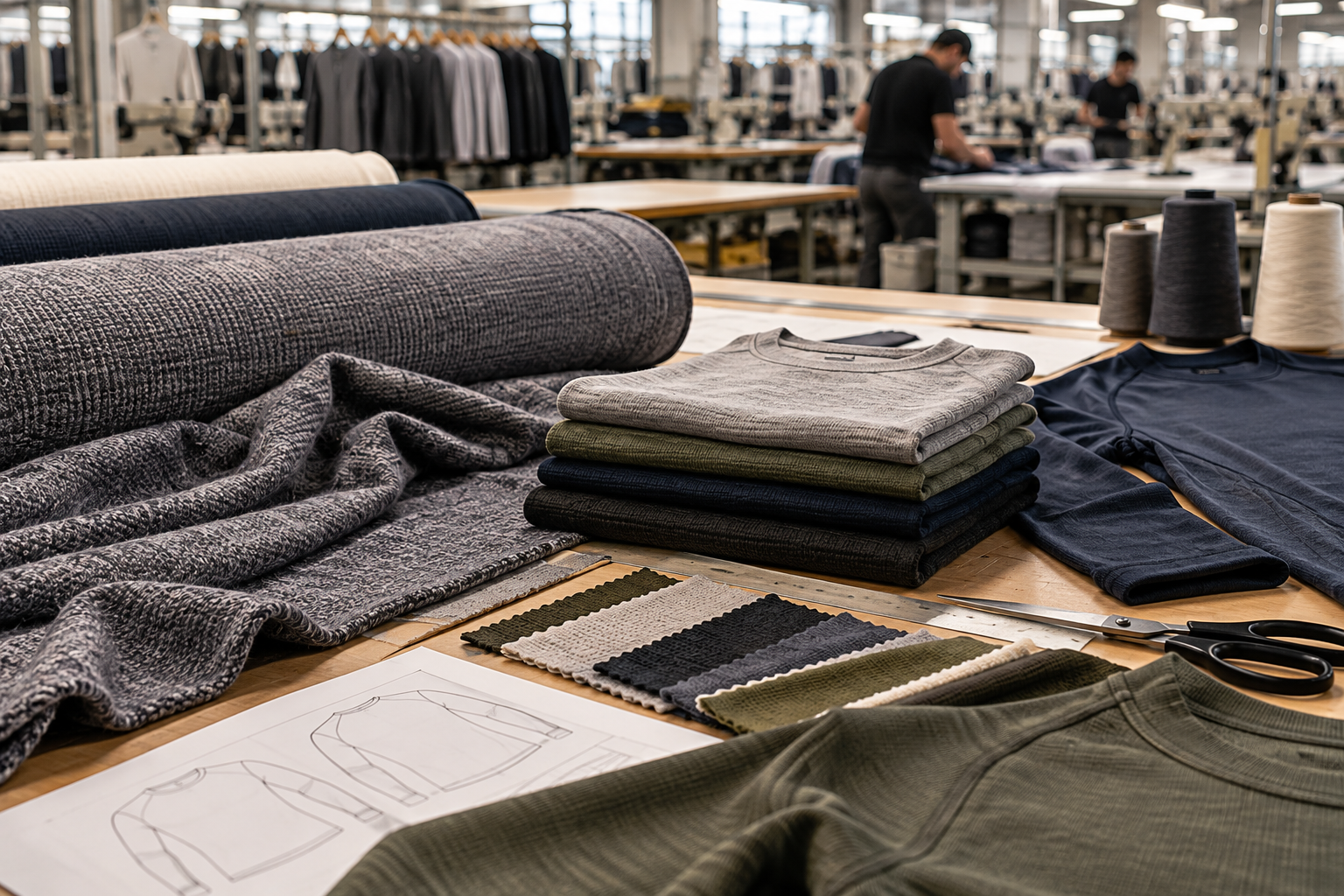
You build your product concept by turning your hero product into a tech pack, the document a factory uses to quote and sample your garment.
A tech pack is a specification document that tells a manufacturer exactly what to make, including fabric, measurements, construction, trims, and labels. For merino wool, add four items most templates miss. They are exact fiber content, fabric weight in gsm, knit type, and the source of your yarn or fabric. Fiber content means 100% merino or a blend with nylon or elastane.
Add your care instructions and label plan as well. The Federal Trade Commission requires wool product labels to show fiber content, country of origin, and the manufacturer’s or marketer’s name. Build that into your spec now.
Also Read: Tech Pack Clothing: What It Is And How To Create One (2026) →
Also Read: What Is MOQ? Complete Guide For Brand Owners 2026 →
With a tech pack in hand, you are ready for the step that decides everything.
Step 4: How Do You Find a Merino Wool Clothing Manufacturer?
You find a merino wool clothing manufacturer by matching your product to a factory type, then screening five to ten specialists. Compare them on minimum order quantity, yarn source, and sample policy. MOQ (minimum order quantity) is the smallest number of units a factory will produce per style.
This is where most brand owners get stuck, and it decides whether your brand actually launches. The old way is cold emails, trade shows, and industry contacts. Per Maker’s Row’s outerwear guide, choosing a factory takes one to three weeks on Maker’s Row, versus one to three months by cold outreach.
Merino wool adds a wrinkle. Domestic knitting capacity is small, so ask every factory where the yarn and fabric come from. Evolution Knitwear in Kennewick, Washington, is one example. Maker’s Row’s sweater manufacturer guide lists it for small-batch knitting in natural fibers such as alpaca and merino, with no public MOQ. Whole garment knitting is a method where one machine knits an entire garment in a single piece, with no cutting or sewing.
Ask about certifications too. The Responsible Wool Standard (RWS) is a voluntary standard from Textile Exchange that certifies wool from the farm through the last business-to-business seller. If you plan to make RWS claims, every site in your chain must be certified.
What to Check | What to Ask | Strong Sign |
MOQ per style | Is the minimum per style, per color, or per size? | A stated number that fits a first run of 50 to 200 units |
Location and lead time | Where is the knitting done, and how long is sampling? | US knitting and a sampling time quoted in weeks |
Yarn and fabric source | Which mill supplies the merino? | A named supplier and fiber content in writing |
Sample policy | Do you make paid samples before bulk? | Paid samples with a stated turnaround |
Communication speed | How fast do you answer new inquiries? | A first reply within 48 hours |
Certifications | Do you hold RWS certification? | A current certificate, plus paperwork that travels with each certified shipment |
Say you are a Denver founder planning 100 merino base layers for your first run. You post one brief stating 100 units per style, 100% merino knit fabric, and a target ship date. Factories that cannot meet that quantity stay out, so you compare only the bids that fit. For a full sourcing walkthrough, read Maker’s Row’s guide to finding a clothing manufacturer in the USA.
Find Merino Wool Manufacturers on Maker’s Row
Finding the right merino wool clothing manufacturer does not have to mean months of cold emails. On Maker’s Row, post your merino project for free and verified US manufacturers bid directly. Review bids, check profiles, connect when ready.
Maker’s Row is a marketplace connecting apparel brand owners with verified US manufacturers. State your fiber content, fabric weight, and target quantity in your brief, and only factories that fit will respond. Brand owners post unlimited manufacturing projects for free and receive bids from verified US factories at no upfront cost. To connect directly, subscription plans give full access.
Once you have a shortlist, you can start requesting samples.
Step 5: Order Samples and Refine
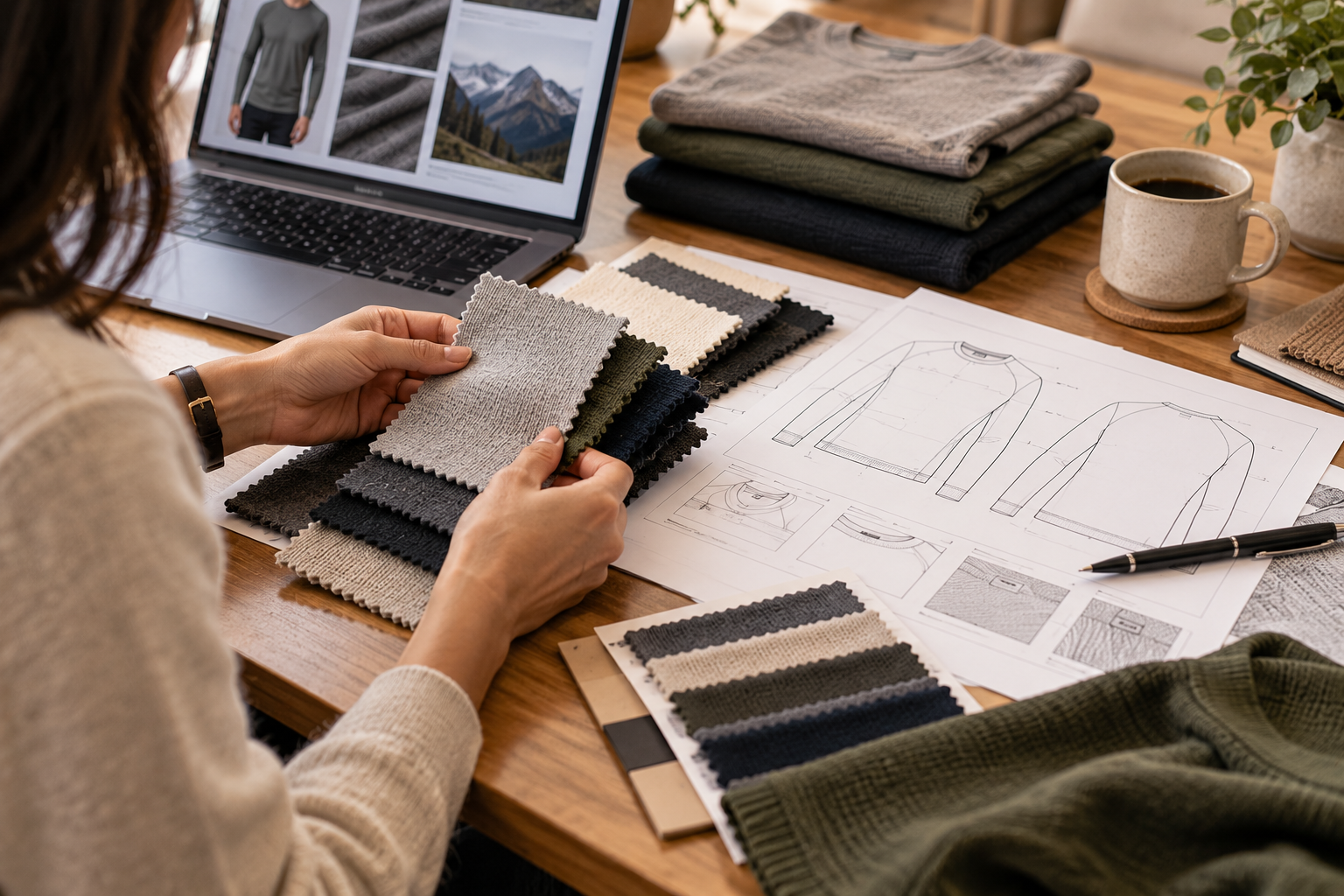
You order merino wool samples from at least two manufacturers and refine your design before you commit to a production run.
Sampling takes four to eight weeks, according to Maker’s Row’s outerwear guide, so start early. When a sample arrives, check it against your tech pack. Measure every dimension listed in your tech pack. Wash it three times following your care label, then measure again to check shrinkage.
Look for pilling in high-friction areas such as underarms. Compare hand feel and stretch recovery with your competitors’ products. Ask each factory for an itemized quote so you can compare yarn, labor, and finishing separately.
Put every fit note in your tech pack, not in scattered emails. Once a sample passes, you can price and plan the real run.
Step 6: What Should Your Production Run and Budget Look Like?
You should plan your first merino wool production run at 50 to 200 units per style, then add sampling, labels, and freight to your budget.
Maker’s Row’s guide to starting a clothing brand calls that range a realistic first run for a startup. The table below collects the other numbers Maker’s Row publishes, so you can plan against them.
Budget Item | Typical Range | Source |
Factory MOQ | 50 to 500 units per style | Maker’s Row MOQ guide |
US cut and sew cost | $15 to $45 per unit | Maker’s Row guide to finding a clothing manufacturer |
Sampling | 4 to 8 weeks | Maker’s Row outerwear guide |
Production | 4 to 8 weeks | Maker’s Row outerwear guide |
Multiply your MOQ by your unit cost to find your cash floor. At 100 units and $30 per unit, that is $3,000 before sampling, labels, and freight. Merino is a premium fiber, so ask every factory to price yarn separately from labor. Do not assume you will land at the low end.
Use the SBA startup cost calculator to add your one-time and monthly expenses. Start with a small test order before you scale. With production planned, you can prepare to sell.
Step 7: Launch and Market Your Brand
You launch your merino wool line by selling your first run through one channel and collecting proof before you reorder.
Sell through your own site or one retailer first. Wear-test the product yourself, and photograph it in real use, whether that is a trail, a commute, or a flight. Keep your claims supportable. Say what you can prove, such as the fiber content on your label, and back any odor or temperature claims with your own test notes.
Textile Exchange says any RWS claim must be approved by an authorized certification body. Reorder based on what sells, then repeat the sample and test-order steps for each new style. The questions below cover what founders ask most before they start.
FAQs About Starting a Merino Wool Clothing Brand
You need roughly $750 to $9,000 to produce one style, plus sampling, labels, freight, and marketing. That range multiplies a 50 to 200 unit first run by Maker’s Row’s $15 to $45 per unit US cut and sew cost. Merino may push you above the low end. Ask for itemized quotes before you set a budget.
Yes, you can start with no experience if you prepare a brief and a tech pack first. Then screen factories on sample policy and communication speed rather than price alone. Choose a manufacturer that offers development support, and follow the steps in Maker’s Row’s guide to starting a clothing brand.
Post your project on Maker’s Row and let verified US manufacturers bid, or research knitters and cut and sew factories directly. Either way, state fiber content, fabric weight, and target quantity up front. Ask each factory where the merino comes from, because domestic knitting capacity is limited.
MOQ is the smallest number of units a factory will make per style, and it sets the minimum cash you must commit. Maker’s Row’s MOQ guide reports 50 to 500 units per style for US clothing manufacturers. Ask whether the minimum applies per style or per color, because colors can multiply it.
Expect roughly 9 to 19 weeks from choosing a factory to finished goods, before you count design time. That range adds one to three weeks to choose a factory, four to eight for sampling, and four to eight for production. These figures come from Maker’s Row guides. Budget toward the longer end if your design needs extra fit rounds.
Yes, a tech pack is the fastest route to accurate quotes. Without one, two factories can quote different materials and stitch counts for the same product. If you are not ready, bring a detailed design sketch, your target quantity, your fabric preferences, and your ship date.
Ask each factory to sign a non-disclosure agreement before you share files, and confirm in writing that you own your patterns. The USPTO explains that a design patent protects the ornamental design of an article. You can also register your brand name as a trademark. Talk to an intellectual property attorney before filing, since this guide is general information, not legal advice.
Some US factories start at 25 units, though 50 to 500 units per style is more common. Maker’s Row’s guides report both ranges. Small-batch natural fiber knitters such as Evolution Knitwear scale from small to large runs. Confirm the exact number in writing before you send a deposit.
Your Merino Wool Clothing Brand Is Closer Than You Think
Your merino wool clothing brand is one manufacturer away from becoming real. The factories are on Maker’s Row, ready to bid.