Launching an anorak should be exciting, but finding an anorak manufacturer who answers your emails is where most first lines stall. Many shops sew basics well and turn away hooded outerwear, because of the seams, zippers, and technical fabric. This guide walks you from spec sheet to first production run. It is written for founders who have never sourced a jacket before.
Outerwear is a technical corner of apparel, and the domestic base is larger than most founders expect. As of the first quarter of 2026, the U.S. Bureau of Labor Statistics counts 6,199 private apparel manufacturing establishments in the USA (preliminary data). Those factories employed 25,280 sewing machine operators in 2025, according to the same BLS page. Only some of them sew woven outerwear.
If you are launching your first anorak, three obstacles usually stand in your way. Few US factories advertise anoraks by name, so you must screen by capability. First-run minimums can outrun a startup budget. And nobody hands you the order of steps.
This guide solves all three. You will define your style, build a tech pack, and shortlist factories by capability. Then you will collect quotes, approve samples, and vet your anorak manufacturer before the first run.
Step 1: Define What Kind of Anorak You Are Making
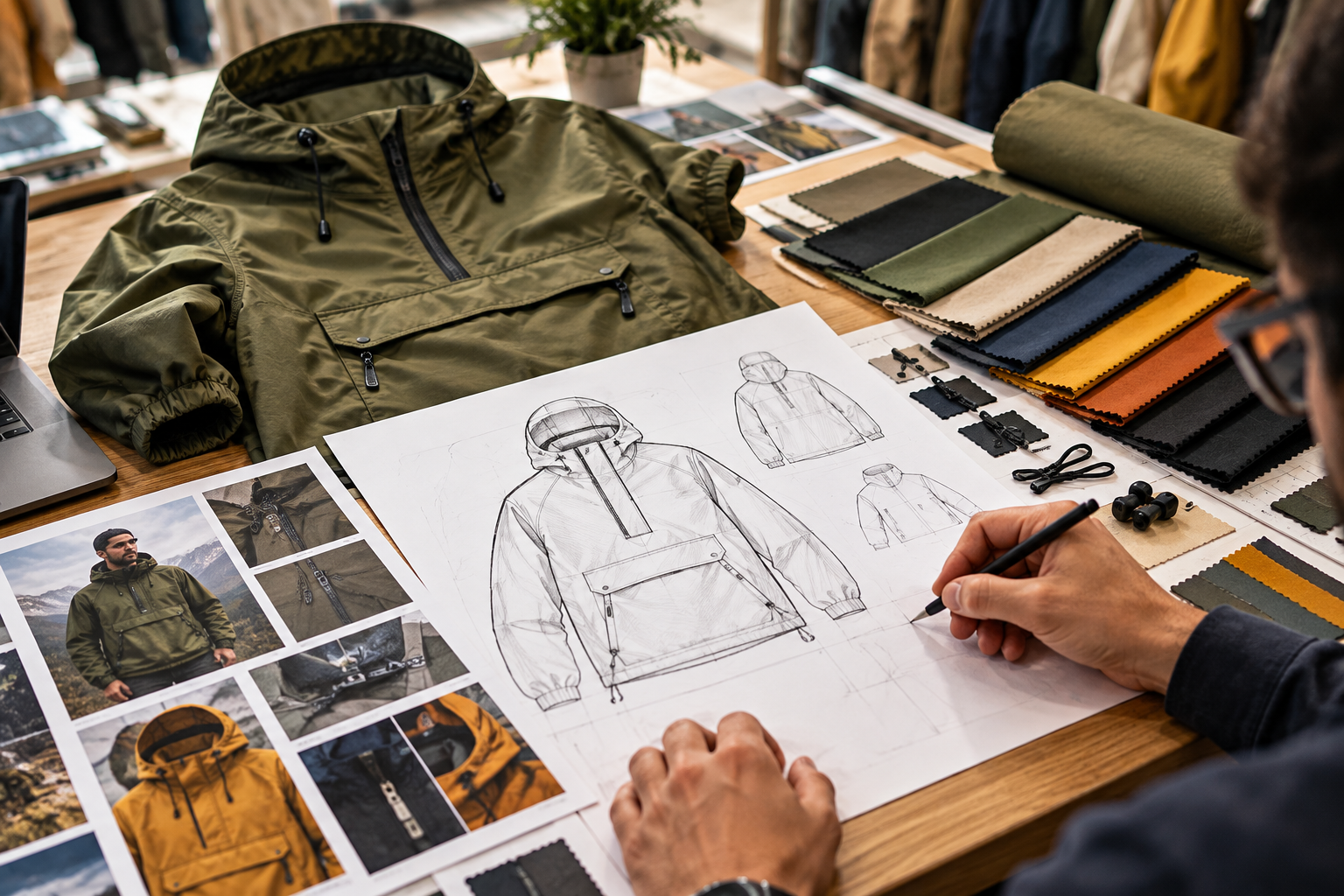
Defining your anorak means fixing five decisions before any anorak manufacturer sees your name: fit, fabric, closure, pockets, and water resistance. An anorak is a hooded pullover jacket, usually made from lightweight woven fabric, with a half-zip or short front opening. Most styles add a kangaroo pocket and a drawcord at the hood or hem. Parkas, windbreakers, and puffers overlap with the anorak, so compare them in Maker’s Row’s guide to types of men’s jackets before you settle on yours.
Write a one-page spec that covers these five decisions:
- Fit: cropped, hip length, or oversized, plus your target size range.
- Fabric: nylon ripstop, polyester taffeta, or a cotton-nylon blend.
- Closure: half-zip, quarter-zip, or snap placket (the reinforced strip along the front opening).
- Pockets: kangaroo pocket, chest pocket, or hidden zip pocket.
- Water resistance: DWR (durable water repellent) is a coating applied to fabric so light rain beads and rolls off. Full waterproofing adds seam sealing, covered in Step 3.
Pick one anorak, not a full line. A single hero style keeps your minimums low and your sampling budget under control. Next, turn that spec into a document any anorak manufacturer can quote against.
Step 2: Build a Tech Pack for Your Anorak
A tech pack for an anorak needs flat sketches, a measurement chart, a bill of materials, and construction notes for the hood, zipper, and seams. A tech pack is a specification document that tells a manufacturer exactly how to build your garment. Without one, two factories can quote the same anorak with different fabrics, stitch counts, and finishes. That makes their prices impossible to compare.
Every anorak manufacturer will ask for this document before quoting. Anoraks need detail that a T-shirt tech pack skips. Add these items before you send anything out:
- Hood: pattern shape, lining choice, and drawcord channel placement.
- Closure: zipper length in inches, zipper type, and placket construction.
- Pocket: kangaroo pocket depth, opening angle, and whether it has a zipper.
- Trims: cord locks, eyelets, snaps, and labels, each with a supplier or spec.
- Seams: stitch type, seam allowance, and whether seams are taped.
- Measurements: points of measure (the body locations you specify, such as chest width) for every size, with a tolerance in inches.
Most professional US manufacturers require or strongly prefer a tech pack before quoting, according to Maker’s Row’s tech pack guide. If you have no technical designer, hire a freelancer for this one document. Then ask every factory to sign an NDA before you share the file. An NDA (non-disclosure agreement) is a contract that stops a factory from sharing your files.
Also Read: Tech Pack Clothing: What It Is and How to Create One →
Step 3: Which Factories Can Work as an Anorak Manufacturer?
A factory qualifies when it runs woven outerwear lines with hood shaping, zipper insertion, and, for waterproof styles, seam sealing. Seam sealing is the process of applying waterproof tape over stitched seams so water cannot enter through the needle holes. A knit-focused shop or a basics factory may lack both the machines and the experience. Screen every anorak manufacturer on capability first, and on location second.
Capability | Why it matters for an anorak | Question to ask |
Woven outerwear experience | Nylon and polyester behave differently from jersey | Which woven jackets have you made recently? |
Zipper and placket insertion | The half-zip is the first thing customers test | Can you show a finished half-zip placket? |
Hood construction | A poor hood pattern gaps or droops | Do you make hood patterns in house? |
Seam sealing or taping | Needed only for fully waterproof styles | Do you tape seams in house or outsource it? |
Fabric sourcing | Mills sell fabric in minimum yardage per color | Do you stock fabric or buy per order? |
Outerwear capacity clusters in cities with a jacket history. Maker’s Row’s 8 Best Jacket Manufacturers in the USA and its coats manufacturers guide profile outerwear-capable factories in Los Angeles, San Francisco, and Seattle. Neither list is anorak-specific, so confirm the capabilities above in writing.
Fabric minimums feed directly into your order size. MOQ (minimum order quantity) is the smallest number of units a manufacturer will produce per style. Step 4 shows the typical US ranges.
Also Read: What Is MOQ? Complete Guide for Brand Owners 2026 →
Step 4: Find Your Anorak Manufacturer and Get Quotes
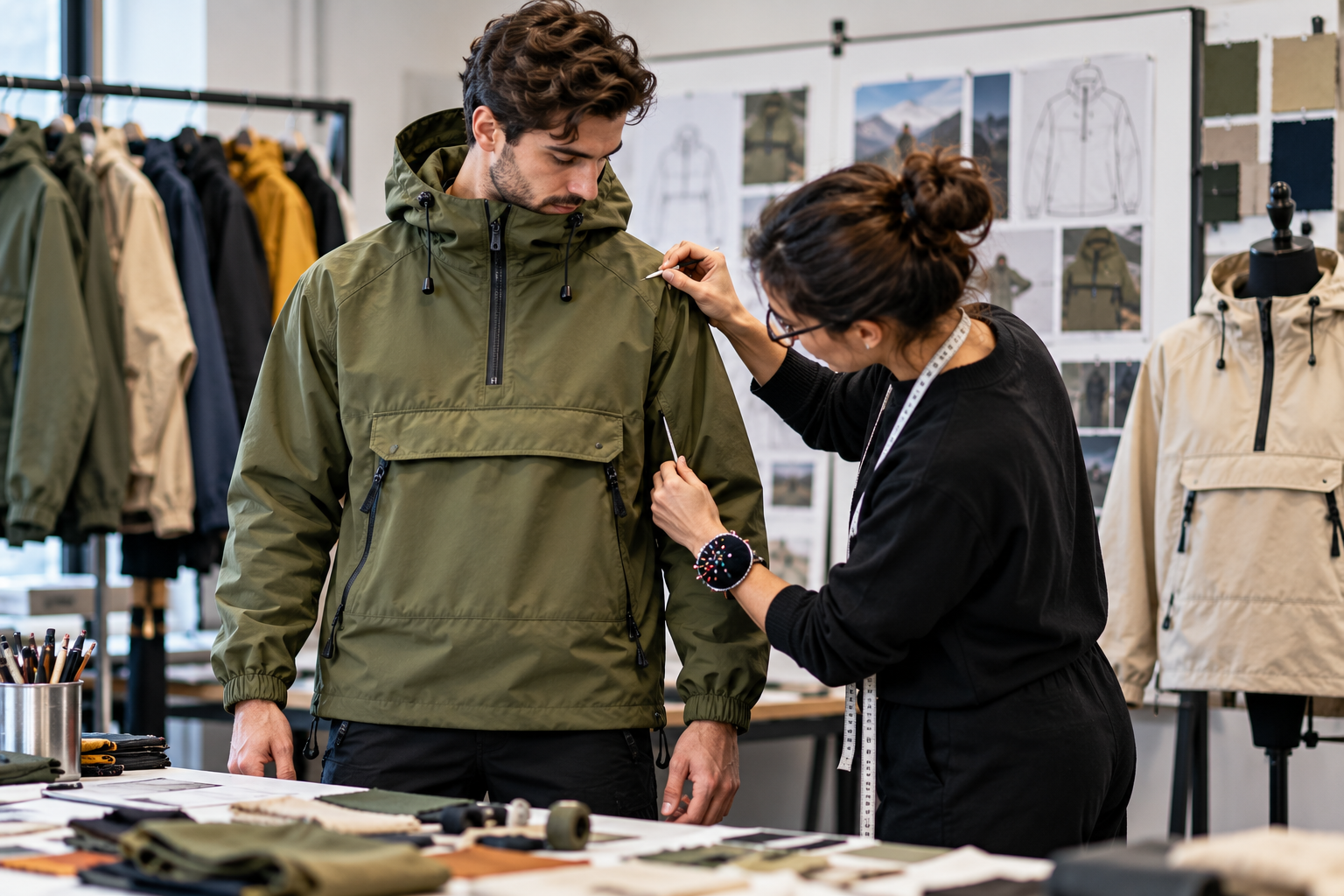
Finding your first anorak partner starts with posting a detailed brief where outerwear factories can bid, then comparing written quotes side by side. This is where most first-time founders stall, and it decides whether your anorak launches. The old routes still work. Cold emails, trade shows, and referrals each produce leads, but each puts the vetting work on you.
Every factory that replies still needs the capability check from Step 3. Use the same four criteria to compare each anorak manufacturer on your list:
Criterion | What to ask | What good looks like |
MOQ | What is your minimum per style and per color? | A number in writing. Maker’s Row’s coats guide reports US outerwear MOQs starting between 50 and 300 units per style. |
Location | Can I visit, or ship samples quickly? | Short shipping windows. SCORE notes that domestic suppliers face fewer supply chain hurdles. |
Sample policy | Do you make paid samples before bulk? | A paid sample with a quoted turnaround. Maker’s Row’s jacket guide puts US jacket sampling at 2 to 4 weeks. |
Communication speed | Who is my contact, and how fast do you reply? | A named contact who answers quotes and questions in writing. |
Example: Testing an anorak in Los Angeles. The Evans Group runs its main studio in downtown Los Angeles. Maker’s Row’s jacket guide lists full-package outerwear and complex woven construction among its services. Maker’s Row’s San Francisco sourcing guide reports no minimum at studio level and factory production starting at 50 units per style.
A founder with one anorak could sample at studio level, then commit to 50 units only after the fit is approved. Confirm anorak experience directly before you rely on any studio.
Find Anorak Manufacturers on Maker’s Row
Maker’s Row is a marketplace connecting apparel brand owners with verified US manufacturers. Finding the right anorak manufacturer does not have to mean months of cold emails. On Maker’s Row, post your anorak project for free and verified US manufacturers bid directly. Review bids, check profiles, connect when ready.
Posting projects is free and brings unlimited bids at no upfront cost. To reply to factories and connect directly, subscription plans give full access. Name your hood, zipper, and seam-sealing needs in the brief, so only outerwear-capable factories respond. You can also browse the clothing manufacturers directory to see who is active.
Step 5: Order Paid Samples and Refine the Fit
Order a paid sample from at least two factories before you choose an anorak manufacturer, and expect the first sample to need a revision. Maker’s Row’s jacket guide puts sampling at a US jacket factory at 2 to 4 weeks per round. Ask each anorak manufacturer to quote sampling lead time separately from production lead time. The two timelines rarely match.
Check these six points on every sample:
- Hood: it should stay up in wind and not block your side vision.
- Half-zip: it should run smoothly and sit flat with no puckering.
- Fit: try it over a sweatshirt, since anoraks are layered.
- Water test: spray the shell for two minutes, then check the inside for damp seams.
- Drawcords: pull them fully and confirm the cord locks hold.
- Measurements: compare every point of measure to your tech pack tolerance.
Send written notes on every miss, and attach photos. Keep one approved sample as your production standard. Once the sample passes, you can vet your anorak manufacturer before you pay for a first run.
Step 6: How Do You Vet the Factory and Place a First Run?
You vet an anorak manufacturer by verifying its business, checking references, and starting with a small paid run before any large order. Before your first call, the FTC advises searching a company’s name online with the word scam or complaint. It also warns that scammers demand payment by wire transfer, cryptocurrency, or gift cards, so refuse those methods.
SCORE recommends weighing supplier stability, quality, customer service, cost, and compatibility. Before you sign with any anorak manufacturer, ask these questions:
- Who owns the fabric if you cancel mid-production?
- What is your sample turnaround, in days?
- Do my pattern files and tech pack stay mine after the contract ends?
- Is your MOQ per style, per color, or both?
- How do you handle a failed quality inspection?
Then place the smallest first run the factory will accept, and keep it to one colorway (a single color version of the style). Pay a deposit, not the full balance, and inspect the goods before the final payment. With a vetted factory and a small first run, your anorak is ready to launch.
FAQs About Finding an Anorak Manufacturer
Your starting budget equals your first run plus sample costs, and no single figure fits every factory. Multiply the quoted unit price by the MOQ, then add two or three sample rounds and your tech pack cost. Maker’s Row’s MOQ guide reports that US clothing MOQs typically run from 50 to 500 units per style. Your first commitment sits inside that range. Request itemized quotes from at least two factories to compare fabric, labor, and trims separately.
Yes, you can, if you sample before you commit and choose a factory that offers development support. Begin with one style, a written spec, and a tech pack from a freelance technical designer. Studio-level partners without a studio minimum, like the Los Angeles example in Step 4, suit first-timers. SCORE also offers free mentoring for first-time founders.
Find one by screening factories for woven outerwear capability, then posting a detailed brief where they can bid. Cold emails, trade shows, and referrals also work, but they move slower. On Maker’s Row, you post your anorak project for free and receive bids from verified US factories.
Expect roughly 50 to 300 units per style from a US outerwear factory, and less from some studios. Maker’s Row’s coats guide reports outerwear MOQs starting between 50 and 300 units per style. Its jacket guide notes studio minimums as low as 10 pieces. Ask whether the minimum applies per style or per color. Fabric minimums often set the floor.
Plan for at least one sample round of 2 to 4 weeks before production begins, according to Maker’s Row’s jacket guide. Each revision adds another round, so a complete tech pack saves time and sampling cost. Ask the factory to state production lead time in writing, separate from sampling.
Yes, most professional US manufacturers require or strongly prefer a tech pack before they quote. Without one, they cannot price the job accurately, and your samples are likely to miss the mark. A complete tech pack also makes quotes from different factories comparable.
Ask every factory to sign an NDA before you share files, and speak with an intellectual property attorney about protection. The USPTO explains that a design patent protects the way an article looks, while a utility patent protects how it works. Its guidance also says a design dictated primarily by function does not qualify. An attorney can tell you which details of your anorak, if any, are eligible.
No, an anorak is a pullover with a half-zip or short opening, while most windbreakers zip fully down the front. Parkas are longer and usually insulated. These differences change the pattern, the zipper, and the MOQ your factory quotes.
Your Anorak Brand Is Closer Than You Think
Your anorak brand is one manufacturer away from becoming real. The factories are on Maker’s Row, ready to bid.