Starting a lingerie brand is one of the most personal things a founder can do, because you solve a fit problem you have felt yourself. It is also one of the hardest apparel categories to launch, since a bra that misses by a few millimeters gets returned. Most guides tell you to “find a manufacturer” without saying how. This guide shows you how to start a lingerie brand in seven steps, from your first product to your first production run. No factory experience is needed.
Domestic production is still a real option for a first run. As of the fourth quarter of 2025, the U.S. Bureau of Labor Statistics counted 6,338 private apparel manufacturing establishments (preliminary). Only some of them sew bras, which is why Step 4 shows you how to screen for that.
Three obstacles stop founders who want to know how to start a lingerie brand: finding a factory, budgeting for fit, and sequencing the steps. Each one gets a direct answer below. You also get a worked budget for your lingerie brand, with real numbers and the labeling rules you must meet before you sell. This guide is general information, not legal or financial advice.
Step 1: Define Your Brand Identity and Hero Product
Your hero product is the one bra or set you launch first, and it should be the piece you can fit, source, and explain best. A hero product is the single signature item a brand builds its identity and first production run around. Hanky Panky grew around one lace thong, the Original Rise Thong launched in 1986, according to Maker’s Row’s guide to the best lingerie brands in the USA.
The first written step in how to start a lingerie brand is a 1 to 2 page brief covering your customer, price point, and three competitors. Then pick one silhouette. A wireless bralette is the lowest-risk start, because Maker’s Row’s brassiere guide reports that underwire and molded cup styles take longer to sample than soft bralettes.
Search the USPTO trademark database before you commit to a lingerie brand name. A name already registered for clothing can force a rebrand after you have printed labels.
Step 2: Know Your Target Customer
Your target customer is defined by the fit problem they have not been able to solve, not only by age or income. Interview 10 people who would buy your lingerie brand and write down their top 3 fit complaints, such as gaping cups or straps that dig.
Then set your launch size range, because the range you pick when you start a lingerie brand drives your cost. Seam Apparel’s 2026 bra cost guide says a range from 32A to 38DD produces 20 to 30 distinct grades for one style. At 100 units per style, that leaves about 3 to 5 units per size. Starting with 8 to 10 sizes lifts that to roughly 10 to 12 units per size.
Step 3: Build Your Product Concept and Tech Pack
When you start a lingerie brand, you build your product concept as a tech pack, the one document a factory needs to quote or sample. A tech pack is a design specification document that gives a factory your sketches, materials list, and measurements for one style. For a bra, include front and back flat sketches, band and cup measurements for each size, fabric and elastic specs, underwire or wireless construction, hook-and-eye tape, and labels.
Your factory then turns that spec into patterns. Grading is the process of scaling one base pattern into every size you sell. A bra grades cup volume and band length together, so it is not a simple percentage change, per Seam Apparel.
Also Read: Tech Pack Clothing: What It Is and How to Create One (2026) →
Also Read: What is MOQ? Complete Guide for Brand Owners 2026 →
Do You Need a Fit Model for a Bra?
Yes, plan to test every sample on a real body. A fit model is a person whose measurements match your base size and who tries on samples so you can correct fit before production. Maker’s Row’s fit model guide advises choosing a model in the middle of your size range, so graded sizes skew less.
Step 4: How Do You Find a Lingerie Manufacturer in the USA?
You find a lingerie manufacturer by shortlisting factories that already sew bras, checking five criteria in writing, and posting your project for bids. This is the step where most founders learning how to start a lingerie brand get stuck, and it decides whether the brand launches.
The old way is cold emails, trade shows, and referrals, and it fits lingerie poorly. Maker’s Row’s brassiere guide notes that underwire, foam molding, lace bonding, and elastic sourcing need specialized machinery. A general sewing shop is the wrong first call. Cut and sew manufacturing builds garments from your own original pattern, while private label manufacturing adjusts an existing base pattern with your branding, fabric, or trim. Private label costs less and moves faster, and cut and sew is the only route for a truly new fit. You can learn how cut and sew manufacturers work before you request quotes.
MOQ (minimum order quantity) is the smallest number of units a factory will produce per order. Use this table to screen every factory before you request a sample:
What to check | What to ask | Benchmark for US bra makers |
MOQ | What is your minimum per style? | 50 to 150 units per style; a few go lower if you pay for full sample development |
Location | Where do you sew, and can I visit? | Los Angeles, New York, and Texas hold most remaining intimates production |
Sample policy | Do you charge for samples, and how much per round? | Paid samples are standard; 4 to 8 weeks per round |
Specialty | Do you sew underwire, wireless, or molded cups? | Ask for a sample of the same construction as your hero product |
Communication speed | How fast do you answer a new brief? | Many Maker’s Row factories reply within 24 to 48 hours of a new project |
Benchmarks come from Maker’s Row’s 2026 brassiere guide.
Find Lingerie Manufacturers on Maker’s Row
Finding the right lingerie manufacturer does not have to mean months of cold emails. On Maker’s Row, post your lingerie project for free and verified US manufacturers bid directly. Review bids, check profiles, connect when ready.
Maker’s Row is a marketplace connecting apparel brand owners with verified US manufacturers. Name your style, size range, and first-run quantity in your brief, so factories that sew that construction respond. Brand owners post unlimited manufacturing projects for free and receive bids from verified US factories at no upfront cost. To connect directly, subscription plans give full access.
Step 5: Order Samples and Refine
Order a paid sample, fit it on a real body, and repeat until the band, cups, and straps hold without gaping or digging. Plan two to five fit rounds per style, since Argus Apparel reports 2 to 4 revisions and Seam Apparel reports 3 to 5 for bras. Review each round against the stages in Maker’s Row’s guide to the 7 stages of apparel samples. Sampling is the slowest part of how to start a lingerie brand, so plan your calendar before your cash.
How Long Does It Take to Get a Bra Sample Made?
A US bra manufacturer typically takes 4 to 8 weeks per sample round, per Maker’s Row’s brassiere guide. Two rounds at 4 weeks is 8 weeks, and five rounds at 8 weeks is 40 weeks. Ask each factory how long a revision round takes, because it may differ from the first sample.
Wash and dry every sample exactly as your care label will instruct. The FTC’s Care Labeling Rule requires those instructions to have a reasonable basis. Approve bulk production for your lingerie brand only after a sample passes, then price the real run in Step 6.
Step 6: Plan Your Production Run and Budget
Plan your lingerie brand’s first run around two styles at 100 units each, then price every line before you pay a deposit. Set up the legal business before you start a lingerie brand production run. The Small Business Administration lists choosing a business structure, registering, and getting federal and state tax IDs among its 10 steps to start a business. Maker’s Row also covers licenses and permits for apparel startups.
How Much Does It Cost to Start a Lingerie Brand?
How to start a lingerie brand on a realistic budget comes down to one number: a two-style, 200-unit launch costs about $7,750 to $15,150 before labels, packaging, and marketing.
Cost line | Basis | Estimate for 2 styles |
Trademark filing, 1 class | USPTO base application fee, $350 per class | $350 |
Fit development and sampling | $1,500 to $3,000 per style (Seam Apparel, 2026) | $3,000 to $6,000 |
Size grading | $400 to $900 per style (Seam Apparel, 2026) | $800 to $1,800 |
First run, 200 bras | $18 to $35 per bra at 100 to 300 units (Argus Apparel) | $3,600 to $7,000 |
Core total | Sum of the four lines above | $7,750 to $15,150 |
Seam Apparel and Argus Apparel are bra makers, and these are their published estimates (Seam’s are from its 2026 cost guide), not government data. Argus notes that prices vary by fabric, size range, and whether production is in the USA or overseas. Treat the high end as your US planning number until a factory quotes you in writing. State business filing fees, labels, packaging, photography, your website, and marketing are not in the table, so request an itemized quote for each.
What Labels Does a Lingerie Brand Need?
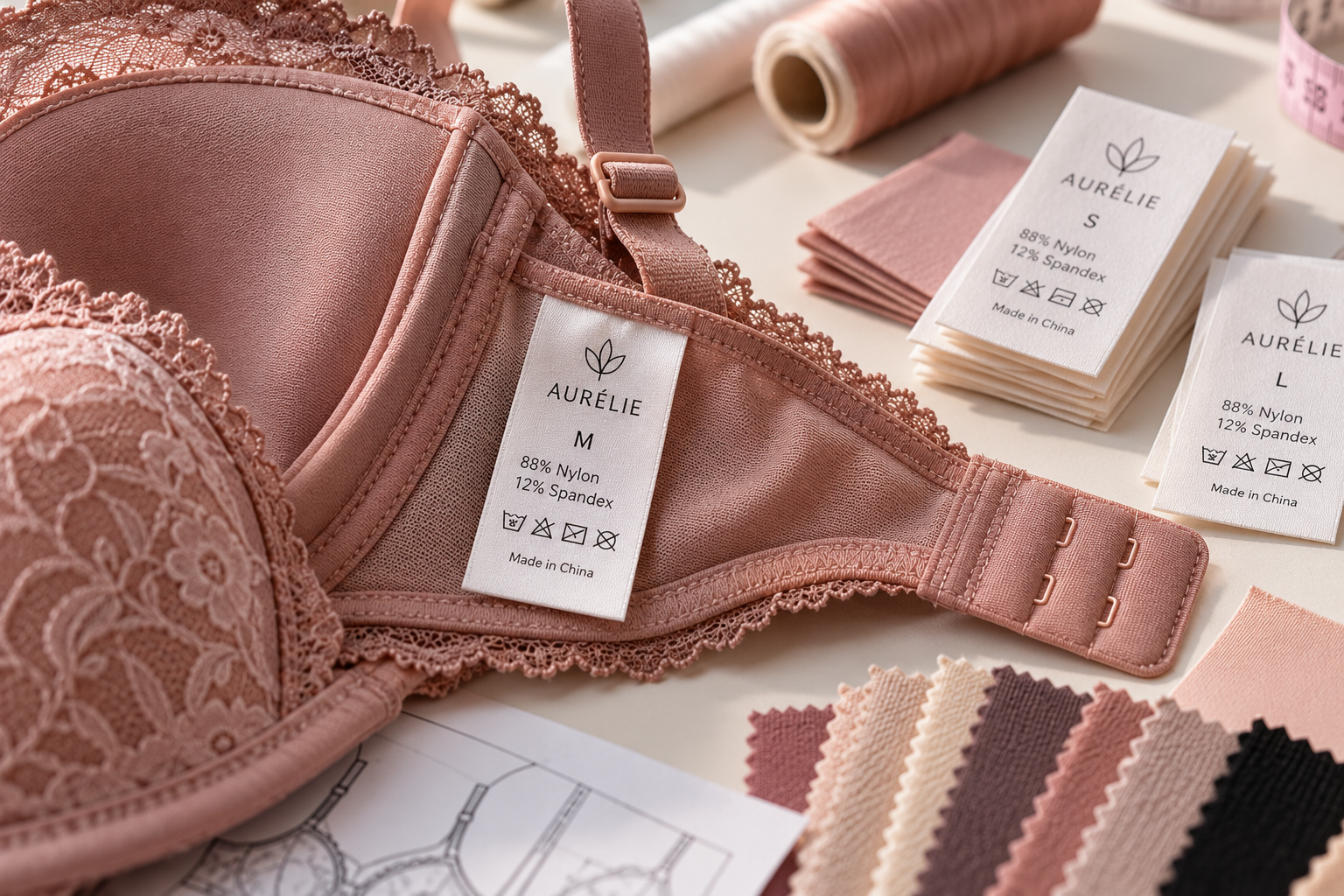
A lingerie product needs a label showing fiber content, country of origin, and your business identity, plus a care label. The FTC’s textile labeling guide requires all three on most clothing. An RN (Registered Identification Number) is an FTC-issued number that US businesses can print in place of their name.
Printing “Made in USA” takes more. The FTC’s Made in USA standard requires the product to be “all or virtually all” made in the United States. Najla, a New York label, sewed in Queens but bought its metal hardware, including underwires, rings, and slides, from France, per Maker’s Row in 2014. Check every imported part before you print that claim.
Step 7: Launch and Market Your Brand
Launch your lingerie brand with a presale, so customers fund your first run and prove demand before you pay a factory in full. In July 2014, the New York label Najla ran a 30-day Kickstarter with a $25,000 goal and raised just over it. It then made its first collection at a small Queens factory, per the founder’s account in Maker’s Row’s Lingerie, Made in the USA. That presale is the most repeatable part of how to start a lingerie brand on a small budget.
Publish a size chart with band and cup measurements before you take the first order, so customers can self-fit. Build an email list for your lingerie brand during sampling, so presale buyers exist on launch day. Questions founders ask when they start a lingerie brand are answered below.
FAQs: How to Start a Lingerie Brand
These seven answers cover how to start a lingerie brand, from budget to design protection.
To start a lingerie brand, you need roughly $7,750 to $15,150 for trademark, fit development, grading, and a 200-unit first run. That range combines the USPTO’s $350 base fee with 2026 cost estimates from Seam Apparel and Argus Apparel. It excludes labels, packaging, photography, your website, and marketing. Request itemized quotes for each before you commit.
Yes, if you choose a factory that offers pattern development and prototyping instead of one that expects a finished tech pack. Maker’s Row’s brassiere guide names Lefty Production Co. and ARGYLE Haus of Apparel as development-friendly options. SCORE offers free business mentoring, and Maker’s Row’s guide to starting a clothing brand covers the category-agnostic basics.
Shortlist factories that already sew bras, ask each for MOQ, sample cost, and sample turnaround in writing, then post your project on Maker’s Row. Step 4 lists the five checks to run. Verified US factories bid on your brief, so bra specialists come to you instead of the other way around.
MOQ (minimum order quantity) is the smallest number of units a factory will produce per order. At 100 units per style and $18 to $35 per bra, one style costs $1,800 to $3,500, per Argus Apparel. MOQ is usually set per style, so two styles double that outlay. Ask whether the minimum applies per style or per size run.
Plan on 8 to 40 weeks of sampling before bulk production starts. US bra makers take 4 to 8 weeks per sample round, per Maker’s Row. Bras need two to five rounds, per Argus Apparel and Seam Apparel. Full production runs take longer than samples. Ask each factory for both timelines separately.
Not always, but a tech pack speeds quotes and reduces sample misses. Maker’s Row’s brassiere guide says Cord Apparel handles tech pack creation and pattern development in-house. If you are starting from a sketch, ask about development support on your first call.
Register your brand name with the USPTO and have each factory sign a non-disclosure agreement before you share your tech pack. A federal trademark covers your name and logo, and brassieres fall in Class 25 at $350 per class. Protection for a garment’s design itself is limited, so read Maker’s Row’s guides to protecting clothing designs and non-disclosure agreements, then consult an IP attorney.
Your Lingerie Brand Is Closer Than You Think
You now know how to start a lingerie brand, and the factory search is the step to start today.
Your lingerie brand is one manufacturer away from becoming real. The factories are on Maker’s Row, ready to bid.